October 29, 2026
Bonus Content: Apple’s Real Acquisition Problem Is Its Own Servers
You’re Missing Out! There’s Still Time To Get
How Thousands Of Americans Help Protect Their Retirement Savings With Gold & Silver

In just the last year, we’ve seen ongoing wars overseas, the U.S. national debt launch above $38 trillion, and annual interest costs nearly $1 trillion a month –– all happening while gold trades near record highs, and silver just broke through $81 an ounce for the first time ever.
But the war isn’t overseas, or in some abstract national debt – it’s the war on your retirement.
Because if you have less than $50,000 saved for retirement, and you can’t afford to lose it, then this is critical.
With everything happening in the world today – Inflation, trade wars and market volatility – we know it’s as important as ever to help protect your hard earned savings.
That’s why we’re here to give you all the information you need to make the best decision for yourself and your family when it comes to protecting your savings with precious metals like Gold and Silver.
When you act today, you’ll get a free digital copy of our Beginner’s Guide To Gold IRAs to arm you with the facts.
In the Beginner’s Guide to Gold IRAs, you’ll get…
- The Top 5 Advantages to a Gold IRA
- How To Move Your 401K To Gold Penalty Free
- The Importance of Portfolio Diversification
- A Simple Checklist For How to Get Started
- Plus, So Much More!
Act today and you’ll get this informative guide at zero cost!
Plus, you could even get up to $10,000 in BONUS GOLD OR SILVER* (while supplies last).
Don’t miss this amazing opportunity to arm yourself with the facts about how a Gold IRA can help you protect and diversify your retirement savings.
Apple’s Real Acquisition Problem Is Its Own Servers
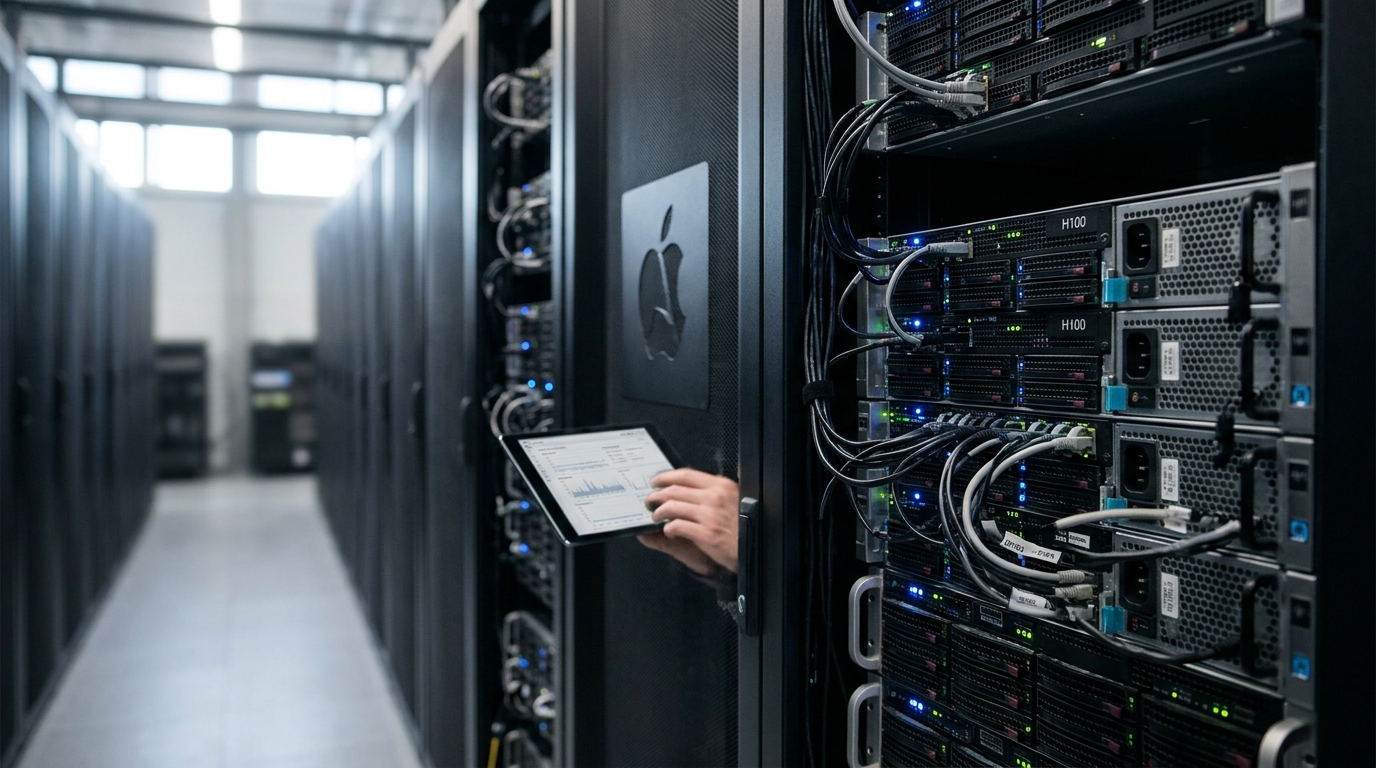
The debate usually goes like this: Apple has roughly $145 billion in cash and marketable securities, a new CEO in John Ternus who appears more willing to spend than his predecessor, and a Siri that keeps embarrassing the company. So what should it buy? A streaming platform? A search engine? An AI lab?
Wrong question. The right one is narrower and more urgent: how does Apple stop paying Nvidia to power its own assistant?
The Infrastructure Problem Nobody Wants to Say Out Loud
Apple’s long-delayed Siri upgrade uses Google’s Gemini language models, and at least one of the cloud tiers runs on Google-owned Nvidia hardware. That is not a minor embarrassment for a company that has spent fifteen years building a vertical integration story. Apple’s own AI server chip, internally codenamed Baltra, had been expected to ship this year but has been delayed. A server system based on future M-series Ultra chips is reportedly being discussed for 2029, not before. That is a multi-year window where Apple’s most important assistant relies on a competitor’s hardware.
Two Targets, Two Different Bets
The acquisition conversation splits into two camps inside investment committees, and they reflect fundamentally different views of where Apple’s problem actually sits.
Camp one argues the gap is at the server. Apple is showing signs it is ready to switch acquisition tactics, prepared to do deals in the range of billions of dollars, rivaling the purchases of Beats and PA Semi. The thesis here is that a chip startup with server-scale inference IP could compress the timeline to Baltra’s successor. Apple’s collaboration with Broadcom, confirmed in a securities filing, runs through 2031, so any acquisition would need to complement rather than replace that partnership.
Camp two thinks the real leverage is on-device. A Caltech-linked startup called PrismML has promoted commercially viable 1-bit large language models intended to run at the edge, and Apple is reportedly paying close attention to techniques that make smaller, more efficient models practical on consumer hardware. PrismML has highlighted 1-bit and ternary-style approaches for shrinking AI models by large factors without fully giving up capability. If that works at scale, Apple’s cloud dependency shrinks without needing a data center chip at all.
Apple is not the only consumer-platform giant trying to shrink its Nvidia bill through proprietary silicon. Amazon’s in-house Trainium and Graviton lines have already crossed a run rate Wall Street had been undervaluing inside the AWS bundle.
What Investors Are Missing
If techniques like PrismML’s mature, the competitive advantage in consumer AI could tilt toward whoever controls the device and its silicon, which is exactly the position Apple has spent years and billions building toward with its Neural Engine. The on-device path is not just cheaper than building server infrastructure. It is structurally more defensible, because Apple owns the hardware stack end to end in a way that Google and Microsoft never will on mobile.
The server acquisition gets more attention because it is more expensive and more legible to analysts. But the smarter bet for a company with 2 billion active devices is the acquisition that makes each of those devices meaningfully more capable without touching a data center.
Stocks to Watch
- Apple (AAPL): The acquirer. Any deal that accelerates on-device AI or reduces Nvidia dependency removes a structural overhang that has weighed on the AI credibility story under Ternus.
- Nvidia (NVDA): The displaced vendor. Apple’s reliance on Nvidia GPUs via Google Cloud is a revenue line that fades the moment Apple can move more Siri workloads onto Apple-run infrastructure or onto devices.
- Broadcom (AVGO): Apple said it plans to spend over $30 billion on a multi-year chip supply deal with Broadcom. Broadcom benefits regardless of which acquisition path Apple chooses, making it the rare name that wins either way.