August 29, 2026
Bonus Content: The Balance Sheet Case Against Small Caps
Dear Reader,

Just an ordinary glass of water right?
Scientists say no.
In a stunning development, a team of MIT materials science and engineering students found that a single glass of water can be used to produce massive amounts of energy.
Enough energy, in fact, to generate all the power a person needs for their entire life.
The students won the grand prize for their discovery.
But the story gets more interesting from there.
The President of the United States has already gotten involved… issuing four executive orders to put huge resources into developing the energy sector that this tech is using.
And just one company is at the center of this shift.
Few people know about this now.
But a big announcement coming November 4th could spell huge headlines for this one company.
This is a BIG moment for investors.
Click here to see the whole story.
At the very least, you’ll learn about one of the great scientific breakthroughs of all-time.
Yours in smart speculation,
Stephen Prior, Publisher
Monument Trend Advisory
The Balance Sheet Case Against Small Caps
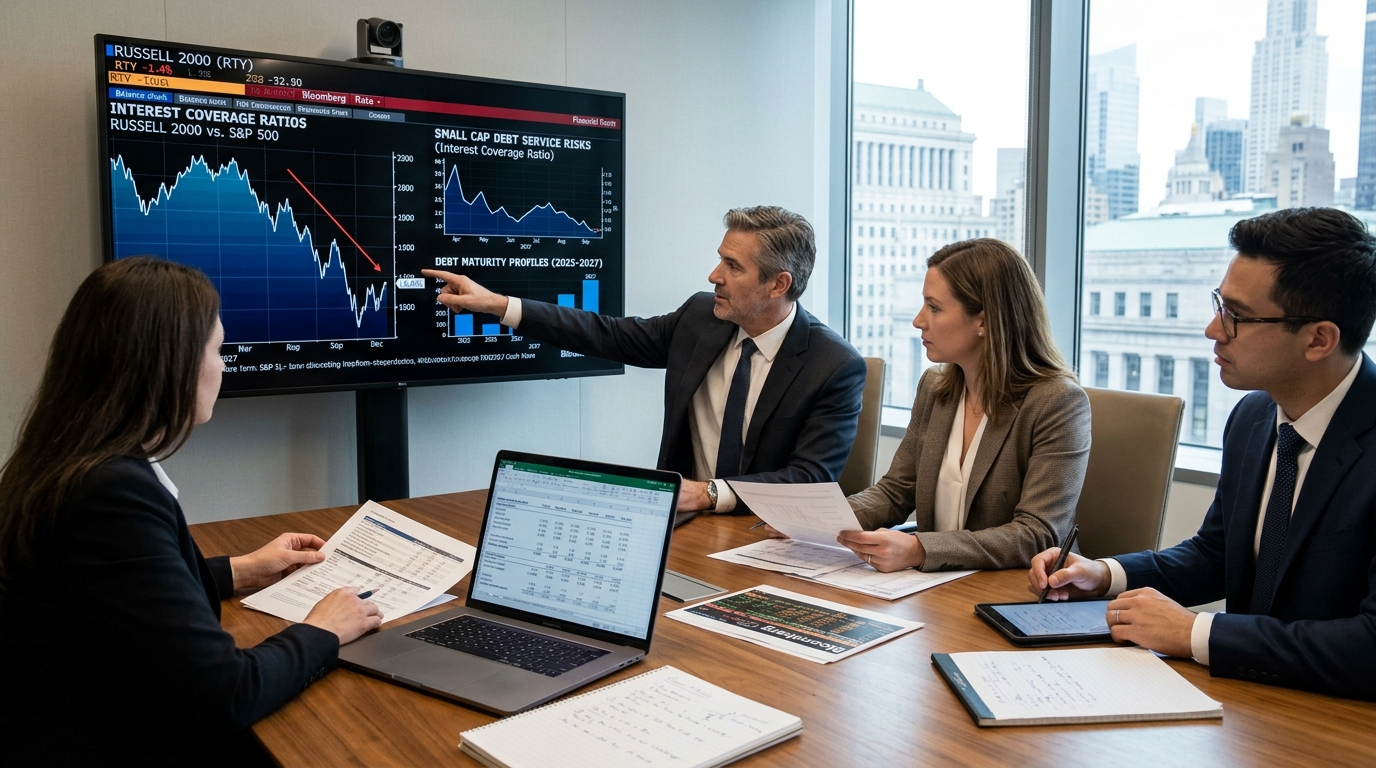
Forget price-to-earnings. The conversation inside institutional investment committees this weekend is about interest coverage ratios and 2027 refinancing calendars. That shift in analytical frame is exactly what Friday’s roughly 1.4% drop in the Russell 2000 was pricing.
The index closed the week near 2,972, the worst performance among the major benchmarks after Fed Chair Kevin Warsh delivered a hawkish message at Jackson Hole. Warsh said inflation is running above the central bank’s 2% goal and implied rate increases are in play if policymakers are not confident inflation is moving to target fast enough. Markets responded immediately. Markets are now pricing roughly a coin-flip chance of a September rate hike, up from about one-third before the speech, according to futures pricing tracked by CME FedWatch. The benchmark rate currently sits at 3.5% to 3.75%, with the next FOMC meeting scheduled for September 15 to 16.
The S&P 500 shook off the speech relatively quickly. The Russell could not, and the structural reason is straightforward.
A Funding Model That Breaks Differently
Small-cap companies do not finance themselves the way megacap technology firms do. Large corporations typically issue fixed-rate investment-grade bonds, locking in borrowing costs for years. Smaller businesses rely more heavily on floating-rate debt, meaning their interest expenses reset far more quickly as the Fed adjusts policy. The numbers are stark: the Russell 2000 has been estimated to have roughly 32% of its debt tied to floating rates, compared to about 6% for the S&P 500.
That asymmetry matters most when a rate move is in play. According to Bank of America, a single quarter-point rate increase can reduce Russell 2000 operating earnings by about 2%. One hike, one decision, 2% off the earnings base of an index that entered this week with consensus 2026 growth forecasts of 38%. The arithmetic is uncomfortable.
The profitability profile makes it worse. Nearly 40% of companies in the small-cap index generate no earnings. Small caps face a sizable maturity wall in 2026, with debt issued during the low-rate era needing to roll over at materially higher rates. Analysts have estimated that roughly 41% to 46% of Russell 2000 companies cannot cover their interest expense with operating profits. A hike does not merely compress multiples for this cohort. It tests solvency.
Why the Rally Made Things More Fragile
The Russell 2000 surged nearly 22% in the first half of 2026, posting its best first-half performance since 1991. That run was built on a specific thesis: the Fed was done, or close to done, and the rate relief would give distressed balance sheets time to repair. Roughly 40% of the companies in the Russell 2000 are currently unprofitable. For the surge to be sustainable, these companies must use the current window of lower rates to repair their balance sheets or reach profitability.
Warsh’s speech closes that window, at least conditionally. The rally has brought the index to nearly 100 points off its August 14 record close, creating a situation where the bullish thesis depended on one macro assumption that is now genuinely in doubt. Institutions are not debating whether small caps are cheap relative to history. They are asking which holdings cannot survive a September move.
Stocks to Watch
iShares Russell 2000 ETF (IWM). The default vehicle for the debate. The all-time high IWM closing price was $305.09 on August 14, 2026. At Friday’s close near $297.50, the ETF is already offering a cleaner short expression of the hike scenario than any individual name, with deep options liquidity that makes it the preferred hedging instrument for managers who want index-level exposure to the rate decision.
Community Health Systems (CYH). Highly leveraged firms like Community Health Systems are facing a maturity wall of debt in late 2026 that will likely need to be refinanced at rates of 6.5% to 8.0%, compared to the 1% to 2% rates secured during the 2021 issuance boom. The name sits at the intersection of every risk factor the September debate raises.
Clear Channel Outdoor (CCO). Another name analysts have flagged in the same maturity-wall context. Heavy floating-rate exposure, a refinancing need, and minimal earnings cushion. If the hike probability stays above 50% into September, this cohort gets screened out first.
The Sept 16 meeting is now a balance-sheet event for a meaningful slice of the Russell. That framing, more than any valuation argument, explains why the index led the market lower on Friday.