
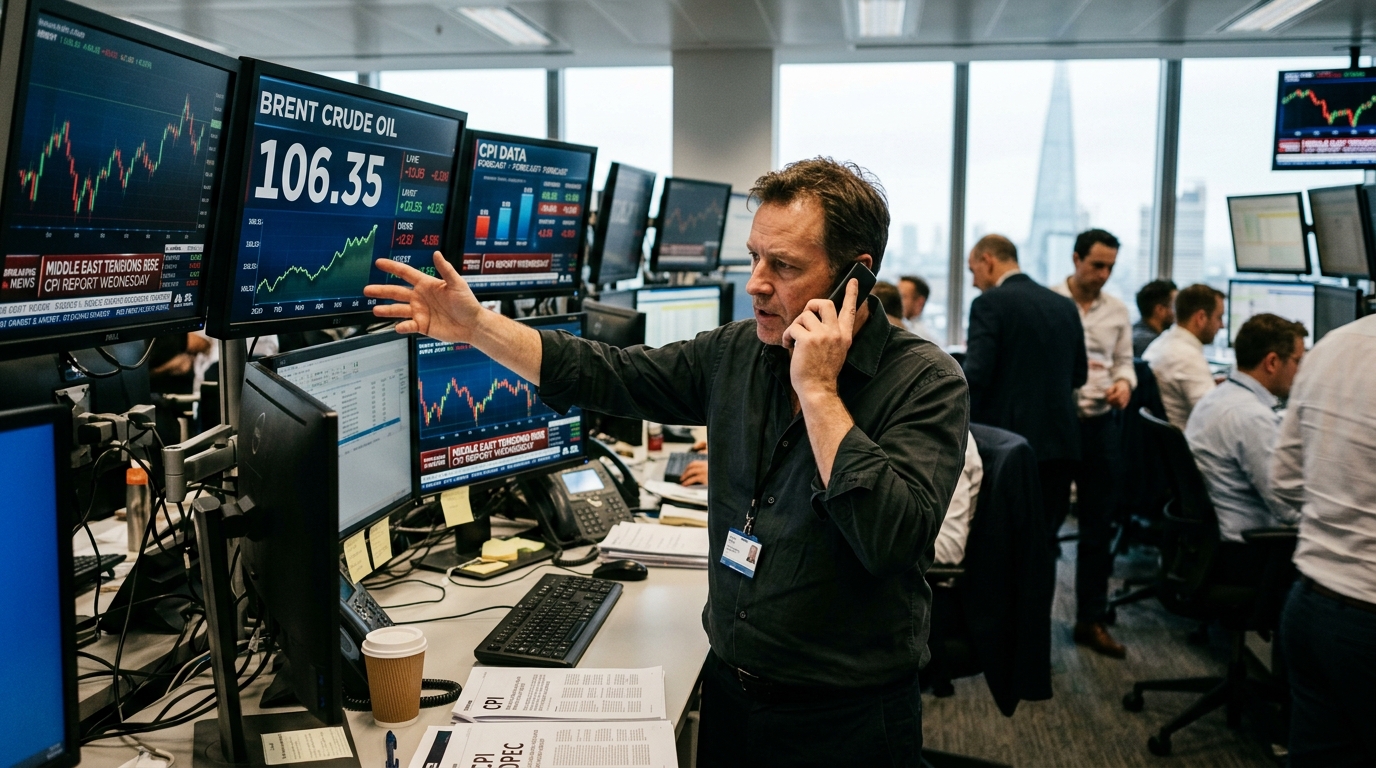
The arithmetic is getting uncomfortable. Brent crude traded above $106.50 a barrel on Monday, the highest level in more than two weeks, as escalating Middle East tensions heightened concerns over regional security. By Tuesday morning the price had slipped back to around $105.80, but that partial retreat should not distract from the more consequential question hanging over Wednesday’s 8:30 a.m. ET release: what happens to December Fed expectations if September CPI comes in hot while crude is still trading near $106?
The conflict is no longer an abstract supply risk. Saudi Arabia said at least 12 people were killed and more than 300 were wounded in a Houthi attack on King Khalid International Airport. Saudi authorities announced that the airport would remain closed until further notice, with a NOTAM indicating it will stay shut until at least October 17. A second strike hit Sunday. Then Monday brought the IRGC Navy’s claim of a third tanker struck by a naval mine in the Strait of Hormuz in two days. A third tanker claim landing while the airspace shutdown was still in force is not background noise; it is a pattern that forces shipping insurers, cargo owners, and tanker operators to reassess every transit through the strait.
It used to cost about $2 per barrel to move crude out of the Persian Gulf. That cost has now spiraled to roughly $33. Futures prices do not fully reflect that freight reality. The gap between prompt Brent and what physical buyers are actually paying to secure barrels is a second oil shock running in parallel with the headline number.
The Pentagon has raised the official death toll of U.S. personnel in operations tied to the war on Iran to 21, with 865 wounded, a figure that underscores how deeply committed the U.S. military posture already is in the region. Escalation risk is not theoretical.
What CPI Does to the Rate Calculus
The September CPI report is due Wednesday, October 14, with published forecasts pointing to headline inflation rising from 3.4% to about 3.6% to 3.7% year over year. It is the last inflation report before the Federal Reserve meets October 27 and 28. Energy is pushing the headline up; everything else is behaving. That split is precisely where the policy complexity lives. A core reading that holds near 2.4% gives hawks and doves something to argue about. A headline at 3.7% or above, with crude still elevated, removes the argument.
Oil’s surge has shifted rate expectations sharply. In an October 8 speech, Fed Governor Christopher Waller said fed funds futures pricing implied a high probability of at least one hike by the end of the December meeting. Goldman Sachs Research has pushed its first expected cut back to June 2027.
A hot CPI print tomorrow, combined with Brent holding above $105, would likely complete that shift in real time. The bond market would adjust within minutes of the 8:30 release.
Where It Shows Up in Equities
The split inside the energy sector is the story. Refining stocks are breaking away from integrated oil majors. Marathon Petroleum rose 5% to $413.75 and Valero Energy climbed 4% to $403.25, while ExxonMobil held practically unchanged. The reason is crack spreads: refiners on the Gulf Coast buy crude and sell gasoline and diesel. When crude spikes and product prices follow, their margins expand. Valero runs about 3.2 million barrels per day of refining throughput capacity; Marathon operates about 3 million barrels per calendar day. Phillips 66 offers a more diversified profile across refining, midstream, and chemicals.
The integrated majors, ExxonMobil and Chevron, benefit from higher crude prices through their upstream operations but face margin compression in refining when crude outpaces product price increases. Marathon and Valero lack an upstream cushion. If crude climbs faster than product prices, Exxon and Chevron offer exposure that nets both sides of the barrel. Valero is approaching an October 22 earnings report, which becomes the next concrete test of whether refining margins are translating into earnings beats.
Risks and Counterpoints
Brent’s Tuesday pullback from above $106 to around $105.80, even as a third tanker claim hit the wires, is the market’s own skepticism made visible. The IRGC claim on the third tanker was unverified and unnamed. The statement did not name the ship, its flag, or how it was struck. Unverified claims have a short shelf life in the oil market.
A softer-than-expected core CPI reading Wednesday would give the Fed room to stay on hold without signaling a hike, and second-round effects from higher energy prices have so far been limited, with core inflation continuing to run around 0.20% to 0.25% month over month outside of a few volatile categories. If that holds in September’s data, equities could rally even as the headline number rises.
What to Watch Next
Wednesday’s CPI at 8:30 a.m. ET is the immediate binary. A headline above 3.7% with any upside in core removes the last justification for a December cut. Below 3.5% on headline with core steady gives the market a reason to buy duration. Brent’s reaction to the number will be nearly as important as the number itself: crude above $107 into a hot print would be the clearest signal yet that the December rate cut is priced for a world that no longer exists.
Beyond that, watch tanker crossing volumes through the Strait of Hormuz for confirmation that disruption is tightening physical supply rather than just generating headlines. Recent tanker incidents have already pushed crossings through the Strait of Hormuz to a two-month low, according to independent war and shipping trackers compiling UK Maritime Trade Operations and industry updates. If that trend continues into next week, Brent’s floor rises and the Fed’s options narrow further.