
October 4, 2026
Bonus Content: Nvidia Wants Lenders to Trust a Chip They Can’t Value
Editor’s Note: Last year, Larry Benedict’s readers had the chance at a 279% return on cash – roughly 18x the S&P 500. He did it the same way he’s done it for over 40 years: by getting ahead of money on the move. He now believes the largest move he’s tracked is heading straight for your retirement account. He explains below.
Dear Reader,
Sometime soon, an email is going to land in your inbox from whoever runs your 401(k).
It’ll look like every other update they send…
Most people will scroll right past it. Don’t be one of them.
Because that email is your official notice that the “Trillion-Dollar Transfer” has reached your account…
The biggest change to what your 401(k) can own in its history.
Thanks to Executive Order 14330, as much as $1 trillion in retirement money is about to move somewhere it’s never been allowed to go…
Straight into the corner of the market where SpaceX grew 600,000%.
Hedge fund legend Larry Benedict has been tracking this shift for months.
And here’s what he wants you to know: By the time that email hits your inbox, the early money will have already moved.
That’s why he’s revealing the one ticker to own before the change reaches your statement…
The one sitting directly in the path of that $1 trillion.
Click here and Larry will name it – free.
Regards,
Lauren Wingfield
Managing Editor, The Opportunistic Trader
P.S. Larry’s traded ahead of Washington’s retirement rule changes before – the last one handed his readers the chance at 188% gains. This one is far bigger, and the clock is already running.
Nvidia Wants Lenders to Trust a Chip They Can’t Value
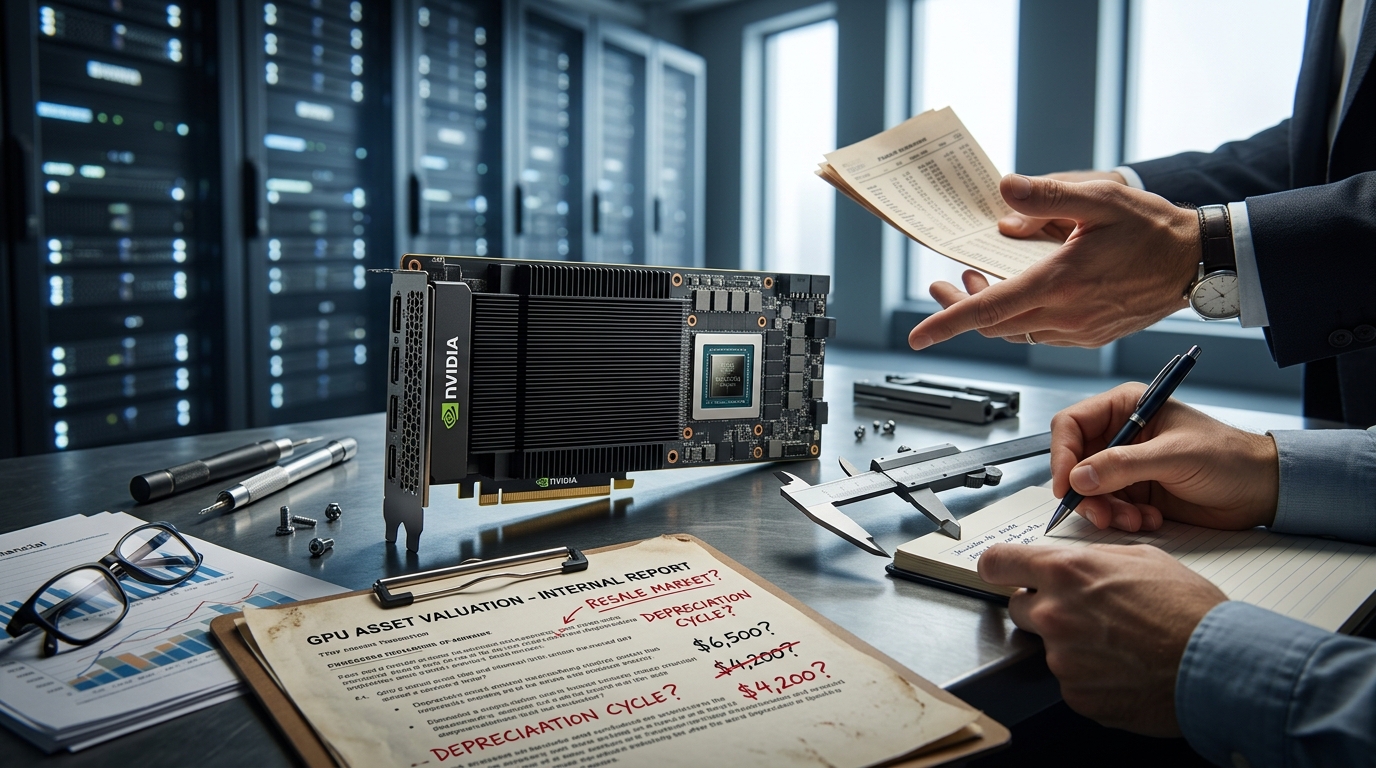
The most consequential disagreement in AI finance right now is not between bulls and bears on Nvidia’s earnings. It is between Nvidia’s own assessment of what a used GPU is worth and the number that Wall Street’s credit desks are willing to put on paper.
The Question Nobody Can Answer
Nvidia’s mammoth financing plan has opened a debate on Wall Street about how much its advanced chips and the infrastructure around them are worth. The answer for banks and investors seems to be: not as much as Nvidia thinks. That gap is not academic. Nvidia’s latest financing initiative is large enough to reshape how AI data centers borrow. On August 10, 2026, the chipmaker announced memorandums of understanding with Apollo, BlackRock, Blackstone, Brookfield, Goldman Sachs and KKR to create independent platforms capable of mobilizing more than $500 billion of third-party capital over time.
Nvidia’s plan had envisioned using chips as collateral with limited guarantee in order to allow AI developers a way to facilitate their access to Nvidia’s compute. The follow-up reporting tells a different story. Some lenders want higher guarantees than the company had originally outlined, even for Nvidia’s industry-leading AI processing power, as they try to calculate how long the revenue from its chips will last, banking sources and credit managers told Reuters.
A Decade vs. Three Years
The core dispute is a depreciation schedule. “Banks typically underwrite GPUs over a 3-4 year depreciation schedule,” said Tony Trzcinka of Impax Asset Management. “That is different than Nvidia, which argues top-tier GPUs can earn revenue for a decade,” he said, adding investors are likely to seek higher interest rates, bigger financial cushions and stronger repayment protections before backing loans secured by AI chips.
Part of the divergence in views is that there still isn’t enough historical data for lenders to confidently underwrite long-term residual value based on GPUs. S&P Global Ratings director Andrew Chang put it plainly: “Nvidia would imply that the GPUs work well north of five years, and that actually has been proven to be true thus far.” Yet “we take a conservative view of the value of those chips.” Wellington Management’s Loren Moran, whose firm manages about $1.3 trillion, framed it from the buy side: “As investors, you’re going to be a lot pickier about the levels that you need to get compensated for to take incremental risk.”
The secondary market data sharpens the concern. Claims about a single, definitive “trade” price for an Nvidia H100 vary widely by configuration, condition and channel. But multiple industry reports and market trackers have described a steep drop from roughly $30,000 in 2023 to roughly $8,000 by mid-2026 for certain H100 units, even as some financings were structured around materially slower depreciation assumptions. That is the bear case in a single data point.
What Broadcom’s Backstop Actually Signals
The Broadcom structure is where theory becomes price. Broadcom struck an agreement to backstop most of a $35 billion financing structure while investors including Apollo Global Management and Blackstone financed the purchase of custom AI racks to lease to a customer that Reuters identified as Anthropic. The backstop helped senior tranches obtain investment-grade ratings, which lowered the borrowing costs. Without it, the deal does not get done at those terms.
In the event of a lease default by the customer, Broadcom’s backstop is designed to cover most of the customer’s lease obligations, with its maximum exposure disclosed by Broadcom at $29 billion. That structure tells you everything about what the credit market thinks of standalone GPU collateral: it needs a semiconductor company’s balance sheet behind it before institutional debt buyers will move.
This is raising concerns that risks are accumulating that are not visible on the balance sheets of these companies. JPMorgan strategist Tarek Hamid described a growing layer of “phantom leverage” underneath the vast AI ecosystem as the backlog of leases, purchase commitments, residual value guarantees and other backstops is poised to stretch into the trillions.
What Investors Are Missing
Equity markets are treating the $500 billion platform as a demand accelerant for Nvidia. The credit market is treating it as a pricing problem that has not yet been solved. Both can be right in the short term. The conflict only resolves when the first large facilities under the platform close with disclosed terms, and the depreciation assumptions embedded in those deals become legible.
The hidden implication: Nvidia’s offer to provide limited residual-value support on a project-by-project basis is not just a sweetener. The chipmaker is essentially taking on some of the depreciation risk on its own products. As that exposure scales, it begins to look less like a financing platform and more like a structured subsidy for demand, one that shows up in Nvidia’s contingent liabilities rather than its revenue line.
Stocks to Watch
Nvidia (NVDA). The company most exposed to the residual value debate. If lenders converge on shorter depreciation horizons, the cost of capital rises for every GPU buyer Nvidia is trying to finance, slowing the very demand the platform is designed to accelerate.
Broadcom (AVGO). Already associated with a $35 billion financing structure and backstopping customer lease obligations with a disclosed maximum exposure of $29 billion. In August 2026, bond traders pushed up Broadcom’s credit risk measures: yields on its 5.15% bonds maturing in 2031 rose about 14 basis points, and the price of its five-year credit default swaps climbed 28 basis points over the same period. The bond market is pricing the guarantee risk before the equity market has fully acknowledged it.
Blackstone and Apollo. Both are inside the Broadcom AI infrastructure platform as financiers. Their willingness to participate with a backstop in place, but not without one, is the clearest signal yet of where institutional credit draws the line on GPU collateral.