
August 7, 2026
Rivian’s R2 Is in Driveways. Q4 Is Where the Math Gets Real.
First a message from Mode Mobile
Some companies you only hear about after they IPO.
And some…
Eventual unicorns like Uber, Airbnb and OpenAI…
Forced the world to pay attention long before that.
Mode Mobile could be a new member to that second group.

Uber turned cars into taxis, Airbnb turned homes into hotels, and Mode Mobile is turning smartphones into EarnPhones.
With $115M+ in revenue, 3-year growth of 32,481%, and an ecosystem with more than 490M+ users, it’s what investors call a “category disruptor.”
The kind that could turn early capital into generational wealth.
They’re raising privately.
For now.
But investors can get $0.52 pre-IPO shares before their share price changes on August 14.
With a Nasdaq ticker ($MODE) secured, and early backers like Kevin Harrington from Shark Tank, the company has its eyes on potentially going public.
Their previous two raises sold out, and this one is on track to do the same.
⏰ Review the offer before August 14.
Rivian’s R2 Is in Driveways. Q4 Is Where the Math Gets Real.
TITLE: Rivian’s R2 Is in Driveways. Q4 Is Where the Math Gets Real.
SUBTITLE: A roughly 45% bill-of-materials cut, record demo drives, and a second production shift expected later this year are converging on the most consequential quarter in RIVN’s history.
The Vehicle Is Real. The Question Is the Ramp.
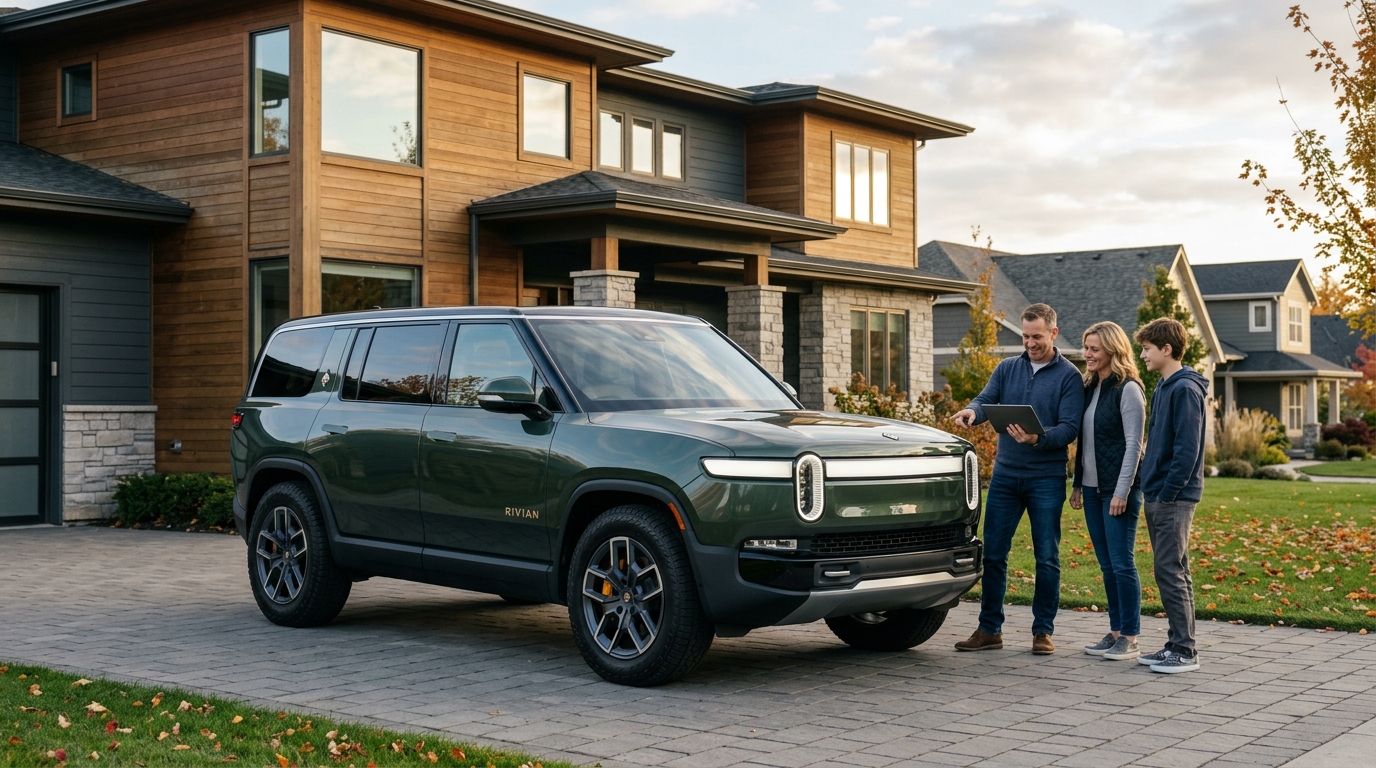
Rivian spent five years building a reputation on premium electric trucks and SUVs that won over buyers who could afford them. The R2 is something different. It is the vehicle the company’s entire financial model depends on, and as of June 9, 2026, it is no longer a concept. Customers are driving it.
The stock, trading near $15.57 as of early August, sits roughly 32% below its 52-week high despite a Q2 earnings beat on revenue, adjusted EPS, and EBITDA. That gap is where the investment question lives.
Market Temperature
The broader EV sector is navigating a genuinely difficult backdrop. Federal tax credits for electric vehicles expired after September 30, 2025, removing up to $7,500 in effective consumer subsidy overnight. Legacy automakers are pivoting back toward hybrids. Tesla’s Model Y retains its commanding lead in the midsize SUV segment. The environment rewards execution, not ambition.
What makes Rivian’s situation distinct is that it entered this climate with a vehicle architecturally designed to win on cost, not just aspiration. That is a different pitch than anything Rivian has made before.
What the R2 Actually Is
Rivian expects the R2, an updated, less expensive EV that looks like its flagship R1 SUV, to attract more buyers and deliver on the company’s promises to cut costs and become profitable in the years ahead. CEO RJ Scaringe has called it the company’s best product.
The Performance model packs 656 horsepower from a dual-motor AWD setup, an 87.9 kWh battery, 330 miles of EPA-rated range, and a 3.6-second 0-60 time. It also includes a lifetime subscription to Rivian’s Autonomy+ driver-assistance suite for Launch Package vehicles and a 4,400-pound towing capacity when equipped with the Tow Package.
Considering the EV tax credit program came to an end after September 30, 2025, the R2 Standard’s low price stands out when compared to other EVs that have seen their effective out-of-pocket costs rise by as much as $7,500 since then. The base Standard single-motor trim, priced at $44,990, is set to arrive in early 2027.
Special system spots Wall Street moves – before the market
I created a proprietary indicator…
That flags Wall Street money moves – before the market sees them.
Our backtest shows 85% of the stocks my system flags have gone up.
In fact, the average stock doubled…
And that includes the losers.
Data-Driven Deep Dive
The Engineering Advantage Nobody Is Fully Pricing In
The R2 is not the R1 with a smaller sticker. It is a ground-up redesign built around a single objective: stripping cost out of the places that historically kill EV margin.
At the core of the R2’s cost-cutting approach is ruthless simplification. Rivian says its new zonal electrical architecture slashes wiring complexity, trimming 2.3 miles of harness length and reducing connectors by 60%. High-voltage cabling is down 70% thanks to consolidating multiple power modules into a single unit.
Rivian’s new Maximus drive unit uses 41% fewer parts than the Enduro units found in the R1 lineup. By integrating the inverter directly into the drive unit and even using its housing as a mounting structure, Rivian cuts both material cost and assembly time. The result is a bill of materials roughly 45% lower than the second-generation R1.
Rivian’s true moat lies in its proprietary zonal electrical architecture, reducing electronic control units from 17 down to 3, a structural software advantage validated by Volkswagen’s up to $5.8 billion investment plan tied to Rivian and the two companies’ joint venture.
Revenue, Margins, and the Profitability Sequence
Rivian’s Q2 2026 revenue rose 27% to $1.658 billion and consolidated gross profit hit a record $179 million as R2 deliveries began, but its car business still lost money. That contrast is the entire story.
The $179 million headline is real but it requires context. Rivian posted $179 million in consolidated gross profit, the best in its history, but the automotive segment that actually builds and sells vehicles posted a $36 million gross loss. The consolidated positive figure is driven in large part by higher-margin software and services, including vehicle electrical architecture and software development services tied to the Volkswagen joint venture, rather than by making money on car sales.
Rivian absorbed roughly $100 million in extra cost of revenue in the quarter from bringing the R2 line up to speed. That’s the price of scaling a new vehicle, and it’s why the automotive side stayed in the red even as the top line jumped.
But the trajectory matters. The automotive gross loss narrowed from $335 million a year ago to $36 million in Q2 2026. That is a $299 million improvement in twelve months, and R2 is only just entering the production cadence.
The Q4 Inflection
A more meaningful profitability milestone, positive automotive segment gross margin, is targeted by management for the end of 2026, contingent on adding production capacity with additional shifts later this year.
Rivian implies approximately 42,400 to 47,400 deliveries in the second half of the year. The company expects deliveries will be weighted towards the fourth quarter as it ramps R2. That is nearly double what it delivered in the first half. CFO Claire McDonough told analysts that Q4 production provides a reasonable near-term benchmark for normalized costs.
Rivian has already raised its full-year 2026 delivery guidance from 62,000 to 67,000 vehicles, to 65,000 to 70,000. The upgrade came before Q2 results were published, driven by stronger-than-expected R2 demand signals.
Demand Is Running Ahead of Internal Models
CEO RJ Scaringe said external R2 deliveries began in June and that more than 57,000 demo drives set a company record. He said reservation-to-order conversion for the Launch Package was meaningfully above expectations, with a significant number of first-time electric-vehicle buyers.
That last detail is the one that could matter most in the long run. First-time EV buyers represent incremental market capture, not conquest from Tesla. In the Q&A session, Scaringe told a Needham analyst that most non-converting customers were waiting for other configurations, including premium and standard trims, due in early 2027. The backlog is not shrinking. It is deferred, and structurally intact.
The Volkswagen Partnership as Structural Moat
The joint venture aims to use Rivian’s electrical architecture and software technology stack, enabling R2’s launch and supporting the expected launch of the first Volkswagen Group models as early as 2027. The JV will evolve this modular and flexible state-of-the-art electrical architecture. It will scale the technology across a wide range of price points and international markets.
This is not just a capital relationship. The joint venture’s software leadership has said the tech stack jointly developed could become a standard technology stack that others can use. He believes Rivian’s software could become the Android of cars, a standard reference operating system that other automakers could use as the foundation for their own technology stacks. That ambition has a direct revenue corollary. Software and services already generated $515 million in Q2 at a 42% gross margin. That segment is Rivian’s current profit engine, and it scales without requiring another factory shift.
Liquidity Is Less Fragile Than the Bears Imply
Rivian ended Q2 with $5.31 billion in cash, equivalents, and short-term investments. In July, it sold 75 million Class A shares at $15.50 per share and underwriters exercised their option in full, bringing the total to 86.25 million shares, for net proceeds of about $1.32 billion.
Rivian has said it expects up to $1.0 billion in loan funding to be made available through the joint venture with Volkswagen and additional milestone-based funding over time, subject to conditions. Add in the DOE loan tied to the Georgia plant, and the company pegs its available and targeted future capital at over $14 billion.
That runway is sufficient to survive a painful ramp quarter. The question is whether Q4 delivers the automotive margin turn on schedule.
Strategic Insight
The R2 is not a product launch. It is a business model transition. Rivian spent its first five years proving it could engineer premium electric vehicles. The R2 is the test of whether it can engineer profitability.
Rivian founder and CEO RJ Scaringe expects the R2 will make up the majority of Rivian’s volume by the end of 2027. Rivian has said that its Normal plant will have the capacity to produce 215,000 units annually, including up to 155,000 R2s.
Combined capacity across Normal and Georgia supports up to 515,000 vehicles per year, with room for later phase expansion. At 155,000 R2 units annually from Normal alone, the fixed-cost absorption math changes materially. Depreciation per vehicle drops, unit costs compress, and the structural pack design, which doubles as the vehicle floor, eliminates an entire assembly step. These are not speculative engineering claims. They are already embedded in Rivian’s cost-per-vehicle trajectory.
The stock is trading at roughly 3.4 times trailing sales, close to the S&P 500’s multiple, which sounds reasonable until you recognize that those sales are still being produced at a deep operating loss. That is the bear case in one ratio. The bull case is that Q4 automotive gross profit turns positive, and the multiple starts reflecting a company on a credible path to operating leverage rather than one perpetually burning cash.
Risks Worth Taking Seriously
- Regulatory credit dependence: Rising raw material, memory, and logistics costs push the same way, and the $164 million of regulatory credits that helped gross profit in the first half of 2026 do not repeat. If auto gross margins turn positive in Q4 but then credits fall away in 2027, the progress may look better than it is.
- Dilution risk: The July follow-on offering added up to 86.25 million shares. If the added production shifts require additional capital ahead of free cash flow turning positive, another equity raise could be on the table.
- EV tax credit absence: The removal of U.S. EV tax credits makes the pricing gap even more painful for buyers. The $45,000 base R2, arriving in 2027, will still cost families more out of pocket than a comparably capable hybrid.
- Launch cost drag persisting into Q3: Management explicitly guided for R2 ramp costs to weigh on automotive gross profit in Q3 as they did in Q2, before improving in Q4. One delay, one supplier constraint, or one production setback could push the inflection back by a quarter, which would test investor patience.
Grid Emergency: 100X More Blackouts by 2030?
The Department of Energy warns blackouts could increase 100 times by 2030. Elon Musk and Sam Altman are already moving “off-grid” – and their next move could reward early investors most.
Big Picture
Rivian’s R2 arrives at a moment when the midsize electric SUV segment is still wide open to a credible challenger. The Model Y’s dominance is real, but it is not built on loyalty so much as it is built on lack of alternatives. The Hyundai Ioniq 5 and Kia EV6 have chipped away at Tesla’s share in the mass market. The R2 is a better engineered product than either, at a competitive price, with a brand that carries authentic adventure credibility.
The platform is designed to carry the R3 and R3X as well, meaning the cost architecture Rivian built for the R2 does not get retired after one vehicle. It scales. Each new model that rolls off the Midsize Platform amortizes the engineering investment further and reinforces the Volkswagen software joint venture’s value as a licensing property.
Rivian’s software leadership believes Rivian’s software could become the Android of cars, a standard reference operating system that other automakers could use as the foundation for their own technology stacks. He admitted that licensing out tech is a very different ball game and a very different margin profile compared to making cars. If even a fraction of that vision materializes, the software and services segment becomes less a Volkswagen subsidy and more a recurring revenue stream in its own right.
Final Thought
The bear case on Rivian is not wrong about the present. Free cash flow was negative $849 million in Q2. The automotive segment is still losing money. Dilution is real. The EV credit tailwind is gone.
But the bull case is not about the present. It is about Q4’s added production shifts and whether the automotive gross loss finally closes. Management has reaffirmed that R2 should reach positive gross profit at Rivian’s 2026 exit rate as higher output improves fixed-cost absorption. If that lands, RIVN begins 2027 as a different company structurally than the one markets are currently pricing.
The R2 is in driveways. The platform engineering is validated. The Volkswagen partnership is funding operations and de-risking the software roadmap. The stock has already sold off post-earnings. Rivian has not confirmed a November 10, 2026 earnings date as of August 7, 2026, so the next concrete catalyst is the company announcing the Q3 reporting date and then delivering the Q3 numbers that make Q4 guidance credible.
That is a concrete catalyst with a concrete date. Worth watching closely.
Disclaimer: This editorial is for informational purposes only and does not constitute investment advice. All figures are sourced from publicly available company filings, earnings calls, and credible financial media as of August 7, 2026. Investing in individual equities involves risk, including the possible loss of principal. Past performance does not guarantee future results. Always conduct your own due diligence before making any investment decisions.