July 25, 2026
The $797 Billion Question
Is the AI spending cycle brilliant strategy or a slow bleed?
First a note from Profits Run
I’ve been trading for over 50 years.
But I still remember my first trade – and mostly, I remember how much of the fear had nothing to do with the market.
It was the logistics. The forms. The numbers. The feeling that one wrong move would embarrass me or worse.
Nobody hands you a map for that part. So I finally made one.
Your First Trade Playbook is the exact path I’d follow if I were starting from zero today.
Which account, which approval level, which settings, a zero-dollar practice run, and the one number to write down before you ever risk a cent.
One sitting. That’s the whole commitment. Normally $29.97 – free today.
Download it free here before your link expires.
Good Trading,
Bill Poulos
P.S. Fifty years from now you won’t remember what the market did this week. You will remember the year you finally started. Get the playbook for free.
The $797 Billion Question
The Big Question Institutional Investors Are Wrestling With Right Now
Here is the question sitting at the center of every portfolio manager conversation this week: Is the AI infrastructure buildout the greatest capital allocation decision in corporate history, or the most expensive overpromise Wall Street has ever funded?
That question got a lot louder on Thursday, July 24, when the Magnificent Seven collectively shed roughly $797 billion in market value in a single session. It was their worst one-day decline since the tariff-driven chaos of April 2025. The S&P 500 dropped 1.2%. The Nasdaq 100 fell 1.9%. And suddenly, a theme that had powered megacap tech for three straight years started feeling a lot less certain.
Why Every Asset Manager Is Paying Attention
The Magnificent Seven are not just stocks. They are the gravitational center of most large-cap equity portfolios. When they move this violently in a single session, it does not just hurt performance. It forces a fundamental re-examination of the thesis.
The trigger this week was earnings. Alphabet and Tesla reported, and both delivered a version of the same uncomfortable message: we are spending far more than you expected, free cash flow has turned negative, and we need you to trust us. Alphabet raised its 2026 capital expenditure guidance to a range of $195 billion to $205 billion, up from a prior estimate of $180 to $190 billion. Tesla disclosed that its capex surged 142% year-over-year in the second quarter alone, reaching $5.79 billion, and said it expects more than $25 billion in total capital expenditure this year.
The market’s response was swift. Alphabet fell roughly 7%. Tesla cratered approximately 14.5%, losing around $200 billion in market value on its own. Amazon, Meta, and Microsoft, which do not report for another week, got caught in the downdraft anyway. Microsoft dropped about 3%, Amazon sank roughly 5%, and Meta fell close to 5%.
One Gold Trade. Less Than an Hour.
A recent gold trade unfolded in under an hour. No overnight holding. No drawn-out waiting. What made it interesting wasn’t just the outcome… But how clearly the setup formed ahead of time. It followed a pattern tied to a specific moment in gold. One that tends to repeat more often than most realize. This report walks through the gold setup, the timing, and what to watch for.
The Bull Case: Spending Is Proof of Demand
The bull case is actually pretty straightforward, and it is not nothing.
Alphabet’s cloud revenue came in at $24.8 billion for the quarter, up 82% year-over-year, beating forecasts by a wide margin. Alison Porter, portfolio manager at Janus Henderson, told CNBC that this was “one of the strongest revenue growth quarters that Alphabet has had in five years.” The message from Alphabet’s CFO was equally direct: the spending increase is primarily driven by an acceleration in delivering capacity to meet demand that already exists. In other words, they are not building in hopes that customers show up. Customers are already there, and there is not enough capacity to serve them.
Elon Musk framed Tesla’s spending philosophy the same way on the earnings call. “We should be spending on capex as fast as we can spend, as fast as we can without it being too wasteful,” he told analysts. The argument is that speed matters more than efficiency in a winner-take-most AI environment. Being second by two years is not being second. It is being out.
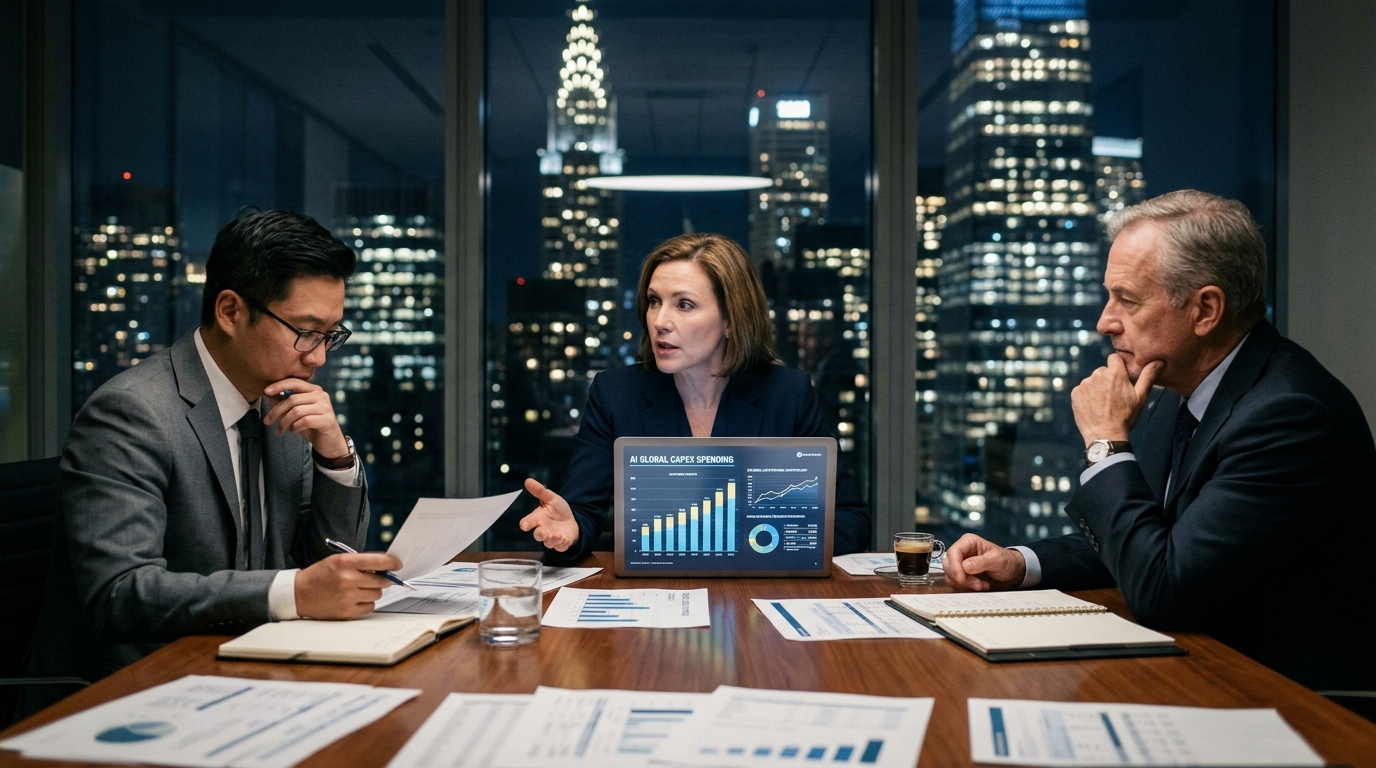
The broader numbers support the scale of commitment. The four largest hyperscalers, including Alphabet, Amazon, Meta, and Microsoft, are projected to spend a combined $650 billion on AI-related capital expenditure in 2026. That is a 67% increase from 2025. Edward Jones senior analyst Brian Therien argued that Alphabet’s higher investment outlook “helps reinforce our view that the AI infrastructure buildout remains a durable theme.”
The Bear Case: Revenue Has to Catch the Spending
Here is where it gets more complicated.
Alphabet reported negative free cash flow for the first time in its history as a public company. Tesla’s free cash flow turned negative in the quarter, showing a deficit of $1.1 billion after generating positive cash flow in Q1. Both companies delivered solid top-line numbers, and the market sold them off anyway. That is a signal worth paying attention to. As Benzinga put it plainly: it is no longer enough to beat revenue expectations. Investors now want to see capex discipline too.
Brent Schutte, chief investment officer at Northwestern Mutual Wealth Management, put it more bluntly, advising investors to focus on companies with actual earnings rather than paying for valuations dependent on outcomes “that may or may not actually happen.” That is not a fringe view. It is increasingly the mainstream one.
There is also a growing macro overlay making this harder. Brent crude topped $100 a barrel for the first time since May, driven by Houthi attacks on tankers near Saudi Arabia. The 10-year Treasury yield moved to its highest level since January 2025. Neither backdrop makes it easier to justify elevated valuations on companies burning cash at industrial scale.
Slight tangent, but it matters: Fidelity’s Jurrien Timmer noted that the Mag 7 index has “only drifted sideways since October 2025,” even as the broader market moved. The relative underperformance of this group, quietly building for months, is now becoming visible. That erosion of leadership has its own momentum.
The Evidence on the Ground
As of Friday, six of the seven stocks were down over the prior five trading sessions. Tesla led the damage, falling more than 19% over that stretch. Alphabet was down 8.5%. Amazon lost 6.3%. Meta fell roughly 6%. Microsoft dropped 1.3%. Apple was flat, off just 0.4%.
The one exception was Nvidia, which gained about 1.9% over the same five days.
That split tells you a lot about where institutional money is moving. JPMorgan strategists flagged the widening divergence between AI chipmakers, which continue to attract buyers, and the hyperscalers who are funding the infrastructure. Their warning was pointed: this divergence echoes patterns from the late 1990s internet build-out, when the infrastructure builders got crushed while the equipment suppliers thrived.
What the Smartest Investors Appear to Believe
Mark Mahaney, senior managing director at Evercore ISI, framed the current dynamic cleanly: during major investment cycles, investors “would rather invest in the companies receiving the investment dollars, rather than spending the investment dollars.” That is not a bearish call on AI. It is a statement about where in the value chain money prefers to sit right now.
The question the investment committee is really debating is not whether AI spending is real. Alphabet’s 82% cloud revenue growth answers that. The debate is about timing. How long does free cash flow stay negative? When do the returns show up in numbers that the market can price? And critically: what happens if Microsoft and Amazon report similar capex surprises next week?
The Magnificent Seven as a group are down roughly 11% from the record high reached in late May, with about $2 trillion in combined market cap erased over that stretch.
The SpaceX “xPhone” story may be bigger than people realize
Elon publicly says SpaceX isn’t building a phone.
Fair enough. But the interesting part is what recent filings and infrastructure moves may be pointing toward behind the scenes. Slight tangent, but some investors think the opportunity here has almost nothing to do with hardware.
What Investors Are Missing
Everyone is focused on whether hyperscalers are spending too much. The more interesting question is almost nobody is asking: who is actually cashing the checks?
When Alphabet commits $200 billion in capex, most of that money does not stay inside Alphabet. It flows outward, into GPUs, servers, networking equipment, memory chips, power infrastructure, and data center construction. The hyperscalers are essentially transferring wealth to their suppliers at a pace the market has never seen before.
According to CreditSights estimates, roughly 75% of total hyperscaler capex, approximately $450 billion, goes directly into AI infrastructure components. That money has to land somewhere, and for two straight years, Wall Street’s estimates of how much would be spent have come in well below actual figures. Actual spending exceeded initial projections by more than 50% in both 2024 and 2025.
Apple is the quiet outlier inside the Magnificent Seven itself. The company has largely stayed out of the AI infrastructure arms race. Its shares have gained roughly 11% just this month and 18% on the year. That is the market saying something interesting: capital discipline is being rewarded right now, even inside a group defined by its AI ambitions.
Stocks to Watch
Nvidia (NVDA)
The most direct beneficiary of every dollar the hyperscalers spend. The company captures an estimated 55% to 60% of total AI accelerator spending flowing through the hyperscaler supply chain, and every major capex announcement essentially doubles as a forward order for Nvidia hardware. While the Mag 7 sold off hard Thursday, Nvidia finished the week positive. That divergence is the market telling you something.
Micron Technology (MU)
High-bandwidth memory is the constraint no one talks about as loudly as GPUs, but it is just as critical. As AI models scale, memory demand scales with them. Micron sits at a key bottleneck in the AI supply chain, and hyperscaler spending commitments are multi-year tailwinds for HBM demand. Memory chipmakers have started attracting institutional attention that GPU names have held for two years.
Alphabet (GOOGL)
The highest-risk, highest-potential name on this list right now. Google Cloud revenue grew 82% in Q2, and the company’s AI products are seeing genuine commercial traction, with the Gemini app crossing 950 million monthly active users. The near-term problem is real: negative free cash flow, a capex guide that keeps moving higher, and a stock that just lost 8.5% in five days. The investment thesis is still intact. The patience required to hold it is being severely tested.
Apple (AAPL)
The overlooked story inside the Magnificent Seven. Apple has not joined the infrastructure spending race at the scale of its peers. Shares are up roughly 18% on the year while the broader Mag 7 index sits 11% below its May peak. Whether Apple is strategically disciplined or simply behind is the central debate. But right now, the market is paying a premium for its restraint.
Broadcom (AVGO)
Custom silicon design is where the real second-order story lives. Broadcom and Marvell are the primary beneficiaries as hyperscalers shift toward building their own chips rather than relying entirely on Nvidia. That transition is accelerating, and Broadcom sits squarely in the path of the capital flow. Less headline risk than Nvidia, and arguably as well positioned for where AI infrastructure is heading over the next two years.
The Magnificent Seven erased $797 billion in a day. That number will make headlines for a week. What matters more is the quieter question underneath it: whether the companies writing the biggest checks in corporate history can eventually show investors a return worth waiting for. Microsoft, Amazon, and Meta report next week. The answer, or at least the next chapter of it, is coming fast.
— Wall St. Mavens Editorial Desk