
July 13, 2026
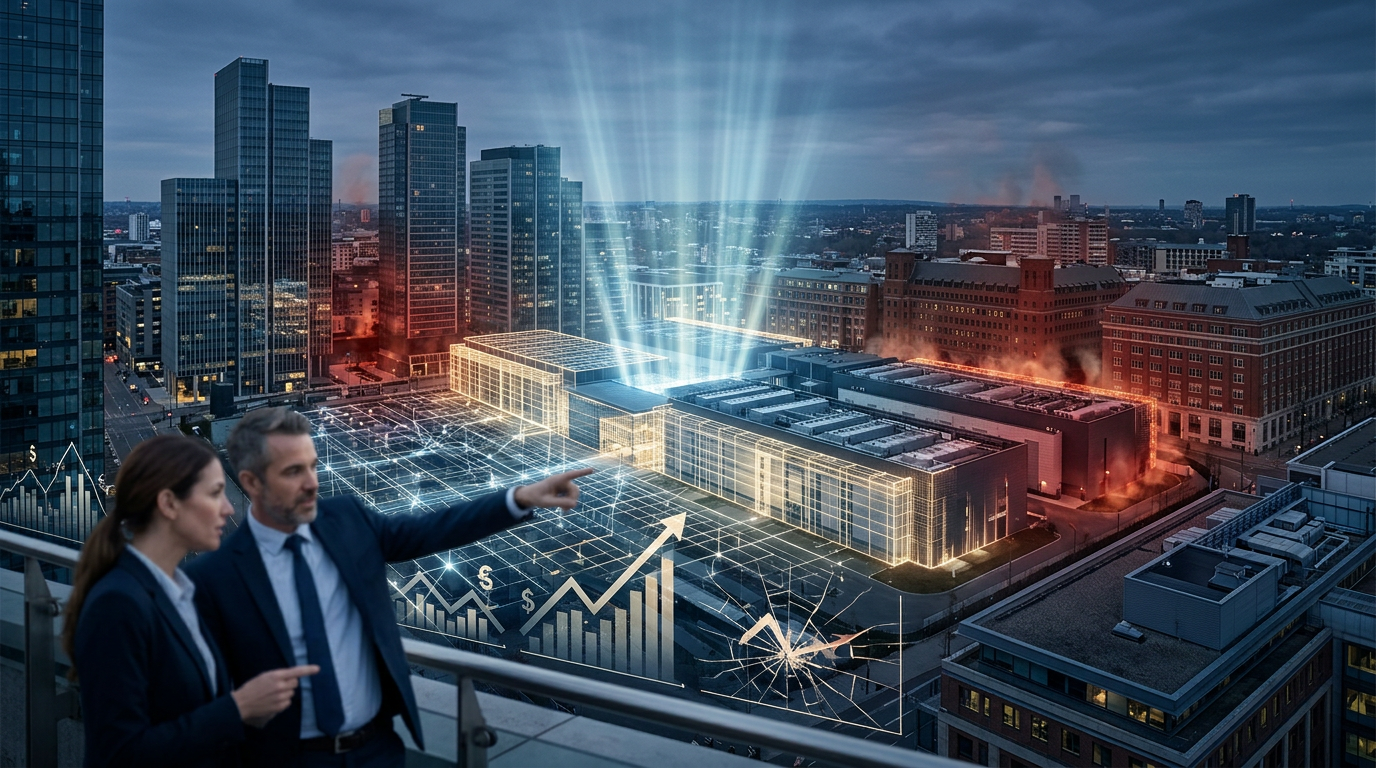
The $725 Billion Question
Is AI spending building the future or burning the house down?
Here is the question sitting at the center of every serious investment committee meeting right now: the four largest hyperscalers are on track to spend roughly $725 billion on AI infrastructure in 2026 alone, up 77% from last year’s already record-breaking $410 billion. Is this the greatest capital allocation decision in corporate history? Or is it the most expensive mistake?
That debate is not abstract. It is reshaping portfolios, rotating money across sectors, and splitting institutional opinion in ways that rarely happen when a trade is this crowded.
Why Funds Can’t Look Away
The numbers are hard to put in context. Microsoft projected full-year 2026 capex of around $190 billion. Amazon reaffirmed $200 billion. Alphabet doubled its guidance to roughly $175-185 billion. Meta is tracking toward $125-145 billion. Combined, these companies alone are committing somewhere between $700 billion and $900 billion to AI infrastructure this year, according to estimates from Evercore and Bank of America, with 2027 projections already topping $1 trillion.
And here is the part that doesn’t make it into most headlines: capex is now rising faster than operating cash flow. For the first time in modern history, the most profitable technology companies on earth are engineering a year of negative free cash flow. Meta’s free cash flow fell to just $1.2 billion in Q1 2026, down from $26 billion in the same quarter a year earlier. Moody’s reported that hyperscalers have approximately $662 billion in data center lease commitments signed but not yet commenced, sitting off-balance-sheet under GAAP standards. The visible capex figures, already staggering, actually understate the full commitment.
The AI Boom’s Most Profitable “Tollbooth” Stock?
Whitney Tilson – the man CNBC calls “The Prophet” – calls it the world’s most profitable tollbooth. One billionaire put more than half his $9 billion fund into it.
Right now it’s trading at a rare discount…the same kind that’s previously turned $10,000 into $55,000…in just over 12 months.
Capex intensity, measured as spending as a percentage of revenue, has climbed to roughly 25-30% across the group. Before the AI buildout, that figure typically ran 10-15%. For historical context, the dot-com peak in 2000 saw aggregate tech capex-to-sales of roughly 32%. The AI boom in 2026 is at 34% and is projected to reach 37% by 2028. Tech now operates with higher capital intensity than most telecom operators.
This is why it matters to every fund manager with a tech allocation, which is essentially every fund manager.
The Bull Case
Start with the demand side, because the bears tend to skip it. All five major hyperscalers report that their AI capacity is being absorbed as quickly as it can be deployed. Microsoft has an $80 billion unfulfilled Azure backlog, largely constrained by power availability rather than customer interest. Alphabet’s cloud backlog surpassed $460 billion. AWS is running at roughly $150 billion annualized and growing 28% year-over-year. Google Cloud surged 63% in Q1 2026. Microsoft’s AI business crossed a $37 billion annual run rate, up 123% year-over-year. The revenue side is real and accelerating.
There’s also a structural argument the bulls keep returning to: no hyperscaler can unilaterally stop spending and cede ground to competitors. The capex cycle is, in that sense, self-reinforcing regardless of near-term returns. Amazon CEO Andy Jassy said the company is “confident in the long-term capex investments” it is making. The CEOs of these companies are not guessing. They have years of forward bookings anchoring their conviction.
One more thing worth noting. This is not 2000. The companies doing the spending are among the most profitable businesses in history. Google, Meta, Microsoft, Amazon generated a combined $372 billion in net operating profit over the last twelve months across all their businesses. These are not pre-revenue startups burning through venture capital. They are cash machines choosing to plow that cash into infrastructure they believe will compound for a decade.
And according to one recent analysis, the AI economy is now generating roughly $1.19 in hyperscaler and neocloud revenue for every dollar of AI infrastructure depreciation, up from below 1.0 a year ago. The math is beginning, just barely, to work in the bulls’ favor.
Trump redacted 750 files while smelling Biden?
Biden’s smell hadn’t even left the Oval Office yet…
And Trump got to work immediately on the most secretive government operation since the Manhattan Project.
While the world was distracted by tariffs, Trump redacted over 750 government files.
Because Trump saw the writing on the wall: These files were about to destroy everything we love about America.
The Bear Case
Sequoia’s David Cahn laid out the arithmetic bluntly: there is approximately a $600 billion annual revenue gap between what hyperscalers are spending on AI infrastructure and what the AI ecosystem is generating in actual end-user sales. That gap, calculated in 2025, is widening in 2026 as capex has accelerated faster than revenue projections. According to Allianz Research, the divergence between AI capital expenditure and revenue growth is running at roughly 46%, already exceeding the 32% divergence observed during the 2001 telecom excess cycle.
The Federal Reserve flagged AI as a top systemic risk in its 2026 financial stability report, ranking it just behind geopolitical threats. Man Group published institutional research calling the current AI financial architecture “unsustainable.” These are not fringe voices.
A few specific concerns deserve more attention than they are getting. First, a significant portion of the capex increase is being driven by input cost inflation rather than new capacity decisions. Microsoft disclosed that approximately $25 billion of its $190 billion 2026 budget is attributable to higher component pricing, particularly memory chips. The industry is paying more for the same or similar capacity. Second, enterprise adoption is lagging the infrastructure build. Multiple enterprise surveys in 2025-2026 reported that the vast majority of corporate AI projects have delivered no measurable return on investment. The technology is real. The business implementation is not delivering at the rate the infrastructure investment assumes.
Slight tangent, but it matters: agentic AI, the mechanism most widely cited for closing the revenue gap, is still 12-24 months away from meaningful enterprise adoption by most credible estimates. That timeline has not shortened much over the past year.
What the Smartest Money Appears to Think
Hedge funds have been net-selling U.S. technology stocks for four straight weeks, with semiconductor and hardware names at the center of the unwind, according to Goldman Sachs prime brokerage data. The Philadelphia Semiconductor Index fell 4.2% over that stretch. Info tech was the single most net-sold sector across hedge fund books.
But here is what makes this interesting: that selling does not look like abandonment. It looks like rotation. Positioning flows moved into commercial services, consumer staples, real estate, and energy, alongside broad index products. The rotation is not out of AI. It is within AI, specifically toward the parts of the infrastructure stack that were overlooked while everyone chased GPU names.
Meanwhile, hedge funds focused on equities and event-driven strategies led performance in the first half of 2026, after a brutal first quarter gave way to a broad recovery. Citadel’s Wellington fund gained 5.7% year-to-date through June. Millennium Management gained 10.5% over the same period. The broader hedge fund industry is on track to hit $5 trillion in assets by 2027, with allocators consolidating into fewer, larger multi-strategy managers at the fastest pace in years.
The consensus view, roughly, is this: the infrastructure build is real and the demand is real, but the market has moved from pricing enthusiasm to demanding evidence. As Kasper Elmgreen, CIO for Fixed Income and Equities at Nordea Asset Management, put it, the market’s margin for error has narrowed significantly, with investors now watching closely to see whether companies can continue exceeding increasingly ambitious expectations.
What Most Investors Are Missing
The real action in 2026 is not at the GPU layer. It is one level below it.
NVIDIA posted 85% revenue growth and the stock has barely kept pace with the S&P 500 year-to-date, a direct consequence of being the most crowded position in the AI trade. The incremental dollar of margin has moved somewhere else entirely: memory and storage.
Morgan Stanley raised its price target on SanDisk to $1,750 from $1,100 with an Overweight rating, noting there is “no quick fix to the memory shortage,” which could drive two to three more years of tight supply conditions. SanDisk posted a 251% year-over-year revenue surge in its most recent quarter. The company has become the best-performing stock in the S&P 500 by a wide margin in 2026. Micron’s gross margins reached 84.6%. The memory market is one where demand is outstripping supply badly enough that suppliers are setting their own terms.
Every AI model needs somewhere to store the data it creates, trains on, and retrieves. That structural reality is still not fully reflected in how most generalist portfolios are positioned. The GPU trade captured the imagination. The memory trade captured the returns.
Stocks Worth Watching
Broadcom (AVGO). The quiet compounder of this cycle. AI semiconductor revenue hit $10.8 billion in Q2 FY2026, up 143% year-over-year. CEO Hock Tan guided Q3 AI semiconductor revenue to $16 billion, implying over 200% growth. Free cash flow of $10.26 billion represented 46% of revenue, a number that looks almost unreal next to the capex drama unfolding elsewhere. Stock is up only about 10-13% year-to-date, which given the underlying numbers, suggests the market is still discounting it against the noise around its more volatile peers.
Micron Technology (MU). The memory cycle story most funds understood too late. The structural driver is straightforward: AI data centers require massive amounts of high-bandwidth memory to feed GPUs, and supply has not kept up. Micron is one of only three companies in the world capable of producing the most advanced DRAM at scale. That is not a commodity position. That is a gatekeeper position.
Marvell Technology (MRVL). Designing custom AI processors and networking components for hyperscalers, Marvell has nearly tripled year-to-date in 2026. CEO Matt Murphy told investors the company is seeing “exceptional AI-related bookings” and significantly raised its revenue outlook for both fiscal 2027 and 2028. Jensen Huang publicly said Marvell could become a trillion-dollar company. That kind of endorsement, from that source, is not nothing. The valuation is stretched, but the custom silicon story has real legs as hyperscalers increasingly design their own chips.
Alphabet (GOOGL). Among the hyperscalers themselves, Alphabet stands out. Google Cloud grew 63% in Q1 2026. The backlog surpassed $460 billion. The company has its own AI chips (TPU v6), a leading model in Gemini, and a global advertising business still generating enormous cash flow to fund the buildout. It is spending aggressively at $175-185 billion in capex, but it is doing so from a position of real competitive strength rather than desperation. Of the hyperscalers, it carries arguably the most favorable risk/reward entering earnings season.
CoreWeave (CRWV). The highest-risk name on this list, but the one that reveals the most about how this cycle ends. CoreWeave is funding its GPU infrastructure scaling with debt, having secured an $8.5 billion term loan in March 2026. It lacks the underlying businesses the hyperscalers lean on to absorb capex losses. If AI demand stays strong and utilization rates climb above 70%, CoreWeave becomes a generational investment. If utilization stalls, the leverage becomes the story. Watch it as the clearest signal of whether demand is real or inflated.
2,500X Smaller Than SpaceX
While everyone piles into the biggest IPO in history…
The man who saw what the Facebook IPO REALLY created is looking somewhere else entirely.
At companies a fraction of SpaceX’s size…
The kind he says get swept up in what he calls the “Aftershock.”
Click here now to see what he’s found.
P.S. History shows past aftershocks minted gains of 1,200%… 17,000%… even 299,000% over the decades. Details here.
The $725 billion question does not have a clean answer yet. The infrastructure is being built. The demand is real. The revenue is growing. But the gap between spending and returns is wider than anything seen since the telecom boom of the late 1990s, and it is still widening.
Sequoia Capital has called 2026 the “moment of truth.” If data center utilization rates climb above 70%, the buildout was prescient. Below 50%, and the comparison to the fiber-optic overbuild of 2000 starts to look less like hyperbole. Current estimates put utilization somewhere between 40-60%, which is exactly the zone where both sides of this debate can find enough evidence to feel right.
That ambiguity is precisely why this is the most important argument in markets right now. And why the second half of 2026 earnings season matters more than any in recent memory.
– The Editors, Wall St. Mavens