
July 10, 2026
Apple Near Its 52-Week High. July 30 Is What Matters.
Featured: Apple Near Its 52-Week High. July 30 Is What Matters.
 |
Musk has pulled two companies back from the edge of collapse. Now he’s warning the next crisis isn’t corporate, it’s national. With the debt at $39 trillion and market turbulence already building, one little-known IRS loophole is letting everyday Americans protect their retirement the same way billionaire fund managers are protecting theirs. Download the free guide here.
FEATURED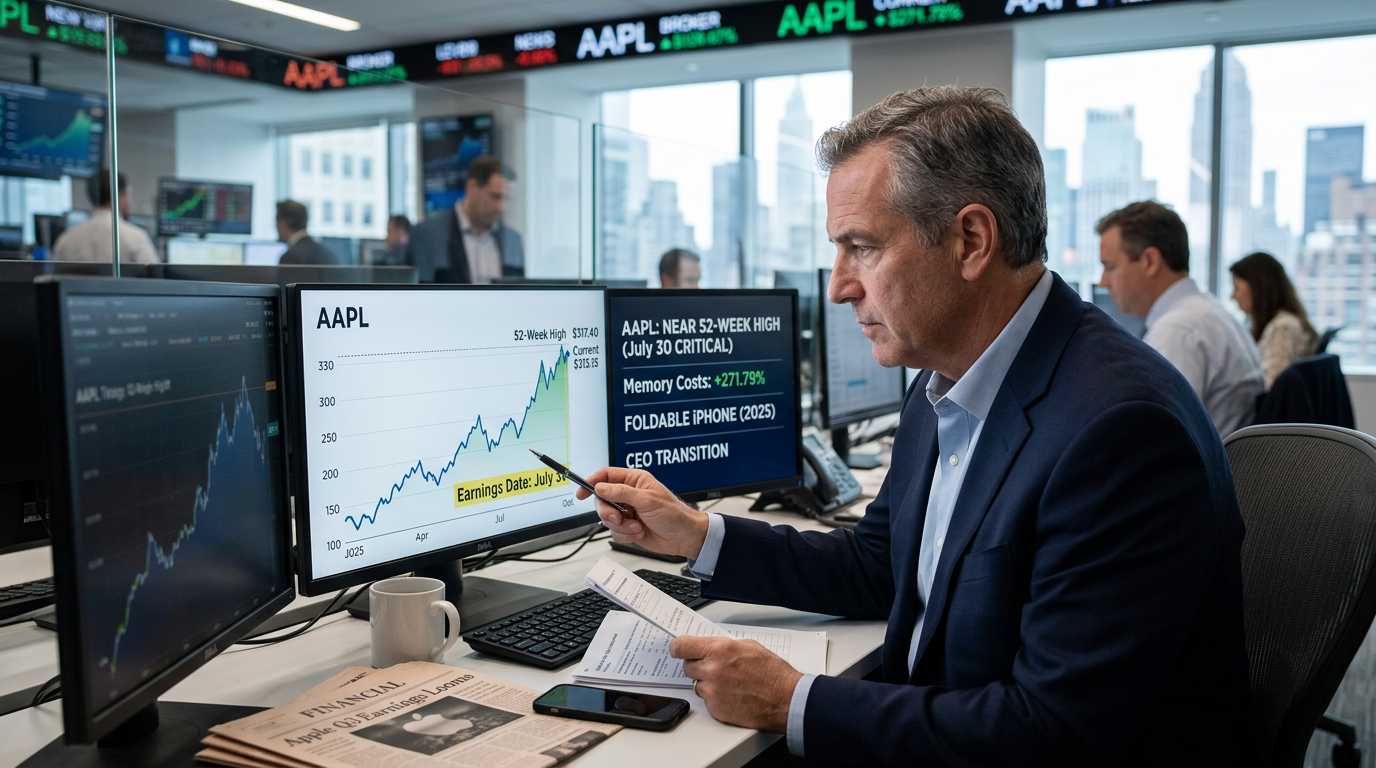
Apple Near Its 52-Week High. July 30 Is What Matters.
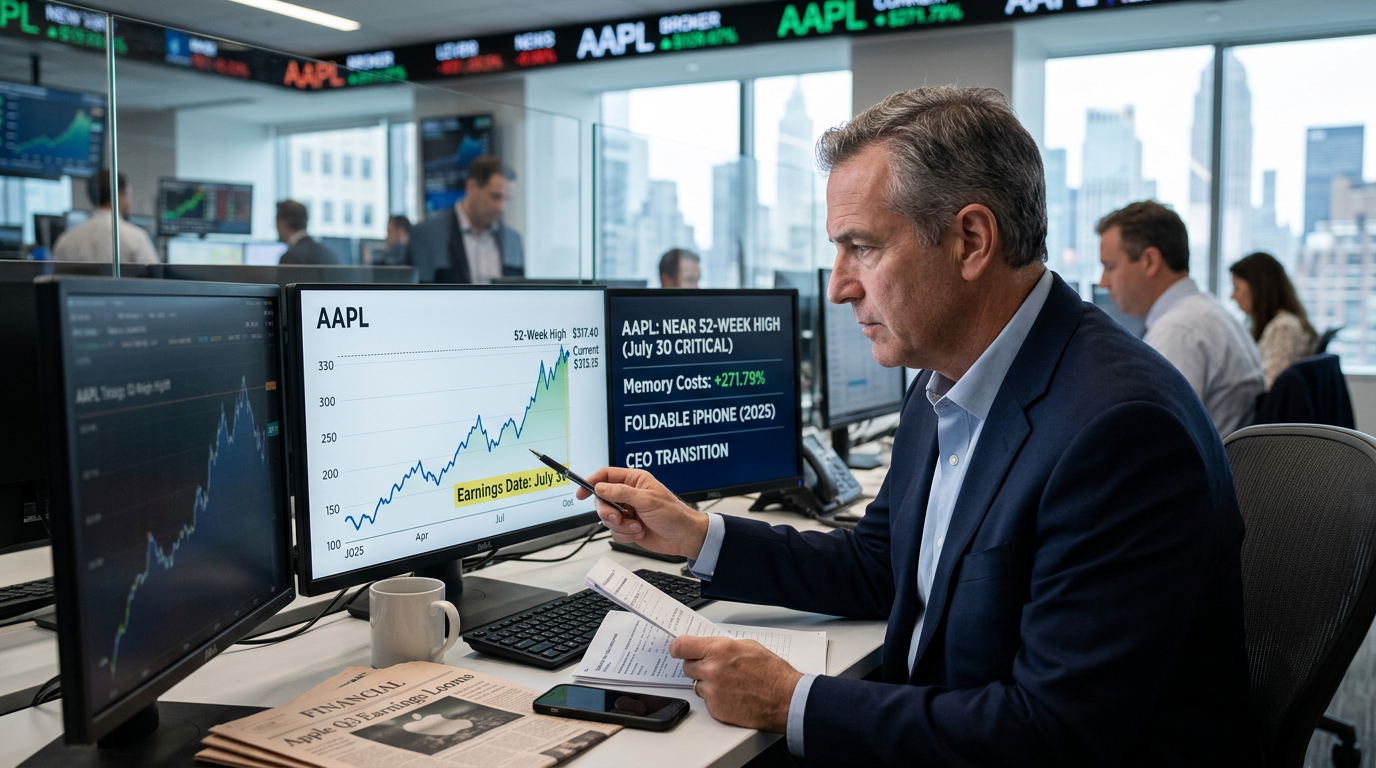
Apple is pressing against its 52-week high. The stock closed at $316.22 on July 9, within striking distance of the $317.40 peak. On the surface it looks like strength. Under the surface, there are three converging stories that make the July 30 earnings date one of the more consequential in recent Apple history.
This is not a simple situation.
The Memory Cost Problem
Start with the least discussed risk. Memory costs for the iPhone 18 Pro have reportedly surged 271.79%. That is not a typo. DRAM contract prices have surged in early 2026, and the AI infrastructure boom has turned what was once a deeply cyclical commodity business into one of the tightest memory markets in years.
Apple CEO Tim Cook called the memory shortage a “hundred-year flood” when the company announced price hikes of up to $300 on some Mac and iPad models in late June. The stock fell about 6% on that news. It has since recovered most of those losses. What changed? Apple disclosed it is in talks to source memory chips from Chinese manufacturers CXMT and YMTC for devices sold inside China. Bloomberg reported the discussions; Apple is lobbying the Trump administration as it seeks U.S. clearance and to limit regulatory blowback.
Mag 7’s relentless assault on Nvidia’s future
Nvidia’s biggest customers are now buying and selling chips to each other. That means, the virtual monopoly that fueled NVDA’s $4 trillion market cap is OVER. If you currently own NVDA, here’s a better alternative. Their competition is scarce, which puts them in a hugely advantageous spot. This supplier’s stock has outperformed Nvidia’s by 50X since July.
Click to get the full details on this urgent “Nvidia alternative” right here.
The market read this as a supply chain workaround. A relief valve. Maybe. But it also introduces political and regulatory risk that did not exist a month ago. Congress previously warned Apple against sourcing from a blacklisted Chinese chipmaker in 2022. YMTC is on the Commerce Department’s Entity List, and CXMT has been flagged on the Pentagon’s Chinese Military Company list. Whether U.S. regulators permit this arrangement or whether the optics alone create political backlash is a genuine uncertainty that sits beneath the current price.
Worth noting: Apple just announced a renewed chip supply agreement with Broadcom worth more than $30 billion through 2031, covering wireless components and custom AI chips. That deal shores up one part of the supply chain. Memory, though, remains the open question.
Management guided gross margins at 47.5% to 48.5% for fiscal Q3. That is down from the 49.3% Apple posted in Q2, and it reflects the early impact of rising component costs. Whether margins held within that range, and what Q4 guidance implies about the memory cost path forward, is the number that moves the stock on July 30.
The Foldable iPhone Situation
This is where it gets interesting. Apple is reportedly preparing multiple new iPhone models for launch between H2 2026 and H1 2027. The centerpiece is the foldable, rumored to carry “iPhone Ultra” branding and a starting price around $2,500, with higher-storage configurations potentially reaching $3,000 according to IDC forecasts. Apple has told suppliers to prepare for roughly 10 million units, up from earlier estimates of 7 to 8 million.
Supply chain analyst Ming-Chi Kuo has suggested a launch that could follow an iPhone X-style playbook: unveiled at the fall event, with constrained initial supply possibly pushing broader availability later in the year. Kuo’s supply chain research pegs Q3 2026 production at only 500,000 to 1 million units, with 7 to 8 million total through H2, short of the 10 million target Apple has communicated to suppliers. The discrepancy is worth watching. A separate report from Chinese outlet Cailian Press, citing Apple supply chain sources, said the device is in mass production and a September delivery window remains on track. So the picture is genuinely mixed.
On the revenue side: JPMorgan, which raised its Apple price target to $345 this week with an Overweight rating, highlighted Apple’s demonstrated ability to maintain demand even as product prices rise. Morgan Stanley has projected that fiscal 2027 iPhone shipments could exceed 250 million units if AI features and the foldable drive demand. For context, Apple’s most recent quarter delivered iPhone revenue of approximately $57 billion, a March-quarter record, on 22% year-over-year growth, out of total revenue of $111.2 billion. Diluted EPS came in at $2.01 versus a $1.95 consensus estimate.
This Is What Modern Warfare Looks Like Now
One operator controlling multiple drones… AI identifying targets in seconds… Technology is rapidly changing the battlefield and creating new opportunities in defense.
This exclusive research highlights five companies at the forefront of this shift and explains why they are gaining attention.
Apple currently sits at roughly a $4.6 trillion market cap, and Nvidia leads the market cap table at around $4.7 to $4.9 trillion as of early July. A strong July 30 report with bullish iPhone guidance could narrow that gap fast. Apple is already being described as closing in on Nvidia for the top spot.
The problem: none of the foldable revenue lands in the Q3 report. July 30 covers April through June. The foldable impact lives in fiscal Q4 and fiscal 2027. So July 30 is really a margin report and a guidance event, not a foldable catalyst. The market already knows this. What the market does not know is where management guides Q4 revenue growth and gross margins in the context of rising memory costs and a new product cycle.
The CEO Transition
This one is underappreciated. The July 30 earnings call will be Tim Cook’s final earnings conference call as CEO. Incoming CEO John Ternus takes over on September 1, 2026. That makes July 30 a legacy call. Cook’s last opportunity to set the tone for the iPhone cycle before handing off the reins. Management teams typically do not miss on their exit.
That does not mean there are no risks. It means expectations management on July 30 will be deliberate.
Valuation and Analyst Positioning
Apple trades at approximately 38 times trailing earnings, per Yahoo Finance data. Wedbush has a $400 price target. The consensus sits near $314 to $315 across major tracking services, roughly in line with where the stock is trading today. That is a real tension: strong fundamental momentum meeting a premium valuation at a technical inflection point.
JPMorgan just raised its target to $345 this week, citing demand elasticity and Apple’s ability to absorb hardware cost increases. Morgan Stanley sits at $330. Goldman Sachs at $340. BofA at $325. Wedbush is the outlier at $400. The bull-bear split is genuine, and it centers almost entirely on whether memory cost pressure is manageable or structural.
Pilots Use One. Smart Traders Should Too.
A pilot never takes off without running a checklist. Not because they don’t know how to fly – because they know that the moment something feels routine is the moment a step gets skipped.
Options trading punishes skipped steps faster than almost anything else. So, I put the 7 that matter most on one page.
It’s called the Smart Trade Options Checklist. Normally $29.97. Free today.
Run it before any options trade. Takes about 30 seconds. You’ll catch the bad ones before they cost you.
Technical Framework
Apple is forming a symmetrical triangle on the 4-hour chart, with resistance near $317.40 and support around the $300 level. RSI has moved toward the 70 range, approaching overbought on shorter timeframes. A clean breakout above $317.40 targets $329 to $340 on the measured move. A close below $300.30 opens the door to a test of the $289.90 level, with the $272.90 area changing the intermediate-term structure entirely.
Volume has been tapering within the triangle. That pattern typically resolves with a directional move rather than continued consolidation. The July 30 catalyst is the obvious resolution event. Implied volatility in AAPL options will likely expand in the two weeks leading into the report as traders position around the earnings.
Scenario Modeling
Bull Case: July 30 delivers Q3 gross margins at or above the high end of guidance (48.5%), Q4 guidance frames the iPhone cycle as margin-neutral or better, and Cook explicitly addresses the memory cost path forward with credible visibility. Stock breaks above $317.40. Foldable production guidance raised toward or above 10 million units adds to the momentum.
Base Case: Q3 lands within the guidance range. Q4 revenue growth guidance of 14% to 17% is maintained. Memory cost pressure is acknowledged but described as manageable. Stock consolidates in the $300 to $317 range into the fall product event. Foldable launch timing and iPhone pricing become the next catalysts.
Bear Case: Q3 gross margins come in at the low end of guidance or miss slightly. Q4 guidance disappoints on margin compression from sustained memory cost inflation. Chinese supplier talks create regulatory headlines. Kuo’s supply chain data on foldable ramp rates, 500K to 1M units in Q3, raises doubts about H2 revenue uplift. Stock breaks below $300, tests $289.90. The premium valuation at 38 times earnings has no cushion for a guidance miss.
Active Trader Strategy Framework
The structure here favors patience over aggression. The stock is pressing a technical resistance zone with overbought indicators on shorter timeframes and a 20-day window before the earnings catalyst. Chasing above $317 ahead of July 30 carries asymmetric risk. Limited additional upside before the report, with meaningful downside if margins disappoint.
The more disciplined approach: define your Q3 earnings positioning in the next week, before implied volatility expands further. Consider the relationship between the stock’s current level and the $317.40 breakout threshold. Understand that July 30 is a margin and guidance event, not a foldable event. Manage expectations accordingly.
Risk management anchors: $317.40 as upper resistance, $300 as near-term support, and $272.90 as the line that changes the intermediate-term structure. Apple’s ecosystem strength, pricing authority, and free cash flow generation are durable. Whether those qualities justify a 38-times multiple in a rising-memory-cost environment, that is what July 30 answers.
Twenty days. A lot can happen. But the data points are unusually clear right now.