

September 9, 2026
Bonus Content: Salesforce’s Predictive Analytics Push Is a Pricing Experiment
Most traders have never noticed the weird market anomaly that happens at 9:35 AM every morning.
They’re too busy with lagging indicators trying to predict the next move… when the market makers have already set the tone for the trading day.
It’s this weird anomaly that points us to the market maker’s key levels above and below.
And by playing the move within that range…
Regular folks like you have been able to reach for $100 or more (on a $1K stake) over 600 times in the last 2 years.
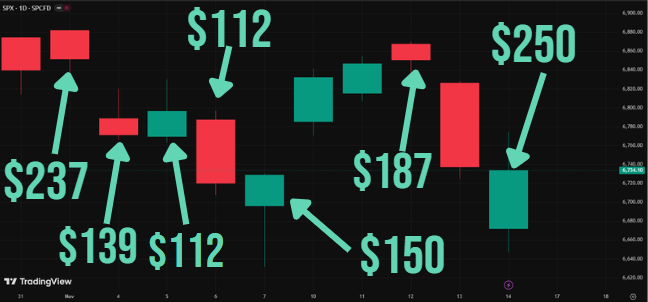
We’ve seen this straightforward approach play out whether the market broke out… broke down… or stayed choppy.
Granted, I can’t make trading guarantees here.
But I’ve opened up the data behind those trades, as well as how you can get in on the very next morning opportunity.
You’ll find the full details right here.
See you in the market.
Chris Pulver
Salesforce’s Predictive Analytics Push Is a Pricing Experiment

Salesforce is not short on AI features. The company has rolled out predictive scoring, conversation intelligence, agentic cadences, and configurable agent workflows across its core CRM platform, and Gartner has taken notice. What institutional investors are debating is not whether the technology works. It is whether Salesforce can charge enough for it to matter.
The mechanics of the current expansion are revealing. The latest enterprise add-ons bundle unmetered Agentforce usage with Salesforce’s full suite of predictive, generative, and agentic AI, along with AI-powered analytics, all under a single per-user fee. By moving Data 360 onto a flex credit model and introducing profile-based SKUs, Salesforce is acknowledging a structural flaw in the traditional consumption-based approach: it forced customers to forecast future use cases and data volumes before they fully understood what they were buying. The new architecture is an attempt to remove that friction and lock customers deeper into the platform.
The revenue signals have been encouraging enough to shift sentiment. Current remaining performance obligation rose 14% year-over-year to about $33.5 billion, implying clients are still willing to spend even while software budgets are being scrutinized. Salesforce has also said Agentforce reached $1.2 billion in annual recurring revenue, up 205% year-over-year. More recently, the company has said Agentforce ARR exceeded $1.5 billion, and full-year revenue guidance rose to a range of $46.1 billion to $46.4 billion.
But the bull case requires more than ARR growth. Salesforce is trying to turn Agentforce into billable digital labor rather than just another AI feature, and if consumption revenue grows faster than software seats disappear while inference costs remain controlled, it could open a much larger growth market tied directly to corporate labor spending. That is an elegant thesis and a fragile one. Inference costs have not remained controlled across the industry, and every new predictive feature added to the core platform raises the question of whether customers will pay incremental dollars or simply treat it as table stakes bundled into existing contracts.
By unmetering Tableau analytics and consolidating credits, Salesforce is trying to drive additional stickiness and value at the analytics layer, where switching costs and data gravity are highest. That is the real strategic logic: not the feature itself, but the lock-in it creates. Zero-copy partnerships with Snowflake and Databricks further cement Data 360’s role as an activation layer, though the window to establish it as the default is closing as AI-native competitors target mid-market buyers with simpler models.
The honest read is that Salesforce’s predictive analytics integration is less a product story than a monetization test. If enterprise buyers accept the bundled pricing at scale, the operating leverage follows. If they push back, the ARR growth will stall before it reaches margins. Backlog is holding and AI traction is showing up, but investors still want proof that agents lift growth and margins, not just costs. That proof has not fully arrived.
Stocks to Watch
- Salesforce (CRM): The core question for the next two quarters is whether predictive analytics add-ons expand revenue per seat or get absorbed into existing enterprise deals with no incremental pricing power.
- Snowflake (SNOW): Salesforce’s zero-copy partnership makes Snowflake a quiet beneficiary if Data 360 adoption scales, as more enterprise data gravity flows through the integration.
- Microsoft (MSFT): Dynamics 365 and Copilot compete directly in the analytics layer. If Salesforce’s bundling strategy fails to hold pricing, Microsoft is the most likely alternative absorbing displaced budget.