
August 10, 2026
Abel Is Spending. Burry Is Not Impressed.
First a note from America’s Gold Co
Central Banks Are Quietly Walking Away From the Dollar.
What Does That Mean for Your Retirement Savings?
Dear Reader,
Something unusual is happening inside the world’s most powerful financial institutions.
And almost nobody on the evening news is talking about it.
According to a survey reported by CNN this summer, more central banks now plan to reduce their U.S. dollar holdings over the next decade than increase them.
And what are they buying instead?
Gold.
The same survey found a record number of central banks planning to expand their gold reserves in the years ahead.
Stop and think about what that means.
The institutions that create paper money for a living…
The institutions that understand currency better than anyone on earth…
Are trading dollars for the one asset that cannot be printed.
The headlines are getting harder to ignore:
The Guardian reported in January that central banks are scrambling for gold because, in the words of its own reporting, the dollar is losing credibility.
Goldman Sachs analysts, cited by Yahoo Finance, describe gold as a hedge against currency debasement.
And Reuters has repeatedly noted that when confidence wavers and the dollar softens, money tends to flow into gold.
This is not a fringe theory anymore.
This is the quiet consensus forming among the people who manage entire nations’ wealth.
Now here is why this matters to you.
If you have spent decades building your savings in an IRA, 401(k), TSP, or 403(b), nearly every dollar of it depends on one thing: the purchasing power of the U.S. dollar.
A currency does not have to collapse overnight to hurt your retirement. It only has to keep buying a little less, year after year, while you hold it.
Gold makes no promises.
It has no printing press.
It has no deficit.
And it has historically served as a store of value through periods of inflation, currency stress, and political uncertainty.
That is exactly why America’s Gold Company created a FREE Precious Metals Retirement Guide that shows how everyday Americans may be able to protect a portion of their retirement savings with physical gold and silver, the same asset the world’s central banks are stacking right now.
→ Click here to request your FREE Precious Metals Retirement Guide.
Inside your free guide, you will discover:
- ✔ Why central banks are shifting reserves out of dollars and into gold, and what it may signal for the savings you hold.
- ✔ How gold has historically responded during periods of inflation and weakening currency confidence.
- ✔ How a Gold IRA generally works, and how you may be eligible to move a portion of an existing IRA, 401(k), TSP, or 403(b) into physical metals.
- ✔ How physical metals can help diversify savings outside the paper system.
- ✔ A simple, conservative way to get started.
Here is the uncomfortable truth.
By the time a currency story is on the front page, the institutions have already moved.
The central banks are moving now. Quietly. Steadily. Deliberately.
The only question is whether you will see the signal before the rest of the country does.
→ Request your FREE Precious Metals Retirement Guide now.
Or speak with a precious metals specialist today at {phone number}.
To your financial security,
America’s Gold Company
P.S. The central banks that print the world’s currencies are choosing gold with their own reserves. Your free guide explains what that shift may mean for your retirement, and how to request yours takes less than a minute. Get your free guide here.
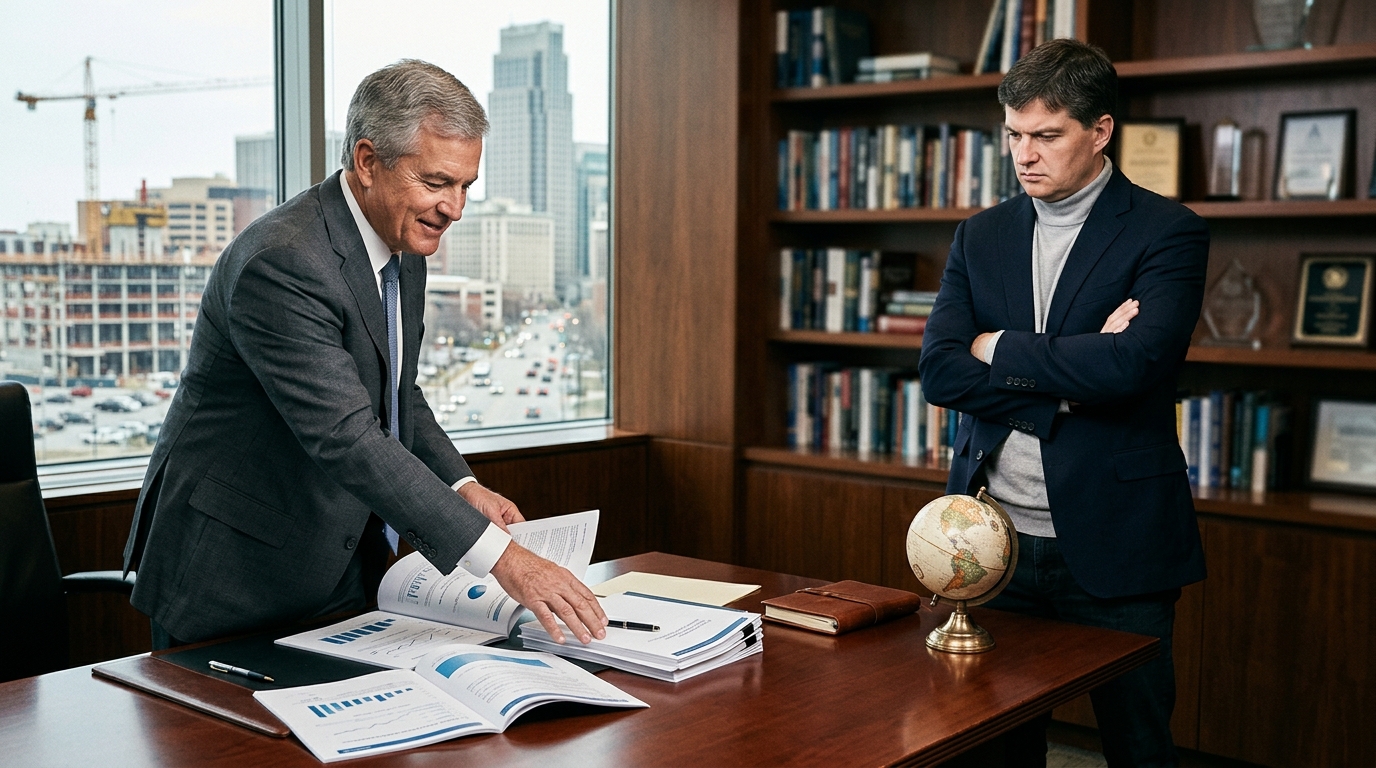
Abel Is Spending. Burry Is Not Impressed.
Michael Burry said it plainly on August 9, 2026. He no longer finds Berkshire Hathaway an attractive investment. The reason isn’t complicated, but the debate it opens is.
The Big Question
Greg Abel has now spent seven months in the CEO chair. He has flipped Berkshire from a net seller of equities across 14 consecutive quarters into a net buyer, deploying roughly $20 billion in net equity purchases and about $4.5 billion in buybacks in a single quarter. The cash pile, which stood at $397.4 billion at the end of March 2026, fell to $365.5 billion by June 30. That is the first sequential decline in several years.
So the capital is moving. The investment committee question is whether it should be.
Why Wall Street Cares
Berkshire has always been, at its core, a capital allocation vehicle. The operating businesses, spanning insurance, railroads, energy, manufacturing, and retail, generate cash. Omaha decides where that cash goes. That decision is the whole game.
For decades, the market priced in a premium for Buffett’s judgment. Institutional holders bought BRK.B not just for the earnings stream but for the optionality embedded in several hundred billion dollars of dry powder held by the most celebrated allocator in history. That optionality was worth something. The question Burry is now raising, and the one portfolio managers are genuinely debating, is what it is worth under Abel.
The stock’s performance so far is a data point, not a verdict. Berkshire shares are up modestly in 2026, while the S&P 500 is up by a double-digit percentage. That gap matters because Berkshire’s size means it cannot outperform the index through stock-picking the way a smaller fund can. The premium it commands has to come from somewhere else: timing, pricing discipline, or operational leverage. Right now, none of those is working in its favor.
The Bull Case
The bull argument starts with the operating businesses, and it is more credible than the stock price suggests.
Q2 operating earnings rose 16% to $12.98 billion. Manufacturing, service, and retailing jumped 24% to $4.47 billion. Berkshire Hathaway Energy surged 27% to $891 million. BNSF, the railroad, posted a 6% gain to $1.56 billion. These are not flattered numbers. Strip out the foreign exchange tailwind and the non-insurance businesses still grew operating earnings nearly 18% year-over-year.
The Alphabet position is the most instructive Abel move so far. A $10 billion stake, initiated with Buffett’s blessing, that vaulted the Google parent into Berkshire’s top five holdings alongside Apple, American Express, Bank of America, and Coca-Cola. It is the first explicitly technology-scale bet in Berkshire’s equity portfolio in years, and it signals something about how Abel thinks differently from the man he replaced.
The Taylor Morrison acquisition, a $6.8 billion homebuilder deal closed on July 24, adds a cyclical consumer angle that Buffett historically avoided. Together, these moves suggest Abel is not afraid to stretch the mandate.
“Something Worse Than a Crash is Coming October 27th”
The man who announced “historic volatility is coming” 3 months before the 2025 crash and rally has a new prediction. He now says he’s not predicting another tariff crash – a recession – or anything of the kind. Instead, he has a far more peculiar warning for the rest of 2026.
Click here for his full blueprint and 5 free recommendations.
The Bear Case
Burry’s critique lands on a specific point. He warned for years that the biggest risk to Berkshire post-Buffett was a successor who lacked the patience for what Buffett called the fat pitch: the rare, mispriced opportunity that justifies committing billions. Burry wrote that he feared the successor would be “too old and otherwise not Warren” and would lack that patience. He now believes the fear has materialized.
His evidence is the deployment itself. The roughly $20 billion in net equity purchases came in Q2, a period when the S&P 500 was near record levels. Berkshire is buying into an “ebullient market,” as Paul Lountzis of Lountzis Asset Management told the Wall Street Journal, calling public markets “kind of silly” right now. Burry’s own characterization of Abel’s moves as “framing moves rather than investment moves” is the sharpest part of his argument: he is suggesting Abel is proving he can deploy capital, not that he is deploying it wisely.
The insurance segment adds texture to the bear case. GEICO’s pre-tax underwriting income fell sharply year-over-year in Q2. Private passenger auto claims frequencies climbed for bodily injury coverage and for property damage. The insurance float, historically Berkshire’s cheapest source of capital, is under structural pressure as the auto insurance market softens. Abel flagged at the annual meeting that the business is “becoming a more challenging environment” with more capital flowing into the industry. Insurance headwinds are likely to keep full-year operating earnings growth at low to mid-single digits, according to Glenview Trust analysts.
The Evidence
There is a legitimate case that both sides are talking past each other.
The bulls are right that the underlying businesses are healthy. The bears are right that the market premium Berkshire commands historically reflected Buffett’s capital allocation reputation, not just the earnings power of BNSF and GEICO. Those are two different things, and conflating them leads to a muddled investment thesis either way.
The Alphabet investment is the clearest test case. Berkshire paid roughly $10 billion for a position in a company that was already widely held by institutional investors and trading at a premium to its five-year average. That is not a classic Buffett move, which typically involved buying quality businesses at prices nobody else wanted to pay. Whether it is an Abel move worth respecting will depend on what Alphabet does over the next three years, not the next three months.
The Taylor Morrison deal is more interesting from a timing perspective. Abel closed it just as the housing market remained structurally supply-constrained, with mortgage rates elevated enough to suppress existing-home turnover. A homebuilder with a strong land position could benefit meaningfully if rates fall. That is a macro bet embedded in what looks like a straightforward acquisition, and it may reflect more sophistication than Burry is crediting.
The Mavens’ View
The institutional debate is not really about whether Abel is a good manager. By most accounts he is. The debate is about whether Berkshire’s valuation, which has historically included a premium for Buffett’s capital allocation genius, can hold without him.
Burry’s argument is that the premium should compress. The stock has been telling that story in 2026, lagging the index while the operating businesses continue to perform. That divergence is unusual. In past years, a 16% operating earnings gain would have been a tailwind for BRK. This year, it has barely moved the needle.
The more sophisticated version of the bear case is not that Abel is incompetent. It is that Berkshire, with cash and short-term Treasury bills of $365.5 billion, faces a structural problem that no CEO can fully solve: the law of large numbers. The universe of investments that can move the needle on Berkshire’s portfolio is small, and the market conditions that would allow those investments to be made at distressed prices come rarely. Buffett had the discipline to wait. Abel is being tested on whether he has the same, or whether the pressure to show action will produce a decade of mediocre capital allocation dressed up as progress.
What Investors Are Missing
The debate over Abel’s capital allocation is real, but it may be obscuring the most important variable: Berkshire’s insurance float.
The float, the pool of premiums collected but not yet paid out as claims, stood at approximately $176.9 billion as of March 31, 2026. That capital costs Berkshire close to nothing as long as underwriting is profitable. It is the engine that makes every other part of the machine cheaper to run. But GEICO is losing ground. Progressive grew personal auto policies in force by 11% in Q1 2026, while GEICO said its policies in force rose 2%. If that gap persists, Berkshire’s float growth stalls, and the cost of capital advantage that made Buffett’s returns look superhuman quietly erodes.
Nobody in the Abel-versus-Burry debate is talking about this. The focus is on whether roughly $20 billion in Q2 net equity purchases was too aggressive or not aggressive enough. The more consequential question is whether GEICO can compete with a telematics-first rival that is structurally outgrowing it in a market that rewards pricing precision and data infrastructure. That is an operational problem, not a capital allocation one, and it is the part of the Berkshire story that deserves more attention from professional investors right now.
Stocks to Watch
- Berkshire Hathaway (BRK.B): The central debate. Operating businesses are performing. Capital allocation is unproven under Abel. The insurance float question is underappreciated. With Berkshire lagging the S&P 500 so far in 2026, the market is already expressing skepticism. Whether that gap narrows depends less on the next quarter’s earnings and more on whether Abel makes a genuinely contrarian, large-scale bet before the next market dislocation.
- Progressive (PGR): The GEICO counter-trade. Progressive is the direct beneficiary of GEICO’s competitive struggles. Its 11% personal auto policy growth versus GEICO’s 2% in Q1 tells you which insurer’s data and pricing architecture is winning right now. If the insurance market softens as Abel warned, Progressive’s underwriting discipline gives it more room to gain share.
- Alphabet (GOOG): Now a top-five Berkshire holding after a $10 billion commitment. Abel and Buffett explicitly tied the investment to AI infrastructure. The stock’s performance over the next 18 months is effectively a real-time report card on whether Abel’s first major portfolio pivot was timed well or bought into euphoria.
- Taylor Morrison Home (TMHC): Delisted August 3 after the Berkshire acquisition closed July 24. The deal is now fully inside Berkshire, so the play is indirect. But investors who want to assess Abel’s homebuilder thesis have proxies in Lennar and D.R. Horton, both of which operate in the same supply-constrained market Abel is betting on.