
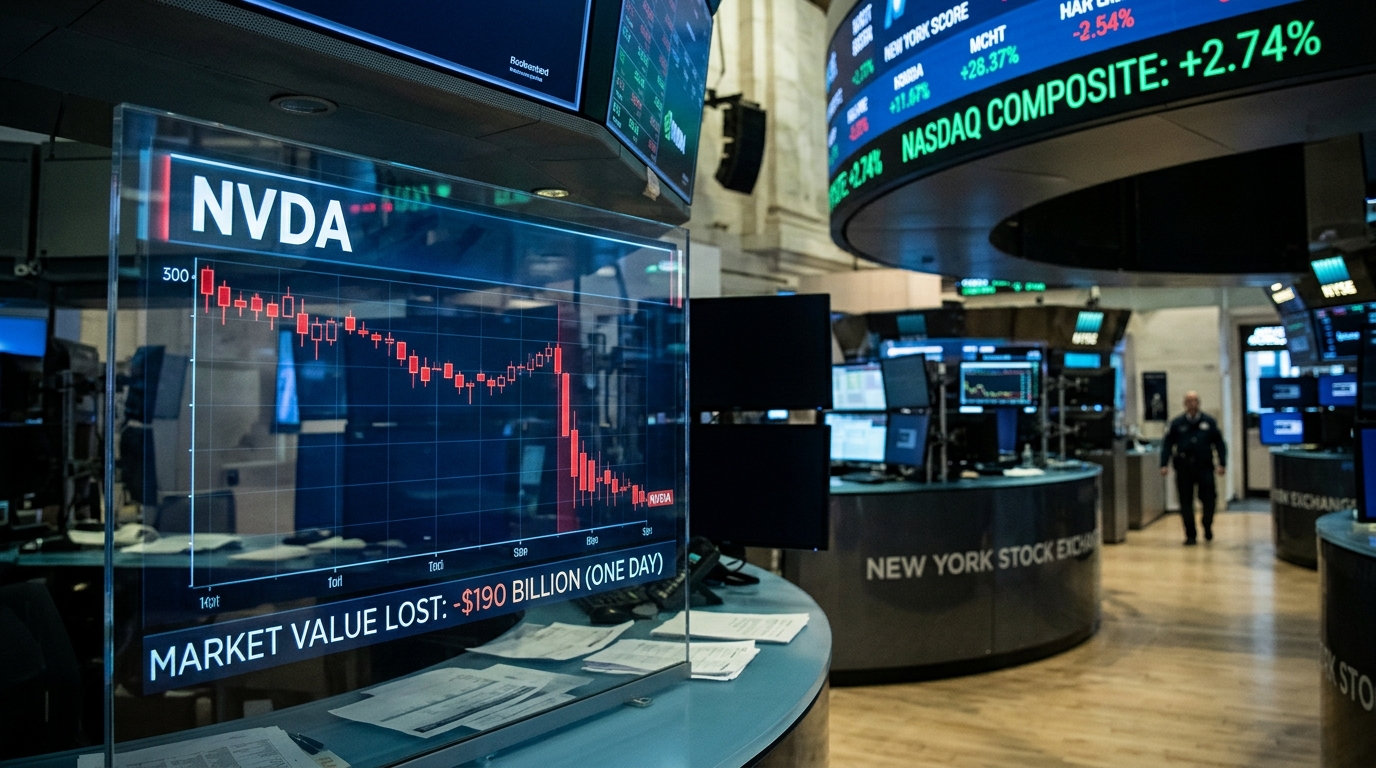
When Nvidia fell 4.3% on Monday while the Nasdaq rose 2.74%, the market did something portfolio managers rarely get the chance to observe: it isolated, in a single session, the value of one person. The chipmaker shed roughly $190 billion in market value not because a chip order was cancelled, not because a hyperscaler flinched, but because the legal and reputational exposure around Jensen Huang personally widened by several degrees in a single afternoon.
That divergence is the number every institutional investor is now working with. Nvidia’s business did not change Monday. Its backlog did not change. Its competitive position in AI silicon did not change. What changed is the probability distribution around the man at the top, and the market adjusted accordingly.
What Happened
President Trump said Monday that the FBI is investigating Nvidia CEO Jensen Huang’s affair with a woman who, according to reporting by The New York Times, U.S. intelligence determined was gathering information for China. The inquiry follows Huang’s public acknowledgment of an intimate relationship with a business executive named Alice Huang. Reporting has identified Alice Huang as a former executive at Singapore-based data centre company Megaspeed, and said U.S. officials believed she was feeding information to Beijing.
Nvidia and Jensen Huang now face a shareholder class action lawsuit alleging they misled investors by failing to disclose Huang’s alleged relationship with the former Megaspeed executive. The complaint, filed with the US District Court for the Northern District of California, accuses Nvidia and Huang of violating provisions of the Securities Exchange Act of 1934, covering investors who purchased Nvidia securities between October 9, 2025, and November 8, 2026. On the Senate side, Senator Chris Coons called for scrutiny of the reporting, saying he is pushing to investigate whether U.S. national security was compromised.
The Valuation Question
Nvidia’s board has been unequivocal: it has “no reason to believe” that either national security or NVIDIA secrets were compromised by Jensen Huang’s relationship with Alice Huang. The company has said Huang is committed to continuing to lead NVIDIA as CEO without interruption. Trump offered public backing, saying Huang told him he had no idea she was a spy, and that he believed him.
None of that stopped the stock from plunging as much as 9% intraday before recovering to close down 4.3%. The question for asset managers is not whether Huang did anything wrong. It is how much of Nvidia’s multiple is a Jensen premium, and what happens to that premium under three distinct scenarios: he remains CEO with investigations concluded quickly; he remains CEO with proceedings dragging into 2027; or the board determines, under sustained political and legal pressure, that a transition is necessary.
The involuntary beneficiary question is already live. AMD’s data center revenue has been growing fast enough to absorb redirected hyperscaler procurement.
The investigation will cast a shadow over Nvidia’s share price as investors question whether Huang will remain at the helm of the company he helped found, as one analyst noted Sunday. That framing understates the issue. Huang is not merely a figurehead. He is the product roadmap, the enterprise sales relationship, and the government affairs operation, all condensed into one figure in a leather jacket.
The Timing Problem
Nvidia is confirmed to report earnings on November 17, 2026, after the market closes. Seven days. The consensus earnings estimate stands at $2.49 per share, and the stock has had a post-earnings announcement drift of -16.3% since its last report on August 26, 2026. That drift predates Monday’s controversy entirely. Now, analysts face the unusual task of separating operational results from a CEO risk discount that did not exist three weeks ago.
The earnings call itself is the immediate flashpoint. If Huang appears, investors will be listening for tone, composure, and whether the board’s confidence survives scrutiny. If the company limits his remarks or pulls him from the call, that becomes its own signal.
What Investors Are Missing
The debate consuming the market is binary: Huang stays or Huang goes. That framing misses a slower-moving risk. It remains unclear whether Alice Huang obtained sensitive information from Jensen Huang, with experts noting that he and his devices may have been in possession of valuable trade secrets about upcoming Nvidia chips, the company’s research strategies, or other sensitive US information. If a congressional investigation surfaces any evidence of information exposure, the conversation shifts from CEO tenure to export controls, government contracts, and Nvidia’s ability to operate as a trusted national security vendor. That is a much larger addressable risk than one man’s employment status.
Stocks to Watch
- Nvidia (NVDA): The center of everything. The earnings call on November 17 is now a dual-purpose event: financial results and the first extended public platform for Huang since the admission.
- AMD (AMD): Any sustained Jensen discount is an involuntary opportunity for Nvidia’s closest AI chip competitor. Hyperscalers that have been building AMD redundancy into their procurement now have a political reason to accelerate it.
- Broadcom (AVGO): Custom silicon work for the hyperscalers moves faster when the dominant supplier faces governance uncertainty. Watch whether Broadcom’s custom ASIC pipeline commentary changes in tone.
- Palantir (PLTR): Government AI contracts require trusted vendors. If Nvidia’s national security positioning weakens, the beneficiaries are companies whose entire brand is built on US government credibility.