August 9, 2026
The Collateral Is the Bet
Featured: The Collateral Is the Bet
Wall Street just got a warning about the AI trade.
Nvidia’s credit default swaps saw their biggest one-day jump on record, with the company losing $250 billion in market value.
Investors are starting to realize that AI needs more than chips.
It needs real human data.
That’s where Mode Mobile has quietly built its edge.
Mode’s EarnOS rewards users for everyday smartphone activity, creating a vast ecosystem of opted-in, first-party data with applications across advertising, commerce, and AI.
While others build AI infrastructure, Mode is building the data layer that powers it.
Their traction is hard to ignore:
- 490M+ total users
- 100M+ monthly active users
- $115M+ cumulative revenue
- $100M+ invested
Deloitte named Mode the #1 fastest-growing software company in North America after 32,481% 3-year revenue growth in 2023.
And pre-IPO shares are still available at $0.52, but only until August 14th.
🚨 Secure your shares at $0.52 before terms change on 8/14.
The Collateral Is the Bet
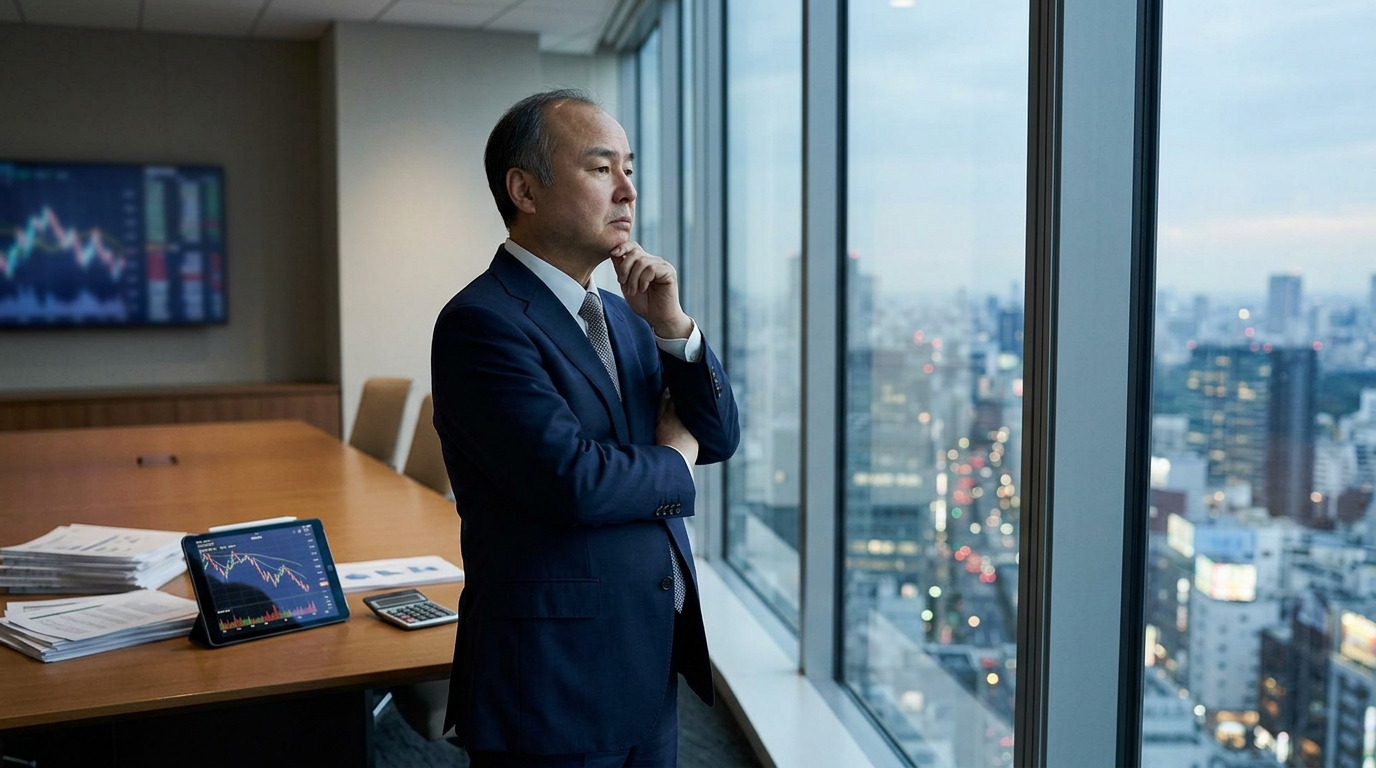
There is a sentence in SoftBank’s August 6 financial filing that deserves more attention than it received: SoftBank itself is the guarantor of the $10 billion margin loan it secured against its stake in OpenAI. Not a subsidiary. Not a special-purpose vehicle. The parent company. That one clause transforms what might read as a confident financing move into something considerably more consequential for investors trying to assess the real risk in this capital structure.
The question institutional investors are debating is not whether Masayoshi Son is right about AI. He may well be. The question is whether the financial scaffolding around his conviction can remain standing until the assets inside it become tradable. That is a timing question, not a valuation question. And timing questions have hard calendar answers.
The Big Question
Can SoftBank’s debt structure survive the gap between when its liabilities come due and when its largest private asset goes public?
That gap is the central investment debate surrounding SFTBY right now. On one side: Son has managed worse, the portfolio is generating record net asset values, and Wall Street’s biggest banks are still extending credit. On the other: the $40 billion bridge facility that funds SoftBank’s OpenAI commitments matures March 25, 2027, OpenAI’s own CFO has told colleagues the IPO is a 2027 event, and the company whose shares back the new $10 billion loan cannot be sold on any exchange today. The mismatch between those two timelines is the entire trade.
Why Wall Street Cares
SoftBank is the single largest publicly traded vehicle for exposure to private AI assets. Its Q1 FY2026 earnings — reported August 6 alongside the loan disclosure — showed a record net asset value of 72.3 trillion yen ($445.2 billion) as of June 30, driven primarily by Arm Holdings gains. Net income came in at 347.3 billion yen, well above consensus estimates. On paper, that looks like strength.
Two details puncture the headline. First, the record NAV had already contracted to a pro forma 58.3 trillion yen by August 5, as Arm’s share price retreated from June highs. A 14 trillion yen NAV swing in five weeks illustrates the structural fragility: Arm Holdings is simultaneously the collateral underpinning SoftBank’s secured financing and the single largest input into its asset value calculation. Second, SoftBank’s shares fell 4.41% on the day of the earnings presentation. A beat that sends the stock lower is the market’s way of saying the financing mechanics matter more than the quarterly profit figure right now.
Professional investors have watched Arm fall 34% in July alone on the broader AI semiconductor selloff, then recover sharply after its July 29 earnings beat, which showed record quarterly revenue of $1.289 billion, up 22% year over year, with data-center royalties doubling. The volatility is the point. A stock that swings 34% in a month while serving as collateral for a $20 billion margin loan facility is not a stable foundation for a leveraged capital structure. It is the reason portfolio managers are asking hard questions about the sequencing of events between now and March 2027.
The Bull Case
The strongest version of the bull case rests on three pillars.
First, the LTV picture is better than the headlines suggest. SoftBank disclosed a loan-to-value ratio of 13% as of the reporting date, well below its self-imposed 25% policy ceiling. Cash on hand of 2.3 trillion yen covers more than two years of expected bond redemptions. The company has navigated credit market scrutiny before and currently holds the backing of five major financial institutions — Goldman Sachs, JPMorgan Chase, Mizuho, Apollo Global Funding, and Sumitomo Mitsui — who agreed to extend $10 billion against an illiquid private stake. That is not trivial validation.
Second, Arm’s fundamental trajectory is intact. Fiscal year 2026 full-year revenue reached $4.92 billion, up 22.79% year over year. The company’s AGI CPU, released in March 2026 and targeting data-center and AI workloads, has accumulated a $2 billion order book for FY2027 and FY2028. The Armv9 architecture transition is lifting royalty rates per chip, expanding gross margins, and positioning Arm as a structural beneficiary of data-center AI spending — exactly the environment Son is betting on. If Arm holds above its post-earnings recovery levels near $280, the secured financing cushion is comfortable.
Third, an OpenAI IPO at or near the $1 trillion valuation that CEO Sam Altman has insisted upon would convert SoftBank’s SVF2-marked stake into tradable equity. That single event clears the collateral problem, simplifies the March 2027 bridge refinancing, and provides a liquidity unlock that would compress the conglomerate discount embedded in SFTBY. Fifteen of twenty sell-side analysts polled by LSEG carried buy or strong buy ratings on SoftBank stock as of August. The consensus is that Son gets there.
The Bear Case
The bear case is not a prediction that AI fails. It is a prediction that the timing goes wrong.
OpenAI filed its confidential S-1 with the SEC on June 8, 2026. Goldman Sachs and Morgan Stanley are leading both that deal and Anthropic’s concurrent offering. But OpenAI held no pre-IPO investor meetings through late June, and by mid-summer, sources cited by the New York Times reported the company was leaning toward a 2027 debut. OpenAI’s CFO Sarah Friar had internally expressed concern about the company’s spending trajectory and its readiness for public-company reporting standards, and had been pushing for 2027 since at least early May. Altman’s position is that any valuation below $1 trillion is unacceptable. Advisers warned that SpaceX’s post-IPO volatility had made retail demand for a comparably priced offering uncertain. An independent forecast model moved its median OpenAI first trading day to July 15, 2027.
That timeline mismatch is the bear case in one sentence: the $40 billion bridge matures March 25, 2027, and the IPO most likely arrives after it. The gap between those two dates is where refinancing risk lives. SoftBank would need to roll the bridge, sell assets, or draw on other credit facilities before OpenAI’s market debut provides a natural exit. Each of those options is available in theory. None is cost-free.
The second element of the bear case involves the corporate guarantee. When negotiations for the $10 billion OpenAI-backed loan began in spring 2026, lenders grew uncomfortable about pricing a liquidation value for shares that cannot be sold on any exchange. By mid-year, the loan had been trimmed from $10 billion to roughly $6 billion. Son restored the full amount in July by adding a corporate guarantee from SoftBank Group itself. That concession was necessary to close the loan. It also eliminated the theoretical separation between SoftBank’s balance sheet and OpenAI’s valuation risk. If OpenAI’s implied valuation deteriorates materially, lenders have a claim against the parent company’s broader assets, not just the OpenAI position. The loan also includes explicit provisions for early repayment if OpenAI’s preferred share value declines substantially.
The Evidence
The financing stack in full context: SoftBank’s planned total investment in OpenAI is expected to reach approximately $65 billion by October 2026, funded in tranches. The $40 billion bridge facility arranged in March 2026 added 21 new lenders in a July syndication phase, maturing March 25, 2027. The $10 billion OpenAI-backed margin loan closes this month, two-year duration. A separate $20 billion margin loan facility is secured against Arm Holdings. The company’s own reported LTV of 13% sits comfortably below its 25% policy ceiling, though S&P Global Ratings uses a methodology incorporating margin loans and other adjustments that produces a higher figure. The gap between those two numbers is itself a variable investors should monitor.
The Q1 profit composition adds a layer of context. Net income of 347.3 billion yen beat consensus of approximately 120 billion yen, but the driver was a 1.3 trillion yen gain in the investment portfolio, largely attributable to Intel and ByteDance fair-value moves. OpenAI contributed no recorded gain or loss. Intel’s contribution to a quarter’s earnings headline is not what lenders, credit analysts, or portfolio managers are watching when they assess SoftBank’s structural health. It is a reminder that reported profit can diverge meaningfully from the underlying liquidity and leverage story.
On Arm specifically: the stock peaked at an all-time closing high of $439.46 on June 18, dropped roughly 34% in July on the broader semiconductor selloff, then recovered above $280 after the July 29 earnings beat showed record quarterly revenue and data-center royalties doubling. That recovery matters for SoftBank’s near-term collateral position. The oscillation matters for anyone modeling what happens if the same pattern repeats before the March 2027 bridge comes due.
The Mavens’ View
The investment community’s read divides along a single axis: how much weight to assign to sequencing risk versus asset-quality confidence.
The majority view, reflected in the analyst consensus, treats SoftBank as an AI infrastructure vehicle with a temporarily elevated financing cost. The logic: Son has managed tighter situations, Arm’s fundamentals are strong, and the OpenAI IPO will eventually arrive. The conglomerate discount will compress once private assets find public reference prices. Buy the dip in SFTBY and wait for the liquidity events to validate the NAV.
The minority view, reflected in SFTBY’s 4.41% decline on earnings day and the cautious positioning in options markets, treats sequencing risk as underpriced. The logic: the corporate guarantee on the OpenAI loan is not a technical detail. Arm’s July collapse to $199 before recovering showed how quickly NAV can erode and how directly that feeds into the secured financing picture. OpenAI’s own CFO has pushed for 2027, which means the liquidity event lenders and models are counting on may not arrive before the bridge maturity. In that scenario, Son needs to find alternative liquidity under time pressure — a situation that has historically produced unfavorable asset sales.
Both views have internal logic. The practical implication is that SFTBY’s range of outcomes over the next six months is wider than its current implied volatility reflects.
What Investors Are Missing
Most commentary on SoftBank’s situation focuses on whether OpenAI is worth its private-market valuation. That is the wrong question for the current investment period. OpenAI’s fundamental value is not what resolves the March 2027 bridge maturity. Liquidity timing is what resolves it.
The overlooked implication is Arm’s dual role in this structure. Professional investors typically model Arm Holdings as a portfolio asset contributing to SoftBank’s NAV. That framing understates Arm’s function. Arm is simultaneously the NAV driver, the collateral backing a $20 billion margin loan facility, and the primary variable determining whether SoftBank’s LTV stays below its policy ceiling as the bridge maturity approaches. When Arm fell from $439 to $199 in six weeks, it was not a NAV event in isolation. It was a collateral event, a credit metric event, and a refinancing-options event simultaneously. All three channels tightened at once. The July 29 earnings recovery reversed much of that pressure, but the sequence demonstrated the mechanism investors need to internalize.
The second overlooked factor is the competitive context for the OpenAI IPO itself. OpenAI is filing alongside Anthropic, which confidentially submitted its S-1 on June 1, 2026, and was valued at $965 billion after its June 2026 funding round. Goldman Sachs and Morgan Stanley are bookrunning both deals. Two AI mega-cap IPOs competing for institutional allocations in a volatile public market, both expecting valuations near or above $1 trillion, create a supply dynamic that advisers are already flagging. Retail demand softened after SpaceX’s post-IPO decline, and the window for both deals to price cleanly in the same quarter is narrow. Any competition for the same investor dollar introduces further delay risk into OpenAI’s timing, which feeds directly back into SoftBank’s refinancing calculus.
Stocks to Watch
SoftBank Group ADR (SFTBY). The direct vehicle for this debate, but it packages the AI thesis with the full leverage stack. The conglomerate discount is real and persistent; closing it requires the IPO liquidity events the bull case depends on. SFTBY is appropriate for investors who want the full risk-reward, including the binary character of the March 2027 event horizon. Position sizing should be calibrated accordingly. The stock’s inability to sustain gains on a record NAV and earnings beat is a signal about how institutional money is currently positioned.
Arm Holdings (ARM). The most important single variable in SoftBank’s capital structure, and also a standalone investment on its own merits. Full fiscal year 2026 revenue of $4.92 billion, up 22.79% year over year. AGI CPU order book of $2 billion for FY2027-28. Data-center royalties doubled in the most recent quarter. The 34% drawdown in July followed by the post-earnings recovery illustrates both the upside in the fundamental business and the valuation sensitivity risk. For investors who want SoftBank’s AI semiconductor exposure without the holding company’s leverage, ARM is the cleaner entry. The $280 level is the near-term reference: sustained trading above it supports SoftBank’s collateral picture; a break below it reopens the credit stress scenario.
Goldman Sachs (GS) and JPMorgan Chase (JPM). Both are mandated lead arrangers on the $10 billion OpenAI margin loan and are bookrunners on the OpenAI IPO. That dual positioning — lender to SoftBank and underwriter of the asset backing the loan — creates a structural incentive alignment around a timely OpenAI public offering. If the IPO prices well, both banks collect underwriting fees and resolve a credit exposure simultaneously. Neither stock is a pure play on this situation, but the IPO timeline is now a meaningful variable for both institutions’ fee revenue in the next two to four quarters.
Oracle (ORCL). SoftBank’s co-partner in the Stargate AI infrastructure initiative, alongside OpenAI. Oracle’s data-center buildout is directly tied to the same AI infrastructure spending wave Son is funding. A Stargate that executes on schedule is an Oracle revenue catalyst. The interconnection between Son’s capital commitments and Oracle’s infrastructure pipeline makes ORCL a second-order way to track the same AI infrastructure conviction without the SoftBank leverage overlay.
Scenario Modeling
Bull Case
OpenAI prices its IPO in Q4 2026 at a valuation close to $1 trillion. SoftBank’s stake converts to tradable equity before the March 2027 bridge matures. Arm holds above $280, keeping the $20 billion margin facility well within its covenants. The bridge is refinanced cleanly or repaid from OpenAI proceeds. The conglomerate discount narrows as private assets gain public reference prices. SFTBY moves toward stated NAV per share.
Base Case
OpenAI delays to mid-2027. SoftBank manages near-term obligations through incremental credit facilities and selective asset sales — the same playbook as the $5.8 billion Nvidia liquidation in 2025. Arm trades between $200 and $300, keeping secured financing from triggering forced sales but preventing material NAV expansion. SFTBY moves sideways with periodic volatility on OpenAI headline developments. The conglomerate discount persists. Son announces additional infrastructure commitments that the market reads as further leverage accumulation.
Bear Case
Arm retraces toward its July lows, tightening the $20 billion margin loan cushion and requiring SoftBank to post additional collateral or reduce the facility. Simultaneously, OpenAI delays beyond mid-2027, and the public S-1, once visible to markets, surfaces cash burn concerns that complicate the valuation case. The March 2027 bridge cannot be rolled at acceptable rates. The corporate guarantee on the $10 billion OpenAI loan shifts from a technical footnote to an active credit concern. SoftBank’s LTV, measured by S&P’s methodology rather than the company’s own, approaches the 35% extraordinary threshold. The bear case does not require OpenAI to fail. It requires only that two dates fail to align: a bridge maturity in March and an IPO that arrives later.
Active Trader Strategy Framework
Three variables, watched in sequence, determine which scenario is actually underway.
Watch Arm’s 200-day moving average daily. ARM’s price relative to that level is the most real-time indicator of SoftBank’s collateral health. When Arm fell 34% in July, SoftBank’s pro forma NAV dropped 14 trillion yen in five weeks. That sensitivity is not theoretical. The $280 level is the immediate post-earnings reference; the 200-day moving average is the trend signal. A sustained break below it correlates with the specific credit stress scenario in the bear case.
Monitor OpenAI’s S-1 filing status. SEC guidance requires a public S-1 to be filed at least 15 days before a roadshow. The confidential filing is already in. The public version is the actionable signal. Any credible confirmation of a Q4 2026 roadshow is a catalyst for SFTBY. A further push into 2027 is a pressure event. Kalshi currently prices only one-in-three odds of an IPO announcement before January 1, and a 73% chance by June 2027. Track those probabilities as they update.
Track SoftBank’s quarterly LTV disclosure. The company targets below 25% under normal conditions. S&P’s methodology produces a higher number. Any quarterly release showing movement toward the 35% extraordinary threshold represents a material escalation. The reported figure as of August 6 was 13%, which provides significant cushion. The question is how Arm’s price action and incremental borrowing affect that figure over the next two quarters.
Position construction should reflect the wide outcome range. The March 25, 2027 bridge maturity is the hard event horizon. Volatility-based frameworks, including defined-risk options strategies and smaller directional positions with wider parameters, are more appropriate than equity positions sized for a trending move. The difference between the bull case and the bear case over the next six months is not a function of AI’s long-term promise. It is a function of whether two calendar dates line up. Calendar events call for calendar-aware risk management.
Research Conclusion
Son has rebuilt from worse. The dot-com bust erased billions. WeWork corroded Vision Fund’s credibility for years before Arm’s Nasdaq listing and OpenAI’s private valuation surge rehabilitated the SoftBank story. The current situation shares one structural feature with those prior episodes: the asset Son needs to be liquid is not yet liquid. The difference is that this time, the asset’s illiquidity is backed by a corporate guarantee and the clock is set to a specific date.
The $10 billion OpenAI-backed margin loan is a competent response to a tight near-term situation. It buys runway. What Son does with that runway depends on three external events he does not fully control: Arm’s share price, OpenAI’s IPO filing timeline, and the credit market’s willingness to roll the March 2027 bridge at terms that do not force asset sales. Each of those will resolve on its own schedule, not on Son’s preferred one.
The preparation investors need right now is not a directional view on AI. It is a precise map of which signal corresponds to which outcome, and a position framework built around the March 25, 2027 event horizon. Conviction without a plan for the intervening dates is not investing. It is hope. The two are not the same thing, and the difference between them becomes most visible exactly when the clock gets loud.
It Happens Before the Trade Begins
Your first options loss may have nothing to do with the market. One common order type can cost beginners before a position even gets underway. Learn the simple rule Bill Poulos says every new trader should know in this free playbook.