September 25, 2026
Bonus Content: NextEra’s Battery Bet Is Really a Speed Bet
Dear Friends,
The Department of Energy said the drill would take 64 days.
A crew in Utah did it in 16.
Nearly three miles straight down through solid granite.
Scientists have known about it for decades. Reaching it was the problem.
That problem is now solved.
Google signed a 15-year deal within months. Bill Gates wrote a $100 million check. The Pentagon made it priority one.
On October 20th, Washington gives this energy source something no competitor gets.
One company controls the technology. Sixty years of head start. No one else is close.
See the company behind the 16-day breakthrough >>
“The Buck Stops Here,”
Kelly Maguire
Behind the Markets
NextEra’s Battery Bet Is Really a Speed Bet
The central debate in power markets right now is not whether AI data centers need more electricity. Goldman Sachs Research has put U.S. data center power demand at 41 GW in 2026, climbing to 66 GW by 2027. The real debate is who gets paid to supply it, and on what timeline.
NextEra Energy’s answer is battery storage, and the logic is less about green credentials than about competitive positioning. CEO John Ketchum has argued that new gas-fired generation to meet load growth will not be available at scale until around 2030, with timelines stretched further by persistent gas turbine shortages and high prices. In its second-quarter 2026 release, GE Vernova said Gas Power equipment backlog and slot reservation agreements rose to 116 GW, up from 100 GW at the end of the first quarter and 83 GW at the end of 2025. Slot reservations are now extending into the early 2030s.
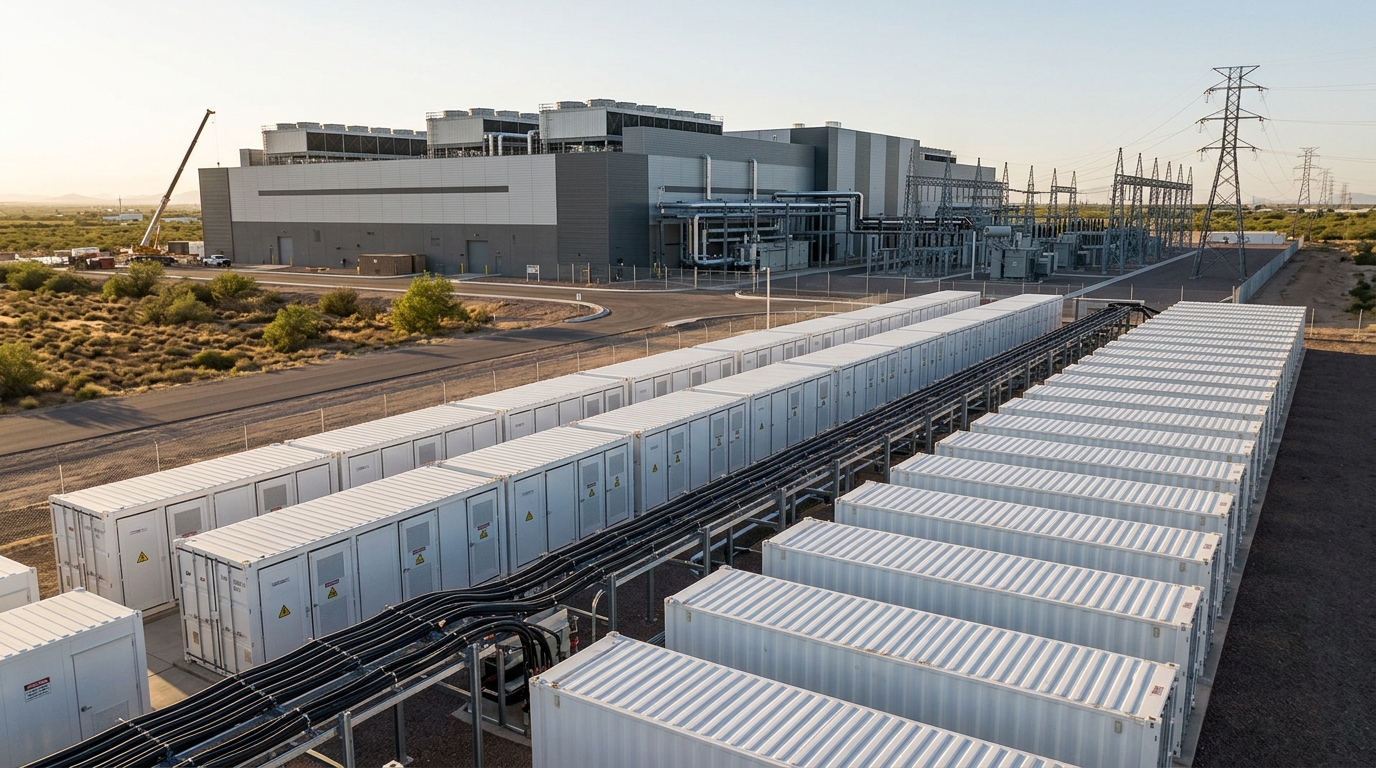
That supply crunch hands NextEra a structural window. In company disclosures, NextEra Energy Resources has said it expects to add 32 to 43 gigawatts of battery storage in the 2026-2032 period. The scale-up implied by those targets is not incremental. It is a doubling and then some, at a moment when every competing technology is effectively supply-constrained.
Ketchum framed it plainly on an earnings call: “Our renewables and storage portfolio provides us with a speed-to-market solution to get the initial phase of a data center off the ground and built.” That framing matters because institutional investors debating NEE are increasingly asking whether battery storage is a permanent fixture of data center power or just a bridge until gas capacity arrives. The answer, for at least a five-year horizon, looks like the former.
Storage projects now account for almost one-third of the company’s project backlog, as management has described it. Energy Resources added 3.6 GW to its renewables and storage backlog in the most recent quarter, bringing the total to 35.1 GW. The Q2 2026 earnings report showed adjusted EPS of $1.15, a 9.5% year-over-year increase that beat the analyst consensus of $1.11. Management reaffirmed its 2026 adjusted EPS guidance of $3.92-$4.02 and maintained long-term growth targets of 8% or more annually through 2032.
What most coverage misses is where the storage is going geographically. In July 2026, NextEra said the U.S. Department of Energy selected it to build and own dedicated generation resources for a proposed data center campus tied to a DOE site in western Kentucky, including up to 2 GW of natural gas and up to 2.6 GW of battery energy storage. The battery deployments shadowing those hubs are what give industrial customers dispatchable power from day one, well before gas infrastructure is complete. Separately, NextEra Energy Resources and Meta announced a set of agreements totaling approximately 2.5 GW of clean energy, including 2.1 GW across ERCOT, SPP, and MISO plus additional projects tied to New Mexico.
The bear case is execution. Management has acknowledged challenges building gas generation quickly due to a dearth of skilled labor, with the same contractors who build gas plants engaged in LNG terminals and data centers, leading to long development timelines. Battery projects face different but real supply chain risks. The next NextEra earnings call is expected around October 27, 2026, and that is when portfolio managers will push hardest on whether the storage backlog converts to revenue on the promised schedule.
Stocks to Watch
- NextEra Energy (NEE): The primary beneficiary. Its storage pipeline and data center hub count give it a multi-year lead over regulated peers.
- GE Vernova (GEV): Turbine scarcity that slows new gas buildouts is also a source of pricing power for major OEMs, and GE Vernova has reported rapid growth in Gas Power backlog and slot reservations.
- Vistra (VST): Competes for the same firm-power contracts in ERCOT. NextEra’s storage speed-to-market advantage applies directly against Vistra’s dispatchable capacity.