June 26, 2026
Featured: GEV Is Up 117% in a Year. The Real Test Is July.
Editor’s Note: Jeff Brown is an angel investor who invested in hundreds of deals involving private companies with returns as high as 5,344%, 7,367%, and even a mind-blowing 11,011%. Today he’s showing how to claim a stake in an Elon Musk-backed startup that’s growing faster than Tesla and SpaceX… starting with less than $50. Read more below.
Dear Reader,
While everyone was distracted by the SpaceX IPO…
Elon Musk quietly started backing a NEW AI startup…
That has been called “the fastest-growing business in the history of capitalism.”
Even though this has nothing to do with robots, self-driving cars, and rockets…
This startup is growing faster than Tesla…
Faster than SpaceX…
And it’s even growing 23 times faster than Nvidia.
It just filed the paperwork to go public in what’s set to be the next hot IPO on Wall Street.
But you do NOT have to wait until the IPO.
Click here and I’ll show you how to claim your pre-IPO stake for as little as $50.
We have so much to look forward to,
Jeff Brown
Founder & CEO, Brownstone Research
FEATURED
GEV Is Up 117% in a Year. The Real Test Is July.
Gas turbine pricing has risen roughly 300% over the last three years. The order book is sold out for years. And GE Vernova is sitting at the center of what looks increasingly like a structural, multi-decade energy supercycle driven almost entirely by AI data center demand.
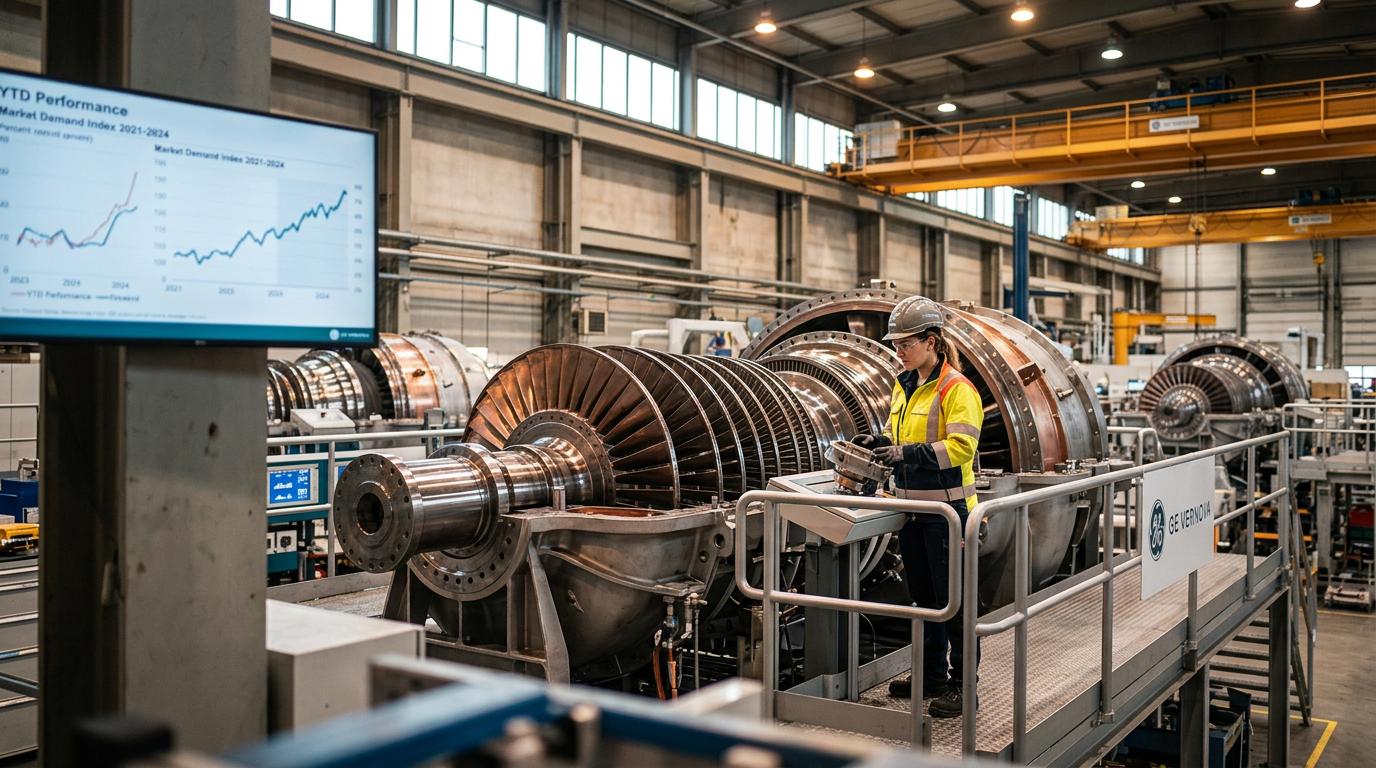
That’s not hype. That’s what CNBC’s Seema Mody reported from GE Vernova’s 400-acre South Carolina plant — walking the floor of a factory where large gas turbines are being built to power hyperscaler data center projects across the country. In Q1 alone, the Electrification segment booked $2.4 billion in equipment orders tied to data centers. More than all of 2025 combined.
Louis Navellier: Don’t buy OR sell another AI stock…
Until you’ve heard this urgent AI warning from the man who called Nvidia before its 44,000% rise…
According to Louis, a massive reset is coming in an obscure corner of the AI market.
This $100 trillion disruption could send some of the world’s biggest AI stocks to zero… and one off-the-radar stock soaring… starting now.
The stock has responded. GEV closed near $1,085 this week. The 52-week range runs from $482.20 to an all-time intraday high of $1,181.95, hit on April 23, 2026. Year-to-date, shares are up roughly 63%. Over the past year, closer to 117%. Market cap sits near $284 billion.
Here is the thing though. The stock has pulled back roughly 8% from that April high. With Q2 earnings expected around July 22, the question is not whether the business is good. The question is whether execution is keeping up with guidance.
The Numbers Behind the Thesis
Q1 2026 delivered an 87% year-over-year surge in adjusted EBITDA to $896 million. Orders rose 71% year-over-year to $18.3 billion with a 2.0 book-to-bill ratio. The backlog expanded to $163 billion, up from $116 billion at spin. Revenue guidance was raised to $44.5–$45.5 billion for full-year 2026, a $500 million increase from prior projections. Adjusted EBITDA margin guidance moved to 12%–14%. Free cash flow guidance jumped to $6.5–$7.5 billion, up sharply from the previous $5.0–$5.5 billion range.
That free cash flow revision — roughly 33% higher than prior expectations — is the single most important number in the GEV story right now. It says the backlog is converting. Hyperscalers signing take-or-pay contracts on gas turbines are not optionality anymore. They are cash flow.
Management guided Q2 Power revenue growth of 15%–17% with an EBITDA margin of approximately 17%–18%. That is a meaningful step up. The bar heading into July is higher than it was in April, which is exactly the dynamic that creates options risk in either direction.
This Elon-Backed Startup is Growing Like Crazy
Time magazine called this startup that’s backed by Elon Musk (click here to get the name)…
“The Most Disruptive Company in the World…”
And said that it “holds the keys to perhaps the most powerful technology of all time.”
No wonder its CEO is projecting growth of up to 8,000% for this year.
It just filed the paperwork to go public in what’s set to be the next hot IPO on Wall Street. But you do NOT have to wait until the IPO.
Click here and Jeff Brown will show you how to claim your pre-IPO stake for as little as $50.
What the Options Market Is Saying
Options traders are pricing elevated implied volatility ahead of the July earnings date. That is telling. GEV’s beta sits around 1.05 — relatively modest for a stock this size. The elevated options premiums say traders are not treating this like a typical industrial earnings event. They are treating it like a catalyst that could reset the multi-month range in one session.
The tension is structural. Two things are true at the same time and they are hard to reconcile. First: the guidance revision was significant, the backlog is real, and AI data center demand is accelerating faster than most models assumed. Second: the Wind segment is still losing money — management is guiding for approximately $400 million in EBITDA losses from Wind in 2026. That is a persistent drag on a business whose Power and Electrification segments are posting record-level numbers.
The coiled spring dynamic — strong guidance on one side, execution and segment risk on the other — is what the elevated options market is reflecting right now.
The Layer Nobody Mentions
Electrification revenue at GEV is projected to reach $14.0–$14.5 billion in 2026, with an 18%–20% EBITDA margin. That segment has grown from a $9 billion backlog at the end of 2022 to $42 billion in Q1 2026. Grid solutions, transformers, and transmission equipment are in high demand not just from AI data centers but from the broader grid modernization wave. Data centers now account for 20%–25% of GEV’s backlog — and big tech hyperscalers made up just 10% of the customer mix in 2025. That figure is expected to reach 25% in 2026.
Slight tangent, but it matters: GE Vernova also holds the largest gas turbine installed base globally, and orders signed in the first half of 2026 are priced 10 to 20 percentage points higher on a dollar-per-kilowatt basis than the Q4 2025 backlog. That pricing uplift has not fully appeared in revenue yet. It will, starting in 2027 and 2028. The forward earnings curve for this company looks very different from what the trailing numbers show.
Bernstein initiated coverage with Outperform and a $1,206 price target. Jefferies carries a Buy rating at $1,210. BNP Paribas stepped to the other side with a Neutral rating and a $1,190 target, flagging execution and valuation risk. The average analyst consensus across 38 analysts sits near $1,212, according to recent tracking — roughly 12% above current levels. The fact that there is at least one visible dissenter on valuation is actually healthy for a stock in a multi-year uptrend.
Options Trade Frameworks
Bull case: For traders who believe Q2 execution confirms the free cash flow ramp and that the Wind drag is already priced in, a call spread targeting the $1,150–$1,250 range through August expiration captures a move toward the all-time high. The risk is implied volatility compression post-earnings reducing the value of long options even on a beat.
Bear case: If GEV misses on the revenue conversion side — backlog is large but delivery timing matters — or if Wind losses come in worse than the $400M full-year guidance, the stock revisits the $950–$980 range quickly. A put spread in that zone through early August provides defined downside exposure at a point where elevated premium is working in the seller’s favor.
Neutral / premium collection: Given elevated IV and a stock that has been consolidating for two months post the April all-time high, an iron condor around the $950–$1,200 range for late July through August expiration is the structure for traders who believe the earnings reaction stays inside the current trading band. The risk is a clean beat that drives a gap toward the $1,200+ zone — which multiple analyst targets imply is not off the table.
Risk Factors
- Wind segment losses of approximately $400M in 2026 are a persistent margin headwind and sentiment overhang — Q2 Wind EBITDA losses alone could be $200–$300M
- Tariff headwinds estimated at $250–$350 million for 2026 are fully built into guidance but could worsen if policy shifts
- Supply-chain and capacity timing risks could delay backlog-to-revenue conversion — a 2.0 book-to-bill is only valuable if the build schedule holds
- The stock pulled back roughly 8% from the April 23 all-time high and has not fully recovered — price momentum is neutral at best entering the July report
- Execution risk is real: GEV is simultaneously scaling three high-complexity product lines while managing a $163B backlog across geographies with active tariff exposure
If I Only Taught One Strategy: Expert Reveals Retirement Hack
A comfortable retirement may seem increasingly out of reach, but investing expert Dave Aquino says that just one simple strategy is turning even his novice students into profitable investors.
In his free guide, “How To Master The Retirement Trade”, Aquino reveals the little known strategy to…
Forward Outlook
The long-term case for GEV is not really about whether the next quarter beats by a few cents. It is about whether this company becomes the picks-and-shovels winner of the AI infrastructure cycle — not through chips or software, but through the most boring and essential input of all: electricity generation and grid infrastructure.
Every AI data center requires roughly three to four times the electrical power of a traditional cloud computing center. GE Vernova manufactures the gas turbines, transformers, and grid management systems that make those facilities possible. The backlog is so large it provides years of revenue visibility. The pricing power is real — 300% turbine price increases do not happen in competitive markets without genuine structural scarcity.
July earnings is when the company has to prove the guidance was not just optimism. The options market is charging elevated premiums to find out. That cost of participation is both a signal and a warning.
Whether the stock delivers or stumbles on execution — that question stays open until the report drops.