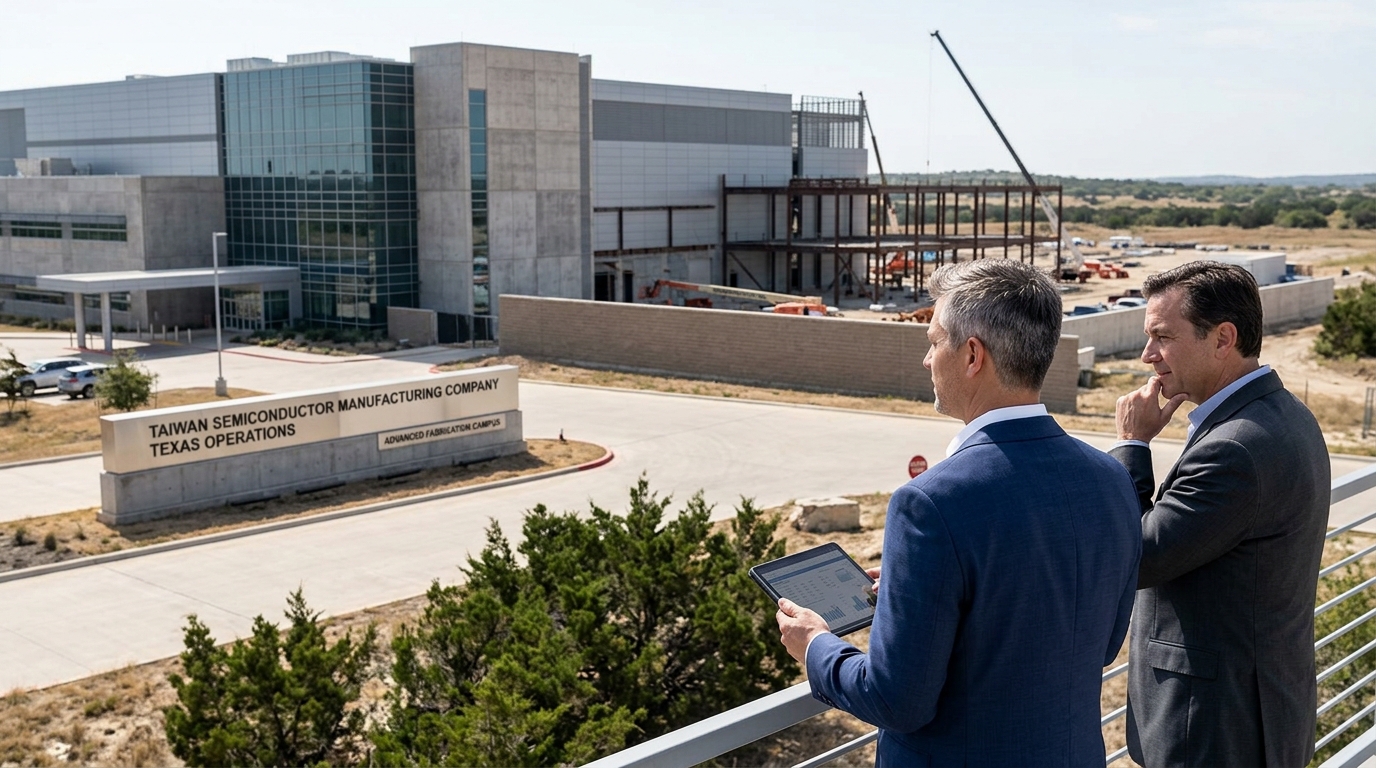
TSMC has spent four decades serving hundreds of customers without playing favorites. A Texas fab dedicated entirely to Elon Musk’s companies would shatter that precedent, and the market is already pricing in the possibility.
TSM shares rose about 3% on Friday, closing at $472.78, putting the stock within a few dollars of its 52-week high. The catalyst was a report from journalist Tim Culpan’s Culpium newsletter, published October 2, followed quickly by something markets rarely get: confirmation from the other side of the table.
TSMC and Elon Musk’s Terafab semiconductor production initiative are discussing a potential collaboration under which TSMC would build and operate a facility that will exclusively serve Tesla, SpaceX, and xAI, according to Culpan’s report. Musk confirmed the discussions early Saturday, writing on X: “Just discussions, but something may come of it,” while TSMC has so far remained tight-lipped.
Why This Is Different From Everything TSMC Has Done in the U.S.
TSMC has already expanded its investment in Arizona to $265 billion, and if the Texas project materializes, the company would establish a dual manufacturing hub in the United States, spanning Arizona and Texas. That Arizona buildout is massive by any measure: including existing and planned projects, TSMC’s Arizona operation is expected to encompass six semiconductor logic wafer fabs, two advanced packaging facilities as well as an R&D center. Texas would sit on top of all of that.
More striking than the geography is the proposed structure. Two models are on the table. The proposed Plan A arrangement could resemble TSMC’s JASM and ESMC joint ventures in Japan and Germany, where local partners provide capital and demand while TSMC contributes process technology and operates the fabs. Plan B, under which SpaceX would hold majority ownership of Terafab while TSMC operates the facility and brings its own process technology, would be completely new for the world’s No. 1 contract chipmaker. A foundry that has always kept equity distance from its customers would, under Plan B, be running a fab it does not own for a single client. That is a structurally different business.
What Terafab Actually Is
Terafab has been described publicly as a semiconductor manufacturing project backed by Tesla and SpaceX in Grimes County, Texas, with an initial investment of $16.8 billion intended to produce chips for artificial intelligence, robotics and space applications. In the long term, Tesla, SpaceX and xAI are to be supplied to a much greater extent by their own or dedicated chip manufacturing.
Intel had been the only named technology partner, with Musk previously indicating Terafab planned to use Intel’s 14A process. If TSMC joins the venture, Intel’s 14A could be dropped in favor of TSMC’s own node. That is the sword hanging over Intel’s foundry ambitions here. Culpan reported that collaboration with Intel on Terafab is not making progress. That detail did not get equal billing in the weekend headlines, but investors in INTC should note it.
The Bull Case for TSM
From TSMC’s perspective, such a project would make economic sense, provided Tesla, SpaceX and xAI actually need the volumes being discussed, as AI accelerators are now consuming large amounts of leading-edge manufacturing and packaging capacity. TSMC reported Q2 2026 gross margins of 67.7% and management characterized AI demand as “extremely robust” and raised expected 2026 revenue growth to slightly above 40%. A captive Texas customer for advanced nodes and packaging fits cleanly into that demand picture. Equipment suppliers such as AMAT and LRCX would benefit from any new fab build, regardless of which ownership structure prevails.
The Risks
Single-customer concentration is a real risk. If Tesla’s vehicle chip requirements shift, or xAI’s compute build slows, TSMC is left holding a specialized facility with no obvious alternative tenant. The confirmation that talks are under way does not say the companies have agreed to work together, who would own a factory or when one might open. TSMC has assigned teams to evaluate the project, but no investment figure, process node, or timeline has been published.
What to Watch Next
Ahead of TSMC’s October 15 earnings call, expectations are building as Musk’s confirmation of talks over a potential Terafab partnership adds another layer to the foundry giant’s growth story. Listen for C.C. Wei to address Texas directly or, more likely, deflect entirely. Any language acknowledging U.S. expansion beyond Arizona would move the stock. A denial or silence would not necessarily kill the thesis but would push the timeline out.
The cleaner signal will be whether Intel responds. If Terafab’s relationship with Intel’s 14A is genuinely stalling, and TSMC steps in with its own node, that is the moment this story shifts from a rumor about a new fab to a structural realignment of who manufactures the chips powering autonomous vehicles, humanoid robots, and Musk’s AI infrastructure. October 15 will start to answer that question.