
July 19, 2026
Is the SanDisk Selloff a Signal or Noise?
The real debate heading into August 5 earnings is about cycle durability, not momentum.
Dear Reader,
Here’s a story that hasn’t made the front page of a single financial news network.
Sovereign wealth funds – the largest, most patient, most sophisticated pools of capital on Earth – have begun making massive, concentrated bets on artificial intelligence.
These aren’t hedge funds chasing momentum. These are NATIONS deploying generational wealth.
Abu Dhabi’s sovereign wealth ecosystem – worth $2.3 trillion – has embedded AI infrastructure into the financial system itself.
Norway’s $2.1 trillion Government Pension Fund Global – the world’s largest sovereign wealth fund – now uses large language models to screen every single portfolio company daily.
CEO Nicolai Tangen wrote: “Artificial intelligence is changing how we work as an investor.”
Kuwait Investment Authority… Qatar Investment Authority… Mubadala… They’re all making their largest-ever digital and AI investments.
The Trump administration issued an executive order to establish a U.S. sovereign wealth fund – focused specifically on AI-related tech investing.
And the Stargate Project – a joint venture between OpenAI, SoftBank, Oracle, and UAE-backed MGX – plans to invest $500 billion over four years building AI infrastructure in the U.S. President Trump called it “the largest AI infrastructure project by far in history.”
Combined, sovereign wealth funds now manage a record $15 trillion in assets globally – with AI as a core strategic investment priority.
And this is important, because we know what happens when state-level capital enters a market.
It happened with oil in the 1970s…
Telecommunications in the 1990s…
Dot-com stocks in the 2000s…
When nations start buying, the smart move is to buy what they’re buying… because the prices will catch up.
Click here to get the lowdown on what they’re buying here.
Good investing,
Alexander Green
Chief Investment Strategist, The Oxford Club
Is the SanDisk Selloff a Signal or Noise?
The Question Nobody Wants to Answer Directly
The investment committee debate around SanDisk right now is not about whether the business is performing. It clearly is. The real question is whether this NAND cycle is structurally different from every prior cycle, or whether the street is sleepwalking into the same trap it always does at peak memory margins.
That distinction matters enormously. Because if this is a normal memory upcycle, the stock at current levels is expensive and the 40%-plus pullback from its recent high is just the beginning. But if AI has genuinely changed the demand profile for NAND in a durable way, then what looks like distribution is actually opportunity. Those are not small differences in outcome.
August 5 is the first real chance to find out which side is right.
Why the Institutional World Is Focused Here
SanDisk has become impossible to ignore from a portfolio construction standpoint. The stock is the top-performing name in the S&P 500 in 2026, up roughly 600% year-to-date even after the recent correction. It is also, by some distance, one of the largest contributors to Information Technology sector earnings growth this year, sitting alongside Nvidia, Micron, and Apple on that list.
The numbers behind that performance are real. In fiscal Q3 2026, SanDisk reported revenue of $5.95 billion, up 251% year over year. Data center revenue specifically grew 233% quarter over quarter. GAAP net income came in at $3.615 billion. Non-GAAP EPS hit $23.41 against a $14.66 Street estimate. Revenue beat consensus by more than 25%.
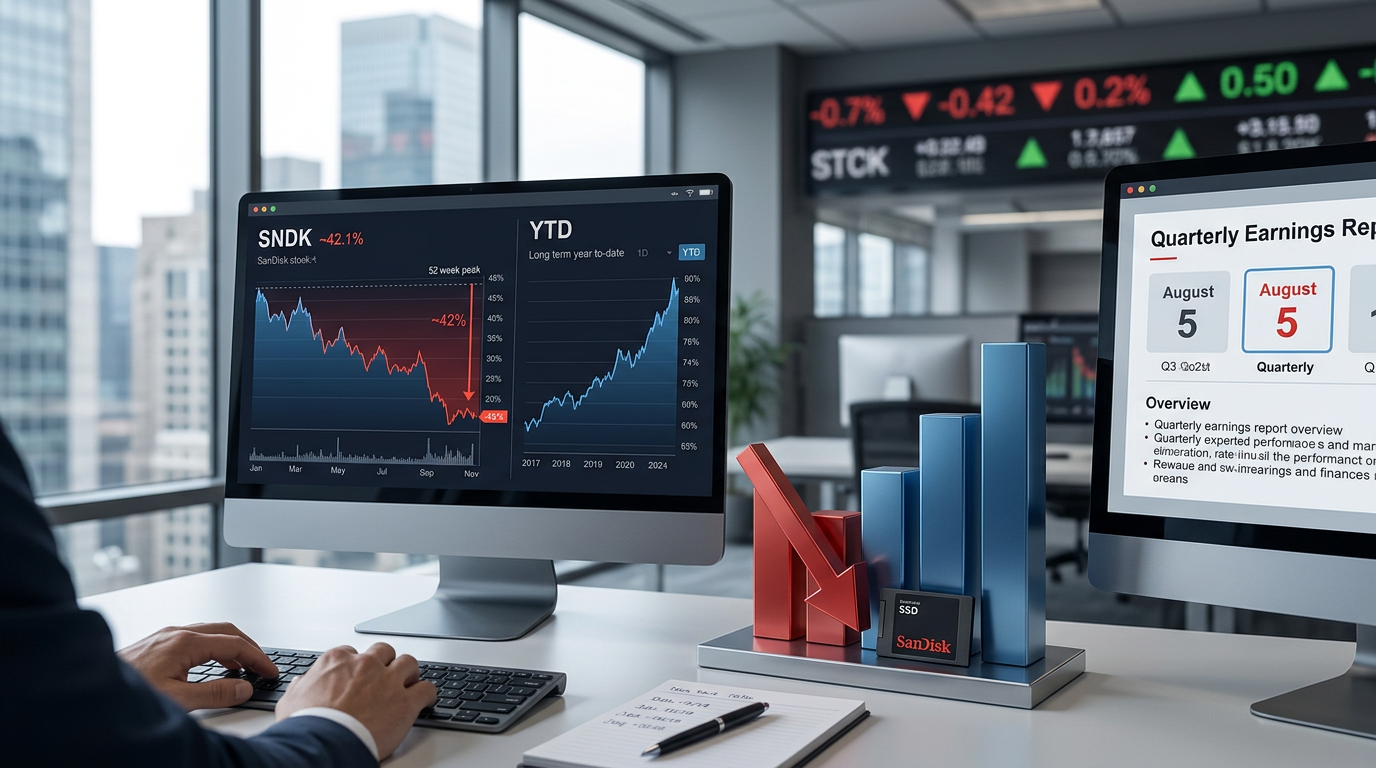
Then the stock sold off 40%-plus from its 52-week high near $2,354, even as analysts kept raising targets. That divergence, sell-side conviction going up as the stock goes down, is the kind of setup that forces portfolio managers to take a view rather than sit out. The Philly Semiconductor Index is down more than 11% from its June high. SanDisk led the decline. It is also the name generating the most debate.
The Bull Case
The bull argument starts with supply. NAND supply and demand remain extremely tight, and by most credible estimates, meaningful relief is not coming before late 2027 or 2028. Goldman Sachs sees tight conditions in NAND persisting longer than in DRAM, driven by limited new capacity across the industry. Bank of America’s Wamsi Mohan modeled $9.1 billion in revenue and $37.01 EPS for the June quarter, well above guidance and consensus, and wrote that he expects the supply-demand imbalance in the NAND market to remain through 2027.
There is also a structural argument that this cycle is different. SanDisk has signed five long-term supply agreements under its New Business Model since separating from Western Digital in February 2025. Those agreements represent more than $41.6 billion in remaining performance obligations as of early April 2026. Evercore ISI’s Amit Daryanani, a top-ranked analyst who more than doubled his price target to $3,100 from $1,400, estimates total committed revenue from these agreements exceeds $62 billion, including more than $11 billion in financial guarantees and prepayments. He projects SanDisk could generate approximately $212.78 in EPS for fiscal 2027, ahead of the Street consensus of $203.33.
The logic here is that hyperscalers are not buying NAND the way consumer electronics companies do. Cloud providers building AI infrastructure care about capability and availability, not getting the cheapest storage possible. That changes the negotiating dynamic for suppliers like SanDisk entirely. Pricing sensitivity is lower. Contract durations are longer. The revenue profile becomes less prone to the violent swings that have always defined this industry.
Goldman Sachs analyst James Schneider raised his price target from $1,200 to $2,200 and reiterated Buy on July 5. His non-GAAP EPS estimate for calendar year 2026 sits roughly 30% above Street consensus. He applied a 20x multiple to a normalized EPS estimate of $110, double his prior estimate of $55. That is not a valuation expansion story. It is a fundamental earnings power revision that most of the Street has not yet absorbed. Bernstein’s Mark Newman lifted his target to $3,000, arguing new supply contracts provide a pricing floor of 29 cents per gigabyte. Citigroup maintained a $2,500 target. Wedbush went to $2,000.
Big Pharma’s $560B White Flag is One Startup’s Ticket
Big Pharma spent decades and $1B trying to solve osteoarthritis. They kept failing because they only targeted one of the many culprits attacking joints. Cytonics figured that out.
They created the first therapy with the potential to address the root cause at the molecular level, already proven across 10,000+ patients. Now they’re pushing toward FDA approval on a version that’s 200% more potent, backed by $32M raised and partnerships with Stanford and Scripps Research.
Invest in Cytonics before this month’s deadline.
This is a paid advertisement for Cytonics Regulation CF offering. Please read the offering circular at https://cytonics.com/
Forward-looking statements are subject to risks and uncertainties. There is no guarantee of performance. Past performance does not predict future results. All investments involve risk, including loss of principal.
The Bear Case
The skeptics are not wrong to be skeptical. Memory has always been one of the most cyclical businesses in semiconductors. When NAND pricing peaks, it does not drift lower. It tends to collapse. Morningstar does not assign an economic moat to SanDisk, arguing that NAND flash is a commodity and that oversupply periods produce severe margin compression. That historical pattern is the bear case in two sentences.
The valuation picture adds to that concern. Trailing P/E sits around 60x, forward P/E near 27x, and price-to-sales above 20x on a company whose consumer segment already declined 10% sequentially in Q3. The bear model puts fair value nearer $955 on a pure forward-P/E basis. Chinese competition from YMTC is a structural risk that will not disappear; if YMTC pushes into global markets at scale, it could unwind NAND pricing faster than most current estimates assume. Bank of America’s base case does assume YMTC focuses primarily on domestic Chinese customers rather than global competition, but that assumption could be wrong.
There is also the contract visibility question that rarely gets discussed in the bull case. SanDisk’s April filing listed $41.6 billion in remaining performance obligations, but only about 15% of that figure, roughly $6.24 billion, was scheduled to show up as revenue in the next 12 months. The backlog headline is large. The near-term revenue conversion is more measured. When a stock has already returned several hundred percent in a year, that kind of nuance matters to anyone managing risk.
What the Investors Who Matter Are Actually Saying
Here is where it gets interesting. The recent selloff was not driven by any analyst downgrading fundamental assumptions. It was driven by a broad risk-off rotation tied to US-Iran tensions and the SK Hynix Nasdaq debut, which triggered sector-wide profit-taking across memory names. The Argus initiation at Hold on July 15 added sentiment pressure. But Argus cited elevated risk of demand tempering rather than any deterioration in current business conditions. Goldman, Evercore, Citi, Bernstein, Bank of America, and Wedbush all raised or maintained targets through the decline.
Evercore’s Daryanani, who ranks in the top 1% of Street analysts by track record, was direct: investors are underappreciating the durability of SanDisk’s earnings and free cash flow over the next few years. His industry channel checks suggest supply could become more constrained through 2027, not less. Morgan Stanley’s Joseph Moore, also a top-ranked analyst, wrote after investor meetings with SanDisk management in late June that NAND supply and demand remain very tight with no visibility to balance. He models ongoing average selling price increases through calendar 2026 and potentially well into 2027.
The CEO’s own words from the Q3 earnings release are worth sitting with. David Goeckeler said the company is advancing to a new business model built on multi-year customer engagements backed by firm financial commitments, and that this transformation is driving structurally higher and more durable earnings power. That is a management team making a specific claim about the nature of their business model change, not just calling a strong cycle. The August 5 and August 13 investor day window is when they have to prove it.
What Investors Are Missing
Most of the debate is focused on NAND pricing and contract sizes. What is getting less attention is the product roadmap underneath the business model change.
SanDisk and SK Hynix are working jointly to standardize High Bandwidth Flash, a flash-based memory layer designed specifically for AI inference infrastructure. The first HBF samples are expected in the second half of calendar 2026, with a full rollout planned for 2027. At CES 2026, Nvidia CEO Jensen Huang described storage as the largest unserved market in AI, and Nvidia’s next-generation Rubin architecture creates incremental NAND demand through KV cache offloading to SSDs. If HBF gains traction as an inference-layer standard, it repositions SanDisk not just as a storage supplier, but as a memory-tier provider inside AI workloads. That is a meaningfully different competitive position than what memory bulls are currently pricing.
The other underappreciated item is the balance sheet. SanDisk’s CEO highlighted a zero-debt position, combined with a recently authorized share repurchase program and strong cash generation. Historically, memory companies have entered downturns with leverage that amplified the damage. That risk is largely absent here, which changes the downside math considerably.
Stocks to Watch
SanDisk (SNDK) — The Primary Question. The fiscal Q4 report on August 5 and Investor Day on August 13 are the binary events. The key focus is not just whether the quarter beats guidance, but how many additional long-term supply agreements management discloses and what they say about NAND pricing trends into early 2027. Goldman’s EPS estimate is 30% above consensus. If Q4 confirms that gap is real, the thesis forces a broader Street re-rating.
Micron Technology (MU) — The Confirmation Trade. Micron’s fiscal Q3 results, which showed revenue rising to $41.46 billion from $9.30 billion a year earlier with an operating margin approaching 80%, provide the external validation for SanDisk’s bull case. Micron’s management said on its June 24 earnings call that supply and demand remain very tight with no near-term line of sight to balance. If SanDisk’s August 5 results confirm the same pricing dynamics, Micron is a second-derivative way to own the same thesis at a lower price-to-earnings multiple.
Seagate Technology (STX) — The Overlooked Storage Angle. Seagate is not a NAND play, but its fiscal Q3 revenue rose 44.1% to $3.11 billion, powered by HAMR-based Mozaic drives going into hyperscaler racks. Seagate confirms that AI storage demand is broad-based across flash and spinning disk. It also trades at a substantial valuation discount to SanDisk, which makes it an interesting place for investors who want AI storage exposure with less cyclical risk concentration.
Applied Materials (AMAT) — The Equipment Bottleneck. If NAND supply stays constrained through 2027 because meaningful new fab capacity cannot come online before late 2027 or 2028, the companies building that capacity are the long-duration beneficiaries. Applied Materials sits at the front of the semiconductor equipment order cycle. New capacity construction requires AMAT’s deposition and etch tools first. The constraint that keeps NAND pricing elevated also delays the day when AMAT’s memory tool orders start declining.
The honest answer is that no one knows yet whether this cycle is different. The structural arguments are compelling. The historical precedents for caution are equally real. August 5 will not settle the debate entirely, but it will tell us whether Goldman is right that the Street is 30% too low on earnings, or whether the bears have identified the ceiling. That is enough to keep watching closely.