Google signing the largest enhanced geothermal power purchase agreement in history should be a meaningful moment for the sector. It is. But the 28% surge in Fervo Energy (FRVO) on September 1, 2026 also illustrates one of the oldest traps in growth investing: confusing a commercial milestone with near-term earnings power.
What the Deal Actually Says
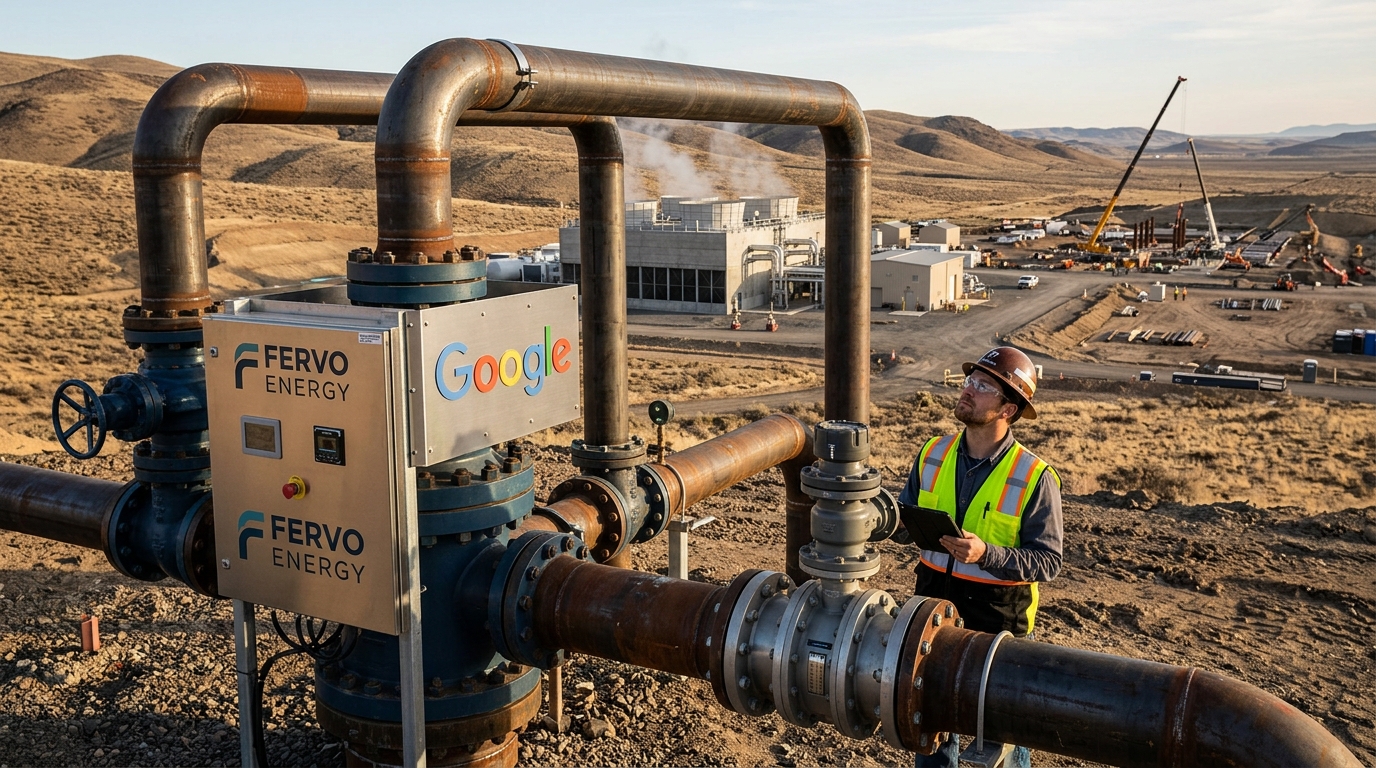
Fervo announced a 396-megawatt PPA with Google to enable continued development of the Cape Station enhanced geothermal systems GeoCluster, expected to come online in 2028. As part of the agreement, Fervo will offer Google an option to expand its offtake by approximately 600 MW, for a total of nearly 1 GW, by June 2030. The electricity purchased by Google is positioned as a foundational building block for Google’s potential future data center development in Utah.
The strategic logic is sound. Nearly 23 GW of new data center computing capacity is forecast to come online over the next three years, and the top constraints to data center development are access to energy and land. Geothermal runs around the clock, regardless of weather, and that reliability is precisely what hyperscalers cannot get from solar or wind alone. The deal is the world’s largest enhanced geothermal PPA to date.
The Numbers Behind the Stock Move
Here is where position sizing becomes the real subject. Fervo recorded revenue of $113,000 in Q2 2026, with an operating loss of $28.7 million and a net loss of $55.9 million. That is not a typo. Revenue was $113,000 for the quarter. Management guided to 2027 revenue between $60 million and $80 million, reflecting potential transmission curtailment events expected during the first full year of commercial operations, and said capital expenditures of $850 million to $900 million are planned for the second half of 2026.
Management anticipates 2027 revenue between $60 million and $80 million, mainly limited by curtailment on transmission lines from the Cape site, which they emphasize is outside operational control and unique to 2027. Taken together: a company spending roughly $900 million in six months, guiding to $70 million in revenue next year, and carrying a stock that just priced in a contract whose cash flows do not begin until 2028. FRVO already sits about 60% below its 52-week high of $42.65, reached on May 15, 2026.
Building Wealth Around This Idea
None of this means Fervo is uninvestable. The company’s contracted revenue backlog stood at $7.2 billion as of June 30, 2026, representing 658 megawatts of contracted capacity. Cash and cash equivalents were about $2.1 billion at June 30, 2026. The balance sheet can fund the build. The Google relationship is genuine and deepening. Google has also highlighted a 115 MW enhanced geothermal arrangement in Nevada developed by Fervo and delivered by NV Energy under the Clean Transition Tariff, announced in 2024 and later approved by Nevada regulators.
Investors who want exposure to the clean firm power theme with less single-project risk might look at adjacent names. GE Vernova raised its 2026 revenue forecast earlier this year to $44.5 to $45.5 billion as rising demand tied to data centers and grid infrastructure strengthened its core businesses. Constellation Energy (CEG) and Vistra (VST) are already generating cash from nuclear and gas assets that increasingly carry premium pricing thanks to the same data center demand. They are not the same bet as FRVO, but they are further along the cash flow curve.
Risks to Monitor
First-of-a-kind commissioning at Cape Phase I carries risks including potential delays in grid synchronization and minor operational issues that could affect the initial ramp. Final data center plans are subject to factors such as engineering feasibility, regulatory approvals, and commercial conditions. Cost per kilowatt is also on a steep improvement curve: Fervo has said the first phase implies an all-in cost of about $7,000 per kilowatt, with a target of $5,500 per kW for the second phase and a long-term goal of $3,000 per kW. Progress toward $3,000/kW is what turns this into a durable business rather than an expensive science project.
Daily Wealth Takeaway
A record contract is evidence, not income. When a stock surges on a deal whose revenue starts two years out, the question is not whether the thesis is right but how much of your portfolio should ride on the execution between now and then. Size the position to what you can hold through the noise, because there will be plenty of it before Cape Station delivers its first commercial electron.