

September 17, 2026
Bonus Content: The EU’s Canada Gambit Put European Stocks at Risk
Editor’s Note: If you don’t know Marc Chaikin, he’s a living Wall Street legend that famous investors like Steve Cohen owe a huge debt of gratitude to for helping them build billion-dollar businesses. He’s even been nicknamed “The Billionaire Maker.” So, when he comes out with a new stock recommendation, I pay attention. The one below is so promising, I had to share it with you today. And if you click any of the links in Marc’s e-mail below, you’ll get the name and ticker of the company he’s pounding the table on absolutely free.
Dear Reader,
In 2023, my system flashed bearish on an automotive company virtually no one had yet heard of.
Soon after, the stock crashed 35%.
But today, that stock’s outlook has made a full 180-degree turnaround.
Check it out:
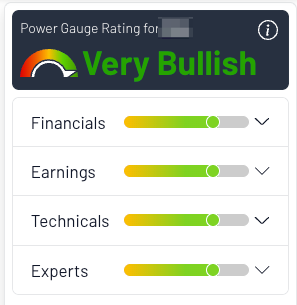
My system now rates this company “Very Bullish,” with extremely high marks across the most critical factors in my stock analysis.
Because the very same company my system warned about in 2023 just formed a groundbreaking partnership with the king of AI, Nvidia.
See, Nvidia has built what is essentially the brains of the AI-powered cars of the future.
But getting that brain inside vehicles and operating safely is an enormously complex job.
That’s precisely the job that went to this company. (Get the name and ticker FREE right here.)
That partnership basically hands this barely-known company the keys to the self-driving kingdom on a silver platter.
So, if you want to benefit from a company quickly becoming the center of the massive autonomous-vehicle trend, forget Tesla and get this stock’s ticker before it becomes a household name…
Sincerely,
Marc Chaikin
Founder, Chaikin Analytics
P.S. Autonomous cars are the future, and too many people make the mistake of thinking Tesla stock is the best way to profit. Not even close! Watch right here where I compare Tesla side by side with the company I’m talking about above and you’ll see why it’s time to dump Tesla and buy this stock instead.
The EU’s Canada Gambit Put European Stocks at Risk

The debate consuming European investment committees this morning is not whether the Canada-EU associate membership proposal has legal standing or geopolitical logic. It is simpler and more urgent than that: does Trump actually pull the trigger, and if he does, how much of this year’s exceptional European equity rally survives?
Why Wall Street Cares
Earnings per share in the Stoxx Europe 600 climbed an estimated 14% in the first half of 2026 and are forecast to rise 15% for the full year, according to Goldman Sachs Research, with inflows into European equities running at their highest level since 2021. The Stoxx 600 is up about 7% so far in 2026. That is the position institutions have built. Trump threatened to blow a hole in it Wednesday evening.
European Commission President Ursula von der Leyen proposed Canada becoming the first associate member of the European Union during her State of the European Union address in Strasbourg, with Canadian Prime Minister Mark Carney in attendance. Trump responded by floating fresh tariffs on EU goods, or even cutting off some trade entirely, if he determined the move was harmful to the US. The trigger is intent: he conditioned his threat on whether he judged the move a “hostile act,” saying he would “put very serious tariffs or stop trading with Europe on many things.”
The Bull Case
Portfolio managers who have been adding European exposure will argue the threat is conditional and the conditions are vague enough to defuse. Any deep Canadian integration into the EU market would require heavy negotiation of treaty-bound rights and obligations, making it more likely that cooperation will focus on loosely constructed alliances for prosperity and security rather than formal structural integration. That gives both sides room to reframe the proposal in terms Washington might tolerate. The earnings engine, meanwhile, remains intact: European companies delivered a strong Q2 earnings season, with several strategists describing it as the best earnings momentum in years.
The Bear Case
The bear case is that intent does not matter if the political incentive is escalation. Trump’s comments risk further inflaming a simmering trade war with Canada; after trade talks collapsed last month, he imposed 50% tariffs on about $20 billion of Canadian goods, and Ottawa retaliated with roughly equal levies on US products. On Wednesday he also signed a memorandum directing the US government to remove Canadian-origin items from the federal civil procurement system, which the White House said was in retaliation for Canada’s Buy Canadian policy. A White House already in active escalation mode does not need a high evidentiary bar to declare the EU’s move hostile.
The Evidence
The Stoxx 600’s valuation gap versus US equities has narrowed in recent years, as European multiples rose and US multiples remained elevated. That compression was built on the thesis that European earnings would keep outperforming and geopolitical risk would stay contained. Both assumptions are now under pressure simultaneously. Canada has been seeking to diversify away from the US following months of escalating trade tensions and the collapse of bilateral trade talks. Trade between Canada and the EU reached over €130 billion in 2025, making Europe Canada’s second-largest trading partner by a substantial margin behind the US. Washington watching that relationship deepen has a clear read: the alliance is explicitly designed to reduce North American dependence.
What Investors Are Missing
The overlooked risk is sector-specific and asymmetric. Markets are pricing this as a binary geopolitical event when the real damage is already embedded in individual company models. LVMH’s exposure to the US is substantial: the company’s most recent full-year disclosures show the United States at about 26% of group revenue. Unlike the automotive sector, where some manufacturers have US production capacity to partially offset tariff exposure, luxury goods manufacturing is almost entirely concentrated in Europe by design. Relocating production to satisfy Washington destroys the brand proposition that justifies the price point. For Volkswagen, the calculus is different but equally difficult: the company’s CEO has warned that tariffs could cost Volkswagen about €5 billion in annual operating profit. Siemens, more insulated by its industrial automation and infrastructure exposure, faces a slower-burn risk through global capital expenditure delays if a broader US-EU trade conflict dampens corporate investment confidence.
Stocks to Watch
LVMH sits at the sharpest edge of this risk. With roughly a quarter of revenues tied to US consumers and no credible production workaround, a broad tariff escalation lands directly on its income statement with limited offsets.
Volkswagen enters this week already under pressure from existing tariff headwinds. Q1 2026 results showed the group navigating higher US tariffs and restructuring costs while delivering revenue of €75.7 billion, down year over year. A second front of tariff risk from an EU-wide trade dispute would compound a recovery that was already fragile.
Siemens is the most defensible of the three, with revenue diversified across industrial automation, smart infrastructure, and healthcare technology. It is not immune, but its exposure to discretionary US consumer demand is far lower than luxury or auto peers.
EWG, the iShares MSCI Germany ETF, and FXE, the euro currency ETF, are the instruments through which institutions will express their first-mover response. A sharp drop in either this morning would tell you whether professional money is treating this as noise or a genuine reassessment of the European equity thesis institutions spent the better part of 2026 building.