
September 16, 2026
Bessent Told Congress He’s Buying Long Bonds
That tension is now central for fixed income investors.
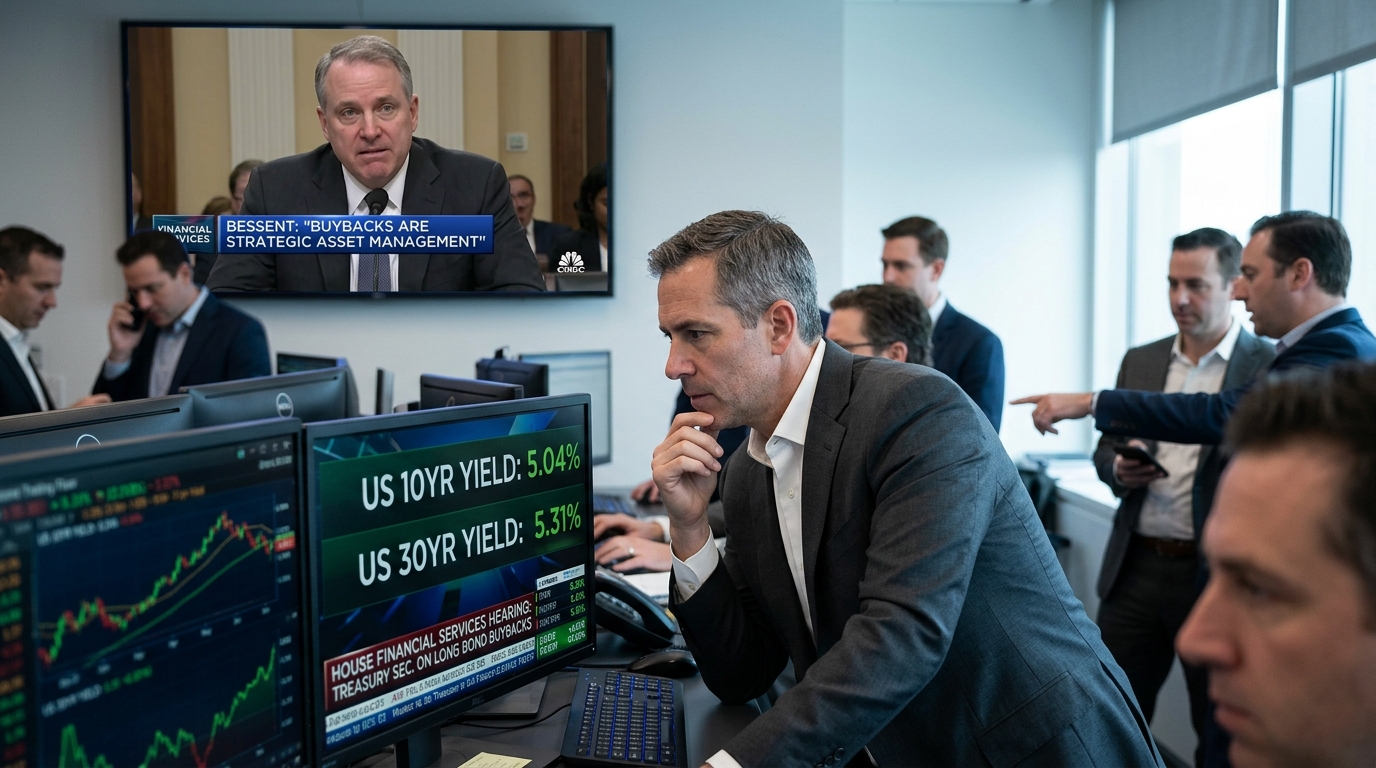
Tuesday produced something institutional bond desks rarely have to price: the U.S. Treasury Secretary, under oath before Congress, defending an expanded program of long-dated Treasury buybacks even as the 10-year yield touched 5.041%, its highest level since July 2007.
The AI Boom’s Most Profitable “Tollbooth” Stock?
A little-known company is quietly building what may be the closest thing to a virtual monopoly the AI era has ever seen.
Whitney Tilson – the man CNBC calls “The Prophet” – calls it the world’s most profitable tollbooth. One billionaire put more than half his $9 billion fund into it.
Right now it’s trading at a rare discount…the same kind that’s previously turned $10,000 into $55,000…in just over 12 months.
The House Financial Services hearing was formally scheduled as annual testimony on the state of the international financial system, but it quickly became a referendum on Treasury’s bond market management. Bessent defended the department’s long-end buybacks as liquidity support even as members pressed him on why yields have continued to rise. Bessent pushed back, arguing that yields would be even higher without Treasury’s intervention.
That argument has drawn pointed scrutiny from fixed income analysts who note the 10-year continued climbing even as the buyback program expanded. our earlier breakdown of why bond markets are discounting Bessent’s long-end buying program walks through the specific mechanics behind that skepticism — including how the issuer-as-buyer dynamic distorts the price signals the market would otherwise generate.
A Coordination Problem the Buy Side Cannot Ignore
The political optics are one thing. The market structure question is another, and it is the one that matters more to portfolio managers. Treasury Secretary Bessent is in the midst of an unusually visible effort to lean against higher long-term yields, and it may also be complicating the work of his counterpart at the Federal Reserve, Chairman Kevin Warsh. The two institutions are pulling in opposite directions: Treasury buying the long end while the Fed is widely expected to raise the short end on Wednesday for the first time since 2023.
The Federal Reserve is expected to lift interest rates on Wednesday for the first time since 2023, a move that has already put Warsh at odds with President Trump, who has publicly called for lower rates. Markets have priced in a strong likelihood of a quarter-point hike in Wednesday’s vote, which would widen the very spread Bessent is trying to compress.
The Buyback That Backfired
The mechanics of Treasury’s intervention have not inspired confidence. The Treasury Department purchased $5.19 billion of debt maturing in 10 to 20 years on September 10, falling short of the $6 billion maximum it had announced, and benchmark 10-year yields extended their rise after the operation, reaching 4.95%, their highest since 2023.
The $16 Trillion Rare Earth Discovery
The Guardian calls it “the beginning of the biggest gold rush in history”… and one stock under $5 owns exclusive rights to harvest these rare earths.
Elon Musk and his companies need these minerals before a January 1 Pentagon deadline.
The forces pushing yields higher are, by most accounts, structural rather than technical: federal debt has passed $40 trillion, inflation expectations have been revived by tariffs and the Iran war’s effect on energy prices, and heavy corporate borrowing to fund the AI buildout is competing for the same investor capital. Against that backdrop, even an expanded buyback program has limited reach.
That structural ceiling on buyback effectiveness is not unique to this episode — it reflects a broader shift in who is setting the price of long-duration debt. why a $29 trillion borrowing wall and BOJ tightening are driving yields with or without Washington examines the same forces from the supply side, making the case that fiscal expansion across NATO economies has effectively removed the Fed from its traditional role as the dominant yield anchor.
Economists across the political spectrum argue the real issue is the federal deficit itself, not a market malfunction the Treasury can fix with buybacks. Unlike the Federal Reserve, which can create money to calm markets in a crisis, the Treasury has no such power, leaving Bessent trying to manage a problem with tools critics say were never built for the job.
What Investors Are Missing
The debate has focused almost entirely on whether buybacks can move yields. The more consequential question is what Bessent’s public defense of the program does to price discovery. When the issuer of debt frames its own bonds as dislocated, it removes ambiguity about intent, but it also signals structural concern. Markets that were already demanding a higher term premium now have explicit confirmation that the government is uneasy about where the long end is clearing.
Mortgage rates have moved back above 7% in recent days, as rising oil prices, hot inflation readings, and fiscal concerns deepened the bond market selloff. That transmission from the long end of the Treasury curve into household borrowing costs is where the political and market story converge, and where the cost of failing to move yields becomes concrete.
Inside the Nuclear Revival Reshaping Energy Markets
Governments worldwide are investing billions to revive a proven energy source. Supply chains are tightening, demand is rising, and select companies stand to benefit. The Nuclear’s Second Act report explains what’s happening next.
Stocks to Watch
TLT (iShares 20+ Year Treasury Bond ETF). The most direct expression of the debate. If the Fed delivers its hike and then pivots to more data-dependent language, long-end yields could stabilize after the decision and TLT could benefit. The key risk is the Fed signaling more hikes, which would push long-term yields higher and hit TLT further.
US 30-Year Treasury. The 30-year yield rose to roughly 5.34% after the September 10 buyback operation, near the highest levels seen since the mid-2000s. Any confirmation from Warsh that the September hike is one-and-done could provide relief here. Any hint of additional tightening accelerates the selloff.
Goldman Sachs (GS) and Morgan Stanley (MS). Higher long rates conventionally support bank net interest income, yet a rate spike large enough to trigger risk-off can outweigh the margin benefit in a single session. Both firms are exposed to the same tension: structurally supportive rate backdrop, tactically hostile when duration assets reset violently. Watch how their fixed income trading revenues respond to the sustained volatility in the weeks ahead.