June 29, 2026
Nike Reports Tomorrow. The Number Everyone Will Ignore Is the One That Matters.
With Q4 earnings due Tuesday, the real debate isn’t the revenue miss — it’s whether gross margin can hold.
Your 82% Discount For Life-Changing Dividends
Time is running out on our 4th of July special! For just $9 – an 82% discount – you could set yourself up for massive dividends as high as 140% – no options trade involved, just buying and holding ETFs. Don’t miss out on boosting your income with this limited-time deal.
Nike (NYSE: NKE) reports fiscal Q4 2026 earnings after the close on June 30. Results are scheduled to be released at approximately 1:15 p.m. PT, followed by a conference call at 2:00 p.m. PT. The stock is sitting near multi-year lows, down roughly 30% year-to-date, and heading into the print with a pile of unresolved questions that numbers alone won’t answer.
At first glance, expectations are low enough that a beat looks achievable. But that framing misses the actual debate.
Analyst Targets
- Deutsche Bank: Hold — $43 price target
- Oppenheimer: Outperform — $60 price target (slashed from $120)
- Stifel: Hold — $50 price target
- UBS: Neutral — $50 price target
- Citi: Neutral — $47 price target
- Consensus: Average price target figures vary by data provider; treat any single “avg target” number as approximate.
What the Street Is Expecting
Consensus revenue and EPS estimates for Q4 FY2026 vary across data providers and over time; the more durable reference point is the company’s own outlook from the Q3 call. Nike guided for Q4 revenues to fall between 2% and 4% year-over-year, versus what management characterized at the time as a Street view that was still expecting growth.
That framing matters because the question isn’t whether Nike can clear a lowered bar — it’s what it implies for the next few quarters.
The Business Right Now
Nike remains the world’s largest athletic footwear and apparel company, with revenue streams spanning footwear, apparel, and equipment across Nike and Converse brands. Its channels are split between Nike Direct — digital and owned stores — and a wholesale network that includes Foot Locker, Dick’s, and major department retailers globally. North America is a key profit driver. Greater China is the biggest structural headache.
CEO Elliott Hill has been running a restructuring he calls “Win Now.” The plan centers on pulling back from promotional discounting, rebuilding wholesale relationships, and refocusing product investment on core sport categories rather than lifestyle. Early signs of progress in North America wholesale are real. The rest of the picture is messier.
Why the Stock Is Moving — Or Rather, Why It Isn’t
Shares have hovered near the low-$40s as a wave of analyst price target cuts swept the stock. The issue isn’t what Nike did — it’s the timeline. Expected gains from Hill’s turnaround have been pushed out, and investor patience is wearing thin amid sluggish demand in key categories and intensified competition.
There’s also a CFO transition in the mix. On June 23, Nike announced that David Denton will join the company as Executive Vice President and Chief Financial Officer effective August 17, replacing Matthew Friend. Nike also said Friend will participate in Tuesday’s earnings call as planned. That’s not nothing — management continuity during a restructuring matters, and investor attention to tone and guidance language will be heightened.
The China Problem Isn’t Going Away
Greater China revenue fell 7% to about $1.62 billion in Q3, and Nike’s Q4 outlook implied an approximately 20% decline in that market. Tariff exposure on manufacturing in Vietnam and Indonesia adds another layer. Gross margins contracted 130 basis points to 40.2% in Q3, pressured by tariffs and other headwinds. Compared with Nike’s Q3 FY2024 gross margin of roughly 44.8%, that’s a drop of more than 400 basis points over two years.
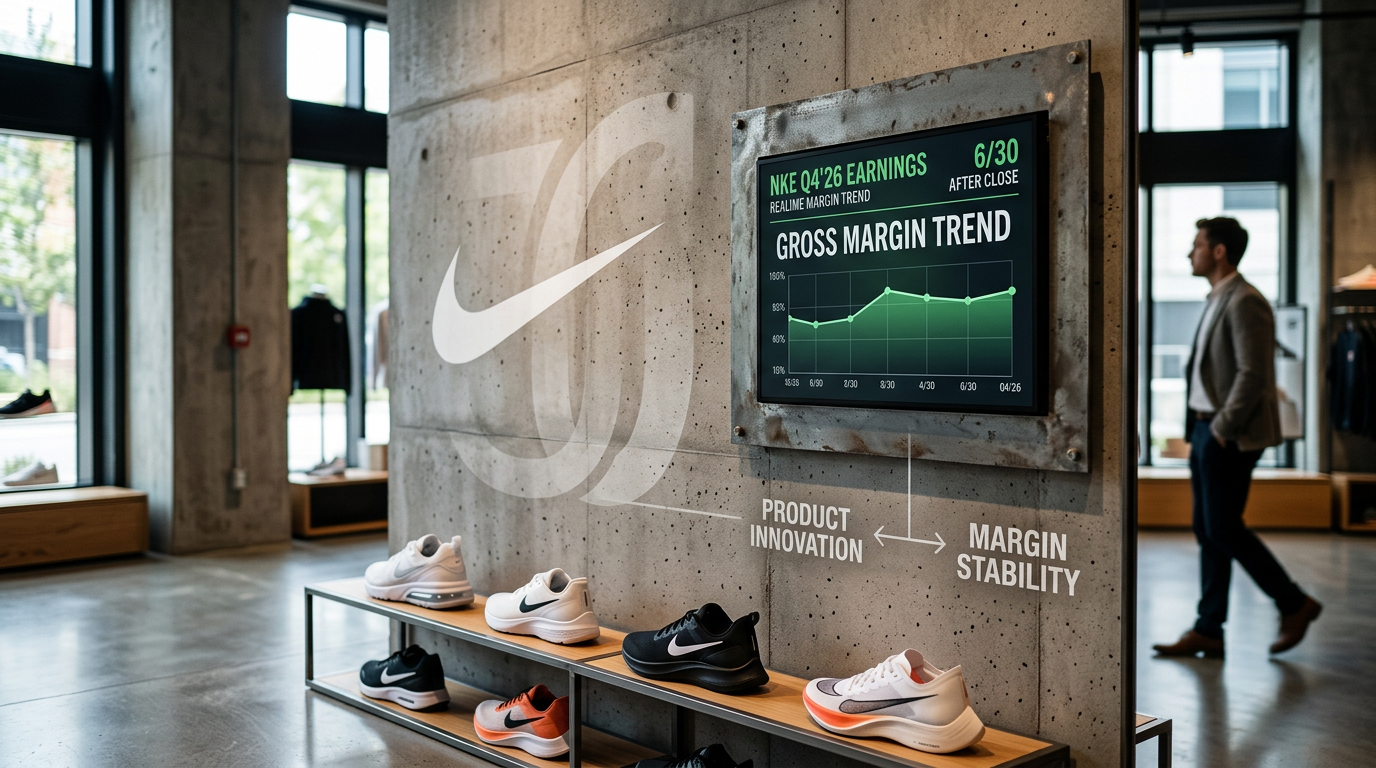
This is the number. Not revenue. Gross margin.
If Tuesday’s report shows stabilization in gross margin — or even a better-than-guided decline — the stock has a credible path toward a relief rally. If margins compress further than expected, all the wholesale progress in North America won’t matter for the stock that day.
Macro and Industry Context
The broader consumer discretionary sector is holding up reasonably well — but Nike’s divergence has been company-specific. The 2026 FIFA World Cup is a genuine marketing catalyst. Beyond that, specific claims about Nike’s World Cup order volumes are hard to verify reliably from primary sources, so treat them as anecdotal rather than bankable.
Forward Scenarios
Bull: Gross margin lands at or above the high end of guidance (management previously indicated a 25–75 basis point sequential decline). China revenue beats the ~-20% bogey. Management signals that tariff headwinds begin to ease on a clearer timeline. Stock recovers toward $52–$55 on multiple relief and guidance clarity.
Base: Revenue declines 2–3% in line with guidance. Margins land mid-range. Hill acknowledges the turnaround is “progressing” but offers no new specifics on an acceleration timeline. Stock stays range-bound between $40–$46 heading into the November investor day.
Bear: China deteriorates beyond -20%. Gross margin disappoints at the low end or worse. Guidance for early FY2027 shows no material improvement. Stock tests the $35–$37 range and attracts further downgrades.
Technical Overlay
NKE is technically broken. The stock has been in a descending channel since late 2021 and recently broke below the $42 support level that had held through much of 2025. The 50-day moving average is well above current price action, and momentum indicators are in oversold territory — which can precede a bounce, but oversold is not the same as bottomed. The key level to watch on the upside is $47–$48; a sustained close above that would suggest the near-term low is in. On the downside, $37–$38 is the next meaningful support.
What Investors Should Watch
- Gross margin guidance for Q1 FY2027 — this is the single most important data point
- Greater China revenue vs. the ~-20% bogey
- Wholesale revenue trajectory — Q3 NIKE Brand wholesale revenue was $6.5 billion, up 5% reported; any deceleration is a red flag
- FY2027 framework language — investors need to hear something about when earnings recover, not just that they will
- Tone from the CFO transition — any signal of strategy shift in capital allocation
Bottom Line
Nike is not a broken brand. It is a brand absorbing the cost of a self-inflicted strategic reset, complicated by tariffs, China softness, and an operating environment that has not cooperated. The question on Tuesday isn’t whether Nike recovers — most analysts assume it does. The question is whether June 30 gives investors a credible anchor for when and at what margin structure.
Without that, the “consensus target” remains a number attached to a hope, not a timeline.
For informational purposes only.