July 28, 2026
Boeing’s Air Force One Money Pit
Featured: Boeing’s Air Force One Money Pit
Hi Trader,
Most “gurus” who teach beginners how to trade options start in the wrong place…
Because they immediately launch into complicated concepts like Greeks, spreads, and implied volatility.
And before long, most new traders are completely lost… and move on.
The free guide I want to share with you today takes a different approach.
Instead of overwhelming you with technical details…
It starts with the basics and shows you exactly how options work, why traders use them, and how they can fit into a simple trading plan.
If you’ve ever wanted to understand options but didn’t know where to start…
This is your chance.
Click here and get your free copy now.
To your trading success,
Dave Aquino
Lead Options Trader, Base Camp Trading
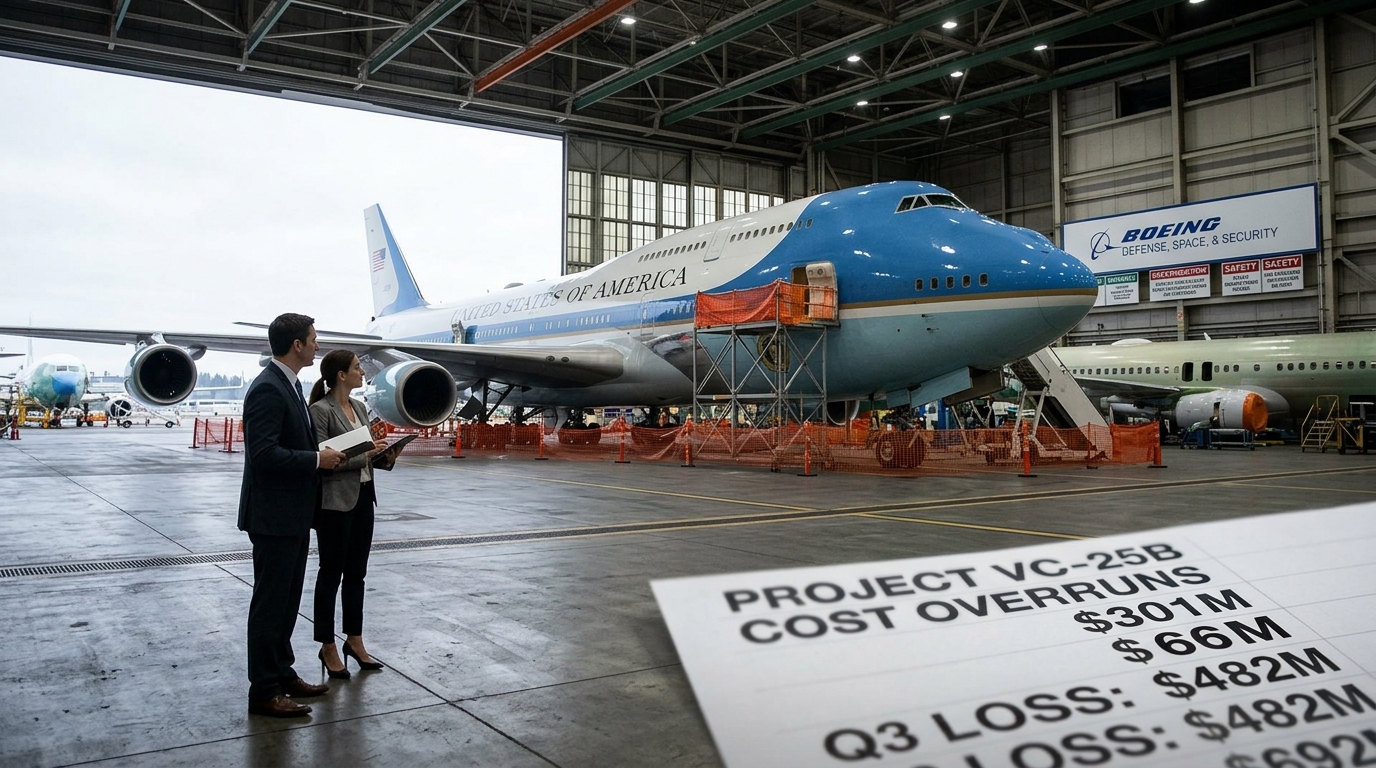
Boeing’s Air Force One Money Pit
The Big Question
Here is the question every institutional Boeing investor is sitting with right now: Is the Air Force One program a contained, closing wound — or is it still an open bleed that can undermine what is otherwise a legitimate commercial recovery story?
The answer matters more than it looks on the surface. Because the numbers that dropped this week are not small.
Why Wall Street Cares
Boeing posted a $428 million net loss in the second quarter of 2026, on top of a $7 million loss in the first quarter. While the quarterly loss was slightly narrower than the same period in 2025, the balance sheet remains filled with red ink. And a big piece of that Q2 miss traces directly back to one contract signed eight years ago.
In 2018, Boeing agreed to build two new Air Force One jets for about $3.9 billion under a fixed-price contract — meaning Boeing, not the U.S. government, absorbs most cost overruns. That decision now looks like one of the costliest miscalculations in modern aerospace history.
The program’s cost overruns have now surpassed $3.1 billion. Boeing has agreed to foot that bill.
How We Got Here
This quarter’s $280 million overrun reflects “additional production and certification resources” as Boeing works to keep the program on track. The delivery target has now been pushed to 2028 — though skeptics note even that date may slip.
Slight tangent, but it matters: A Government Accountability Office assessment concluded the planes won’t be ready until 2029. The original cost was $3.9 billion; the GAO’s current estimate is $5.6 billion. That gap between what Boeing says publicly and what the government’s own watchdog projects is worth paying attention to.
The company has cited various reasons for the massive cost overruns, including engineering design changes related to wiring and other structural requirements, schedule delays, performance issues at a key supplier, and engineering inefficiencies from the pandemic.
After signing the original contract in 2017, Boeing began refurbishing two 747 jets in February 2020 that it had built for another customer but never delivered because of that customer’s bankruptcy — a process that in hindsight probably was more expensive and time consuming than building from scratch.
The Bull Case
The investors who remain constructive on Boeing make a straightforward argument: the Air Force One program is essentially a known, finite loss. It ends. And as ugly as $3.1 billion looks, the commercial side of Boeing is showing real signs of life.
Boeing’s commercial aircraft deliveries rose 14% year over year, from 150 planes in the second quarter of 2025 to 171 in 2026. That is not noise. That is a production ramp actually working.
Boeing continues to project positive free cash flow between $1 billion and $3 billion for full-year 2026 — which would mark the company’s first positive annual result in years. The defense unit, meanwhile, has been stabilizing. Defense, Space and Security revenue in Q1 2026 came in 21% higher with an $86 billion backlog, supported by new contracts including PAC-3 missile seeker production and U.S. Air Force fighter programs.
Bulls also point to something structural: Boeing is still one of only two manufacturers of large commercial aircraft on the planet. The order backlog exceeds $500 billion. You do not replace that competitive position.
The Bear Case
The bears are less interested in what Boeing says and more focused on what Boeing keeps doing. And what it keeps doing is booking fresh losses on the same programs, quarter after quarter.
Boeing predicts it will take additional cost overruns on the troubled VC-25B program to ensure it delivers the first new Air Force One by 2028. Steve Parker, the head of Boeing’s defense unit, said: “I do expect to see some cost growth there as we come through final assembly and we finish off the wiring and the structures, as well as finishing off with certification.” That is Boeing’s own defense chief warning investors that more losses are coming. Hard to spin that.
The deal is now four years behind schedule. And the pattern here is not unique to Air Force One. During 2024, losses on Boeing’s five major fixed-price development programs totaled $5.013 billion, spanning the KC-46A Tanker, T-7A Red Hawk, Commercial Crew, VC-25B, and MQ-25.
Boeing is a high-risk turnaround play with improving revenue and margins but a fragile balance sheet. Free cash flow for the first half of 2026 was still negative at $823 million. The company needs a very strong second half just to hit the low end of its own guidance.
The Bigger Problem Nobody Is Talking About
Everyone is focused on the Air Force One dollar figure. Almost nobody is talking about what this program represents structurally for Boeing’s defense business model going forward.
Lockheed Martin CEO Jim Taiclet stated in a recent earnings call that his company has no “must-win programs” anymore, and L3Harris’ CEO remarked: “If it’s fixed-price, and it’s development, we’re not going to bid it because we don’t want to take a loss.” Defense firms are walking away from the contract structures that built Boeing’s government revenue base.
Keeping the administration and the Air Force happy is critical for Boeing, which gets 42% of its revenue from U.S. government contracts. That is the real leverage point. Boeing cannot afford to walk away from these programs the way Lockheed or L3Harris can threaten to. It is too dependent. That dependency is exactly what got Boeing into this hole in the first place.
Here is what investors are genuinely underweighting: the fixed-price contract problem does not fully go away when Air Force One ships. Boeing’s defense businesses generated approximately 60% of their 2025 revenues from fixed-price contracts. That exposure is enormous. And the KC-46 tanker program is still bleeding. During 2025, losses on fixed-price development programs totaled $802 million, primarily on the KC-46A Tanker at $714 million.
What Leading Investors Appear to Believe
The positioning suggests a split room. The most optimistic investors are betting on a 2027-2028 inflection — commercial ramp delivering free cash flow, Air Force One finally out the door, and the defense unit gradually moving toward the high single-digit margins Boeing’s CEO has been telegraphing.
“We have a lot of work to get these programs through the development phase, but I do love the direction we’re headed,” Boeing CEO Kelly Ortberg told investors.
The more cautious camp is watching free cash flow execution with one eye and the defense cost stack with the other. They are not necessarily bearish on the long-term story. They just want to see Boeing hit a quarter where no new defense charge appears. It has been a while.
Boeing’s ability to hit its full-year free cash flow guidance of $1 billion to $3 billion — which would mark its first positive annual result in recent years — will be a key test. That is the credibility moment the bulls need to see delivered.
Stocks to Watch
Boeing (BA) — The obvious name, but the investment case is genuinely two-sided. The commercial recovery is real. The defense drag is also real. Investors buying here are betting the former overwhelms the latter by 2027. The analyst consensus price target sits around $272, implying meaningful upside from current levels if the free cash flow turn materializes.
Airbus (AIR) — Every quarter Boeing stumbles on defense, Airbus quietly consolidates its commercial order advantage. Airlines that lose confidence in Boeing delivery timelines call Airbus first. The competitive gap in narrowbody backlogs has been widening, and investors in the duopoly trade should be watching that dynamic closely.
L3Harris Technologies (LHX) — The contractor most openly pushing back on fixed-price development contracts. L3Harris’ CEO has publicly stated the company will not bid fixed-price development contracts. That discipline is exactly what institutional defense investors are starting to reward. If the Pentagon eventually shifts toward cost-plus structures for complex development programs, L3Harris is positioned to win a larger share of future work.
Heico Corporation (HEI) — The overlooked angle. As Boeing works through its defense cost pile and commercial ramp, aftermarket parts and MRO spending is accelerating. Heico, which supplies FAA-approved replacement parts at significant discounts to OEM pricing, benefits from every year of delivery delays and from every aging fleet that keeps flying. Quiet beneficiary. Worth a closer look.