
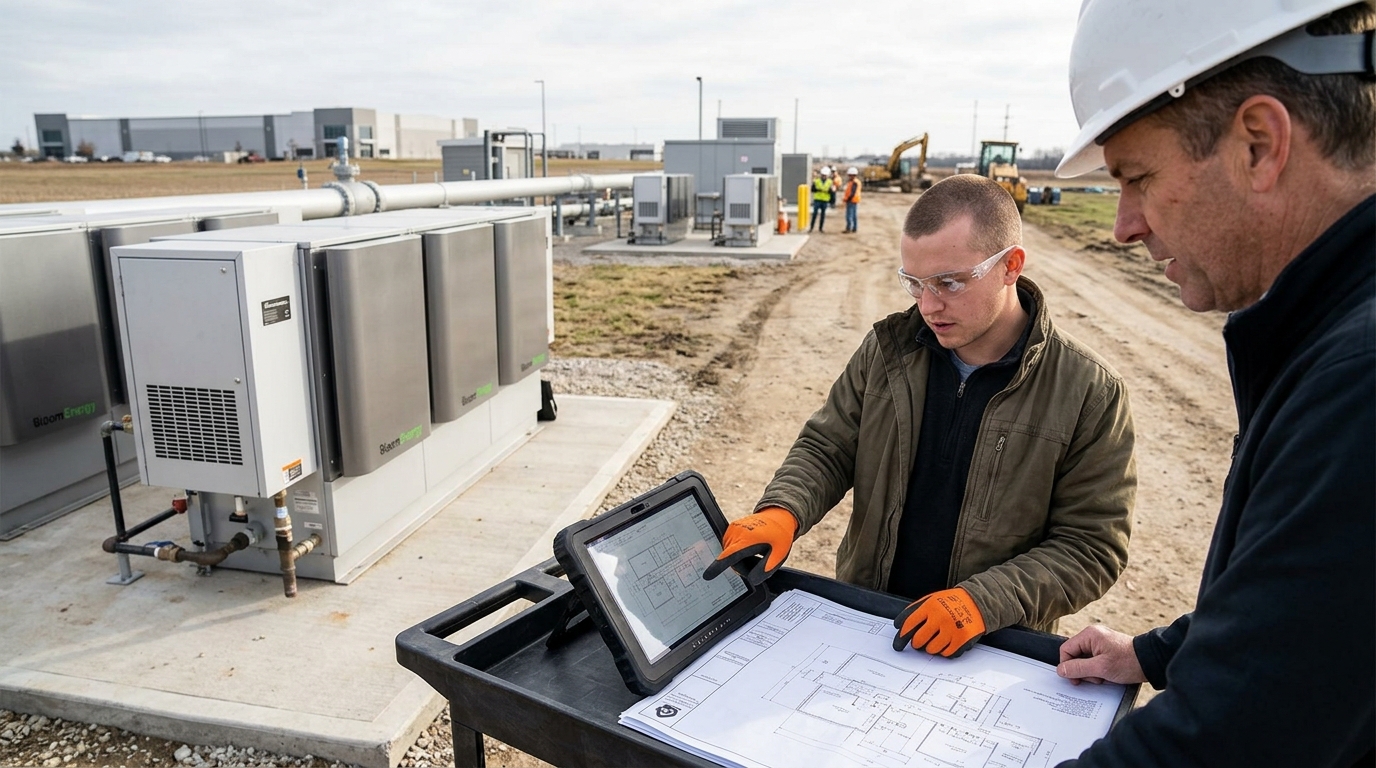
Here is the thing about Bloom Energy right now. The stock is up sharply year to date, it says it has the largest order “backlog” in company history, and it just landed a $1.7 billion project investment commitment from Oaktree and Industrial Development Funding. Then it promptly fell about 40% from its mid-June record high.
That kind of disconnect is worth paying attention to.
The company reports Q2 2026 results after the close on July 28. Options traders have priced in about a 32% move in either direction, a number that’s roughly in line with widely cited options-implied estimates heading into the print and far above Bloom’s recent average post-earnings move (around 12% over the past four quarters). That is not normal pricing. Something has to resolve.
What the Bears Are Saying
Two events hit the stock hard over the past few weeks. First, short seller Hunterbrook published a report challenging Bloom’s backlog disclosures and raising questions about supply chain and materials sourcing (including references to scandium). Bloom said it is reviewing the report and would “correct the record.” A securities investigation has since been announced by at least one law firm. Management’s response matters here. If the supply chain thesis holds, the short case weakens significantly.
Second: Oracle’s Project Jupiter data center in New Mexico hit a regulatory wall. New Mexico’s State Land Office rejected, for a second time, an application tied to Energy Transfer’s proposed natural gas pipeline intended to serve the site. The pipeline has been linked in reporting to Project Jupiter’s plan to use up to ~2.5 gigawatts of Bloom’s fuel-cell capacity. The delay does not necessarily kill the project, but it pushes timeline certainty further out, and the market hates uncertainty before an earnings call.
There was also a quieter technical headwind. Bloom moved from the Russell 2000 to the Russell 1000 as part of the June 2026 reconstitution, which shifted its investor base at exactly the wrong moment. Forced selling tends to look like fundamental deterioration. Often it is not.
What the Bulls Have
Bloom reported Q1 2026 revenue of $751 million, up 130% year over year, with non-GAAP diluted EPS of $0.44 and GAAP net income of about $70.7 million. The company raised its full-year 2026 revenue guidance to a range of $3.4 billion to $3.8 billion, and it has promoted a total backlog figure around $20 billion—though that backlog definition has become a focal point of the short-seller critique.
Oaktree and Industrial Development Funding committed $1.7 billion in project investment tied to deploying Bloom’s fuel cells for the build-out of AI cloud infrastructure associated with Nebius. Slight tangent, but it matters: AI data centers are burning through power faster than the grid can supply it, and Bloom’s solid-oxide fuel cell systems generate electricity through a non-combustion electrochemical process and can run on fuels such as natural gas today, with flexibility to use hydrogen or biogas depending on availability and economics. That is not a niche technology anymore. It is becoming infrastructure.
The fuel cell market is expected to grow at roughly 37% per year through 2031, according to Mordor Intelligence. If even a fraction of the announced deals convert to revenue, the growth story holds.
The Numbers to Watch July 28
Wall Street’s consensus calls for very large year-over-year Q2 revenue growth, with many forecasts clustered around the ~90%+ range. Full-year 2026 consensus is commonly cited around the mid-$3.7 billion area for revenue, with earnings-per-share expectations implying substantial year-over-year growth. Bloom has beaten analyst estimates repeatedly in recent quarters. That streak will be tested July 28.
The gross margin guidance matters as much as the revenue line. Bloom has guided to roughly ~29% non-GAAP gross margin for 2026. Any expansion above that level, or any hint of the Oracle pipeline situation progressing, could be what resets the chart from oversold to opportunity.
Options Market Analysis
With the ~32% implied move priced in, this is high implied volatility territory well above historical realized moves. IV rank is elevated heading into the report. The options market is not predicting direction, it is pricing in maximum uncertainty, which is useful information on its own.
For traders expecting a beat and resolution of the regulatory concerns: A defined-risk bull call spread around current levels gives exposure to upside while capping the downside risk to premium paid. The elevated IV means premium-selling strategies like short puts below key support or risk reversals may also attract traders who believe the selloff is overdone.
For traders with a bear thesis around supply chain and Project Jupiter delays: Long puts or a put spread below the current price captures the downside if Q2 guidance disappoints or the Oracle timeline slips further.
Neutral traders: The ~32% implied move nearly guarantees IV crush after the report. Short straddles or iron condors can benefit if the actual post-earnings move is smaller than the market expects, as it has been on average over the past several quarters.
Risk Analysis
The main risks going in: the Project Jupiter delay reduces near-term timeline clarity; the short-seller allegations, while disputed, create overhang that could persist until more audited detail and contractual clarity are provided; and the valuation is not cheap. The stock trades at a significant premium on forward expectations, which means there is little room for a guidance cut.
On the bull side: the company’s claimed backlog provides a buffer if it proves durable and convertible. The IDF/Oaktree commitment represents real capital behind real projects. And a string of recent beats creates a credibility floor for management.
Forward Outlook
Analysts covering BE hold an average “Buy” rating with an average 12-month price target around $281. Zacks has the stock ranked a Strong Buy heading into earnings. The market appears to be pricing in failure. The business is growing quickly. Those two things cannot both be right for long.
What actually matters on July 28 is the gross margin trajectory, any update on Project Jupiter’s fueling/pipeline situation, and whether management defends the short-seller claims with specific, verifiable data. If those boxes get checked, the gap between where BE is trading and where it was six weeks ago has a plausible path to close, fast.
The ~32% implied move tells you the market is not sure which way. That is either the best reason to wait, or the best reason to define your risk and pick a side before the call starts.
Pre-Earnings Checklist
- Q2 revenue vs. Street expectations (often cited around ~90%+ year-over-year growth)
- Gross margin vs. the ~29% guidance level
- Project Jupiter regulatory/pipeline update
- Management response to Hunterbrook allegations on backlog and supply chain
- Full-year revenue guidance revision vs. current $3.4B–$3.8B range
- Options: ~32% implied move priced in; IV crush likely post-report
- Key date: July 28, after market close