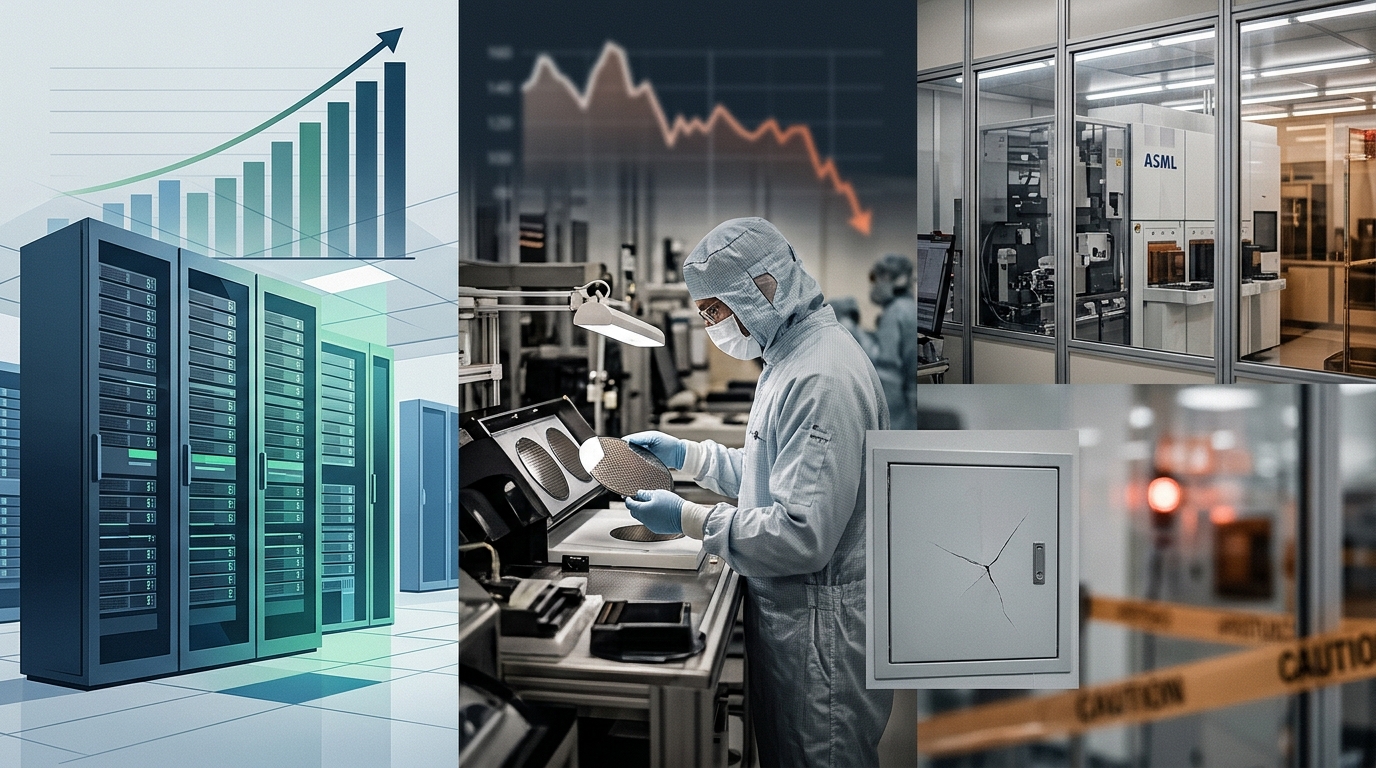
Intel beat Wall Street on every Q3 metric that matters, then watched its stock sink hard in after-hours trading. That gap between what happened and how investors reacted tells you everything about where this turnaround actually stands.
Q3 revenue came in at $16.5 billion, up 21% year-over-year, with non-GAAP EPS of $0.52. That EPS figure beat the $0.40 consensus by 30%. The headline numbers were clean. The market did not care.
What the Guide Revealed
Intel expects fourth-quarter revenue between $15 billion and $16 billion, below analysts’ average estimate of about $17.07 billion. That is a gap of roughly $1.6 billion at the midpoint. Gross margin is guiding to 38%, well below Q3’s 44.1%, and management said it is unlikely Intel will generate positive free cash flow in 2027 during heavier investment.
The driver is the PC business. Intel said Client Computing and Physical AI Group revenue fell 5% year-over-year to $8.10 billion in Q3, and it expects a mid-20% decline in that segment for Q4. Management also signaled that PC unit demand is likely to be weakest in the first half of 2027. Soaring memory prices are the proximate cause, compressing consumer demand for new machines and forcing Intel to cut wafer starts.
The Factory Blast
Layered on top of the PC problem is something nobody modeled. An explosion at Intel’s chip fabrication plant in Israel killed two workers and seriously injured a third, and the company said the incident will cost it about $600 million in lost revenue over the next two quarters. The Kiryat Gat facility is known internally as Fab 28.
CFO David Zinsner said Intel planned to start ramping up production at the facility by the end of this week after a roughly two-week shutdown. But the damage assessment is still running. Zinsner noted: “We’re still assessing all of the wafers to see which ones are usable and which ones aren’t, so we’ll have to see whether there is an impact that stretches beyond that.” The $600 million figure is an early estimate, not a ceiling.
The Foundry Story: Still Intact, Still Unproven
This is where the investment question gets serious. Intel’s entire bull case rests on the foundry business, and the foundry business rests on landing external customers for the 18A process node. Intel Foundry revenue rose 58% year-over-year, though the segment continued to post an operating loss. The revenue growth is real. The profitability is not.
The standout performer was the Data Center and AI segment, which posted $7.3 billion in revenue, a 78% jump year-over-year. Intel itself called it the company’s strongest data center revenue growth in 15 years. The irony is that the Kiryat Gat site disruption hit at the same time data center demand is accelerating, and management has said the incident will reduce supplies and pressure results.
Intel also said its 2026 gross capital spending remains on track to be about $20 billion, and that 2027 capital spending is expected to rise strongly as it expands manufacturing capacity. Committing to heavier spending while warning that positive free cash flow is unlikely in 2027 is the kind of statement that tests investor patience.
Bull vs. Bear
The bull case is still coherent. Data center revenue nearly matches the PC business now, and Intel says 18A has reached volume production, with high-volume production ramping in Arizona. Jefferies previously reiterated a $120 price target and Piper Sandler initiated coverage at $110 earlier this fall, both implying meaningful upside from typical post-earnings levels.
The bear case is that the PC problem is structural and the foundry story depends entirely on external customer wins that have not arrived. Intel has not disclosed a major outside customer in volume for 18A, and some analysts have suggested 18A-P could be a more likely proving point. A plant explosion that disrupts server chip supply is the worst possible advertisement for a company trying to convince hyperscalers to trust its manufacturing.
What to Watch
Two numbers define the next six months. First, the PC trajectory: any improvement in memory prices that restores consumer demand would pull forward Intel’s earnings recovery. Second, and more consequential, is whether the foundry wins that management has been pointing to for the second half of 2026 actually materialize. As one portfolio manager put it, “The explosion at Kiryat Gat brought down Intel’s capacity. The question is whether Intel can build capacity fast enough to capture it.”
Intel delivered the earnings beat investors wanted. What they got instead was a reminder that a turnaround in progress is not the same thing as a turnaround complete.