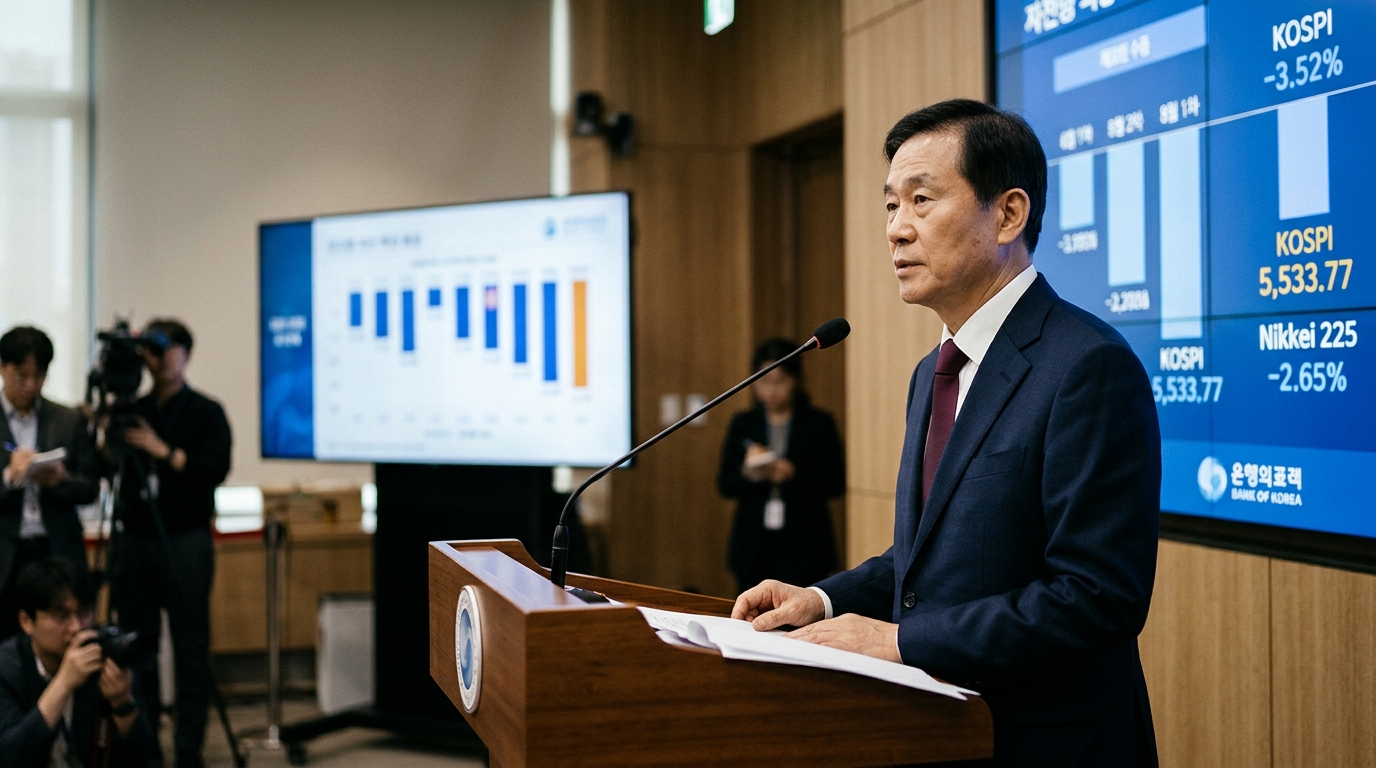
Something changed Thursday that most markets coverage will miss. The KOSPI fell 3.52% to 5,533.77. The Nikkei 225 dropped 2.65% to 62,907.84, sliding back below 63,000 for the first time since September 14. Samsung Electronics lost 4%, SK Hynix fell 5.5%, Kioxia shed nearly 7%, and SoftBank tumbled 6.86%. All of that was bad enough. The bigger development came from a press conference in Seoul.
Bank of Korea Governor Shin Hyun-song, speaking after the Monetary Policy Board held the benchmark rate at 3.00%, acknowledged explicitly that the equity correction is pulling down real spending. “Share prices have undergone significant correction recently, and we see that affecting the real economy as well,” he said, according to Reuters. He added that falling trading volumes and weaker market momentum reduce measured consumption directly, because financial services consumption, brokerage fees and transaction costs, falls with activity. The wealth effect, he noted, may now be larger than historical data captured, because retail participation in Korean equities has grown substantially.
This is the moment professional investors should mark. For weeks the AI derating has been framed as a portfolio problem: does AI capex justify AI valuations? Thursday it became something else. A G20 central banker, at a scheduled policy meeting, built the equity selloff into his consumption outlook. That is a different category of event.
What the Investment Committee Should Be Debating
The bull case for Asian tech has rested on one anchor: even if valuations compress, the underlying demand for high-bandwidth memory and AI infrastructure is real and durable. SK Hynix has guided that its 2026 capital spending is expected to reach the high 40 trillion won range. That thesis has not broken. SK Hynix’s Q3 earnings, due October 28, will be the first hard data check.
The bear case is more structural and harder to dismiss after today. Daishin Securities analyst Lee Kyoung-min argued this week that concerns about AI credit risk and profitability were limiting the durability of any chip-share rebound. KCM Trade analyst Tim Waterer framed it more bluntly: investors cannot find a satisfactory level of AI capital spending. Raise budgets and financing risk rises. Cut them and growth expectations fall. The Nikkei’s break back below 63,000 suggests the same logic is pricing into Tokyo.
The same logic that is repricing Korean semis has already pushed the broader chip index into bear market territory. The Philadelphia Semiconductor Index entered a bear market as a Chinese open-weight model challenged the premise that frontier AI requires ever-more-expensive hardware.
What Shin said Thursday adds a third dimension. If the stock correction is already trimming Korean household consumption, a further leg down in semis would feed back into domestic demand at exactly the moment the Bank of Korea is projecting export strength to carry growth. The central bank’s own model now has an equity variable inside it.
What Investors Are Missing
Most sell-side reaction will focus on whether the BoK rate hold is hawkish or dovish. That is the wrong question. Shin’s consumption comment is the overlooked signal. It means the Bank of Korea’s reaction function now responds, at least at the margin, to where Samsung and SK Hynix trade. A deeper AI derating is no longer just a tech-sector problem; it has a transmission channel into Korean consumer data, which feeds BoK projections, which shape rate expectations, which affect Korean credit spreads. The loop is tighter than it looks from the outside.
The transmission channel runs further than Korean consumer data. Private credit markets financing AI chip infrastructure are already showing signs of masked stress that complicate the debt behind the capex cycle.
Stocks to Watch
- SK Hynix (000660.KS): Down 5.5% Thursday. Q3 results on October 28 are the next inflection point. HBM4E delivery timelines to Nvidia will matter more than the headline profit figure.
- Samsung Electronics (005930.KS): Down 4% Thursday. Broader product mix provides some cushion, but it remains the largest single weight in the KOSPI and the clearest proxy for the AI memory trade.
- SoftBank Group (9984.T): Down 6.86%. Its exposure runs through Arm and a portfolio of AI infrastructure bets. Every AI capex question is a SoftBank question.
- Kioxia (285A.T): Down nearly 7%. The NAND market was already navigating oversupply concerns before Thursday’s session. A prolonged AI derating removes the demand story that was expected to absorb that supply.