Here is a question worth sitting with: what if the most defensible part of Tesla’s business is not the car, not the software, and not the Supercharger network, but a chemistry process happening inside two industrial buildings in Nevada and Texas?
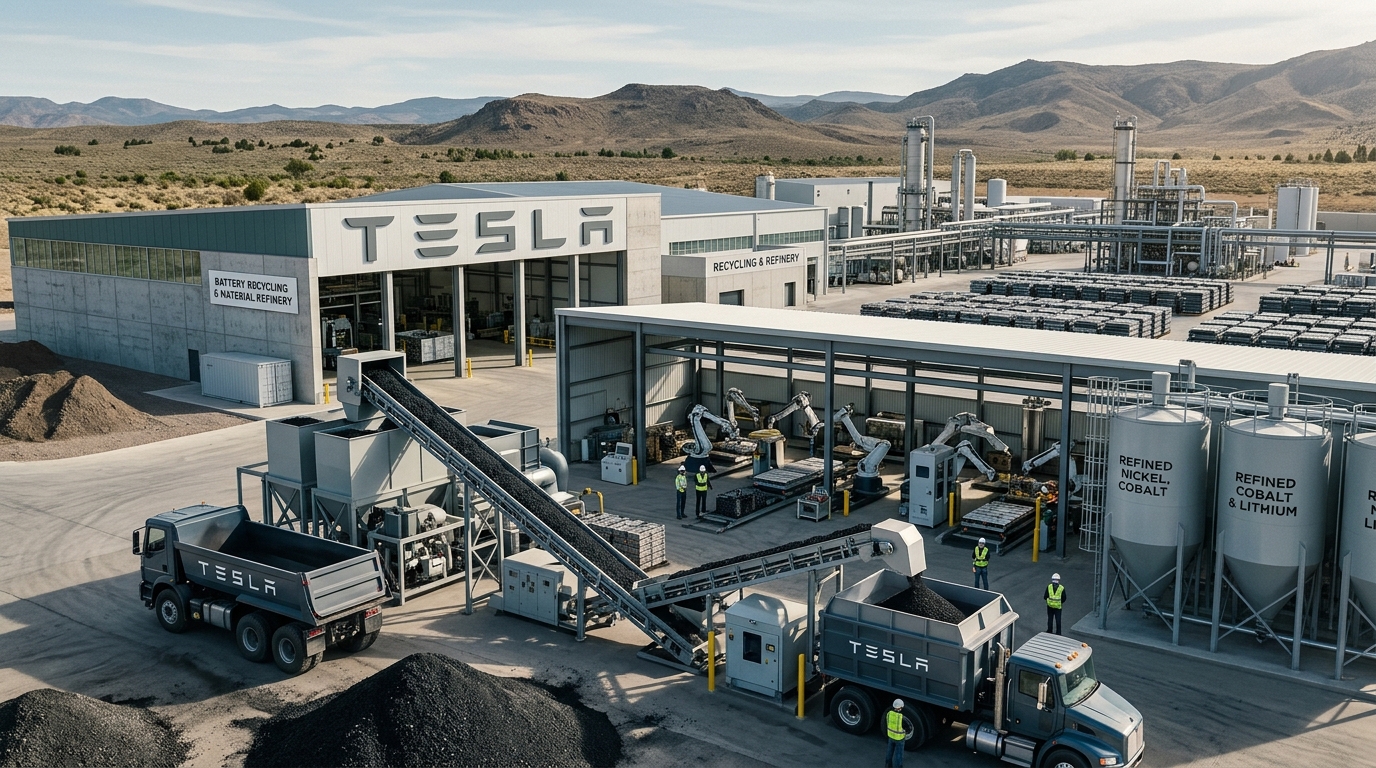
Tesla says its battery recycling volumes rose 20% in 2025, with over 14,000 metric tons of battery material processed through a combination of in-house Gigafactory operations and third-party partners. Put that in physical terms: Tesla said that volume is equivalent to the raw materials needed to produce roughly 46,000 long-range battery packs. That is not a sustainability footnote. That is a secondary ore body Tesla is working to control.
The Loop Is Closing Faster Than Expected
Tesla says that across its U.S. recycling operations, it is now recovering more than 90% of key battery materials, like nickel and cobalt. The Nevada facility is already at scale. Tesla says the Texas facility is expected to process 3,000 metric tons of manufacturing scrap per year by the end of 2026, using a dry shredding line to produce black mass for reintegration into the supply chain, while piloting new lithium recovery technology with the goal of extending closed-loop recovery to graphite, nickel, and cobalt.
The process technology is where the competitive moat deepens. In its 2025 Impact Report, Tesla says its Gulf Coast lithium refinery uses what it calls the world’s first commercial-scale alkaline leach process and that the approach reduces processing steps and eliminates sulfuric acid, cutting greenhouse gas emissions by over 30% compared with traditional hard-rock refining. Tesla has also pointed to water-reuse and heat-recovery features in the refinery’s design, part of a broader effort to make the chemistry both cleaner and cheaper than conventional routes.
The Investment Thesis Hidden Inside the Refinery
Tesla has said the Robstown-area Gulf Coast facility is intended to be North America’s largest lithium refinery, producing 20,000 metric tons of battery-grade lithium hydroxide monohydrate annually, enough to support about 30 GWh of battery production. But public disclosures do not clearly support the claim that the refinery reached full operational capacity in May 2026 and was confirmed fully ramped as of July 2026. What is supported is that the company has described the facility as now fully operational, with at least one local Texas news report in January 2026 citing an Elon Musk post saying the refinery was fully operational.
Closed-loop recovery means materials extracted from end-of-life or scrap batteries are refined and fed directly back into new battery production rather than sold off. Tesla’s stated goal is to extend this loop beyond lithium to cover graphite, nickel, and cobalt, meaning a battery pack’s raw materials could cycle through multiple vehicle lifetimes without ever leaving Tesla’s supply chain. No competitor operates anything close to this vertically integrated at Tesla’s stated scale in the U.S.
The Risks Are Real
Scale is the obvious one. Tesla has suggested that by 2030 it expects recycled material output to rival total production from mines across North America. Domestic lithium extraction today remains limited, with the long-running Silver Peak operation in Nevada often cited as producing around 5,000 metric tons of lithium carbonate per year. The gap between current output and that ambition is enormous, and closing it depends on end-of-life vehicle volumes growing fast enough to feed the recycling pipeline.
The global markets for lithium, nickel, and cobalt have historically been volatile, and supply disruptions or export restrictions can send commodity prices swinging in ways manufacturers cannot easily absorb. A company that sources a meaningful share of its battery materials from its own recycling stream gains insulation from those pressures. That insulation is not yet complete, but it is being constructed, facility by facility.
Bottom Line
Wall Street prices Tesla as an automaker. The recycling infrastructure argues for something more durable: a vertically integrated materials business with proprietary chemistry, captive feedstock, and a cost floor that falls with every vehicle it sells and eventually recycles. Whether that is worth a premium to the stock depends on execution at Robstown and Austin. The operational milestones in the next 18 months will say more than any earnings call.