September 18, 2026
Bonus Content: iPhone 18 Pro Is Easy to Buy Today. That Changes the December Quarter Math.
Dear Reader,
The biggest mistake investors made during America’s first Great Deflation was buying the railroads.
More than 100 of those railroads eventually went bankrupt.
The best investments were the companies that used collapsing freight costs to crush their competition.
And I believe investors are making the exact same mistake with AI today.
They’re piling into the obvious “railroads”: NVIDIA, Microsoft, Meta, and Google.
Meanwhile, one little-known aerospace manufacturer has connected 19 factories around the world into a single AI-ready data system.
And it is already producing remarkable results.
Its record profit margins climbed 25% year over year.
Revenue rose 11% last year.
But I don’t believe the story is finished.
This company isn’t trying to build the next artificial-intelligence empire. It’s using AI to make every factory faster, leaner, and more profitable.
It has now hit all five triggers in my proprietary stock-selection system, including accelerating sales, rising earnings, breakout momentum, insider buying, and meaningful disruption.
Don’t make the mistake of chasing the railroad while this potential “Price Killer” races ahead.
Good investing,
Alexander Green
Chief Investment Strategist, The Oxford Club
P.S. 19 connected factories, record margins, and all five of my triggers tell me the larger story may still be ahead.
See my larger prediction here.
iPhone 18 Pro Is Easy to Buy Today. That Changes the December Quarter Math.
The shelves are not empty. That is the fact Apple bulls and bears have been waiting six days to confirm, and it landed this morning with more force than either side expected.
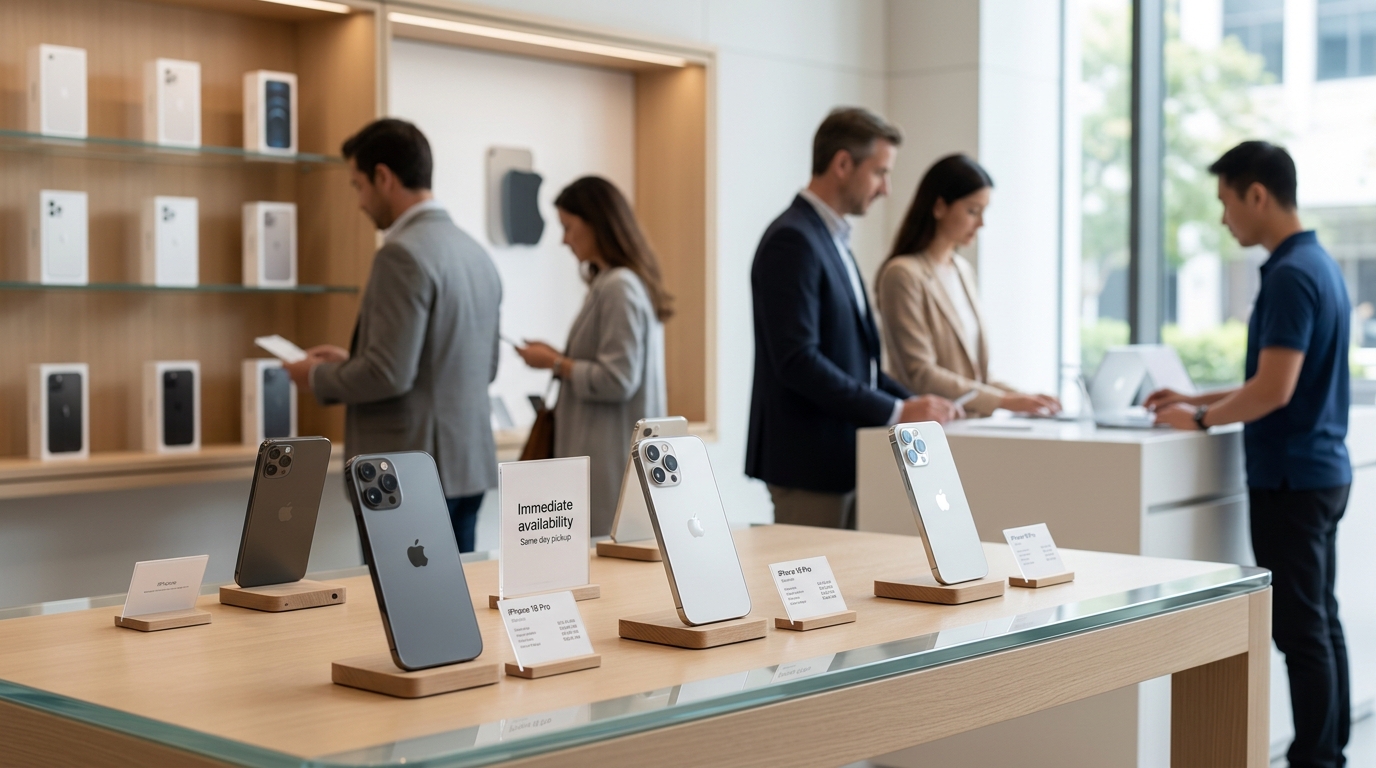
iPhone 18 Pro and iPhone 18 Pro Max models began reaching customers worldwide today following pre-orders that opened September 12. For those who didn’t pre-order, online wait times in the U.S. now run roughly two to three weeks for the Pro and about three to four weeks for many Pro Max configurations, depending on color and storage. Walk into a store, though, and the picture is different. In-store pickup on launch day remains an option at select Apple Store locations, with availability varying by configuration and state. In past cycles, walking in on day one was a gamble. Today it is a genuine possibility for much of the lineup.
The pre-order window told the same story. The iPhone 18 Pro was broadly available for launch-day delivery more often than the Pro Max, which showed longer waits across many configurations. GF Securities analyst Jeff Pu described pre-order data as “lukewarm,” attributing the weakness to limited feature upgrades and a higher price point. The iPhone 18 Pro starts at $1,199, the Pro Max at $1,299. Those are not cheap phones, and buyers appear to know it.
The bear case writes itself: same-day availability usually means inventory is ahead of demand, not the other way around. In a normal launch year, that reading would be fairly clean. This year it is not, because the launch calendar itself is broken in half for the first time in Apple’s history.
The iPhone 18 Pro and Pro Max went on sale today after pre-orders opened September 12. The iPhone Duo, Apple’s first foldable, opens for pre-order October 16 and arrives October 23. The standard iPhone 18, iPhone 18e, and iPhone Air 2 are not part of this launch at all. Reports consistently point to spring 2027 for those models. That means the entire December quarter’s iPhone revenue rides on two Pro models and a foldable, with less volume base underneath than in a typical year.
JPMorgan’s read, cited in several recent notes, is that some buyers are deliberately waiting for the Duo rather than committing to a Pro now. If iPhone 18 Pro sales come in flat, Apple will see it in the stock price by quarter’s end, and management must hope JPMorgan analyst Samik Chatterjee is right that customers are holding out for the Duo in October. That is a plausible thesis. It is also unverifiable until Duo pre-orders open in four weeks.
What the split calendar does, structurally, is concentrate average selling price while removing unit volume. Average selling price replaces unit count as the main growth engine, and higher revenue per device only becomes higher profit if Apple protects the margin behind it. Higher memory and component costs have been a recurring pressure point in Apple’s recent filings, and the $1,199 Pro and a premium-priced Duo will test whether Apple can pass rising costs to consumers. The December quarter could be both the richest mix Apple has ever shipped and the most exposed to a shortfall in unit volume.
For supply chain investors, the split carries its own read. TSMC and Foxconn are not seeing a broad-based iPhone ramp this autumn; they are seeing a premium-only build. Qualcomm exposure is also more concentrated than in a typical year. Most iPhone 18 Pro models use Apple’s in-house C2 modem, but the iPhone 18 Pro Max sold in the U.S. uses a Qualcomm modem. A lukewarm Pro cycle does more damage to that group than a mixed cycle would, precisely because the volume cushion from the base model has been moved to spring.
Stocks to watch: AAPL is the obvious center of the debate, with the December quarter now a cleaner, higher-stakes test than any in recent memory. TSM faces the same concentrated premium ramp, with less base-model volume to buffer against a Pro shortfall. QCOM still earns iPhone modem content, but its exposure is more specific to the U.S. iPhone 18 Pro Max this cycle; a softer Pro cycle compresses that contribution with no offsetting base-model units until spring. And watch Foxconn: if Duo supply stays tight through October, assembly revenue recognition slides, which matters for a quarter the market is already pricing as exceptional.