July 1, 2026
Broadcom Is Down 25% From Its High. The Business Has Never Been Better.
First a message from InvestorPlace Media
Editor’s Note: Our friend Louis Navellier is a regular guest at Mar-a-Lago, President Trump’s private residence in Palm Beach Florida. He’s also one of America’s top tech investors, managing a $1.1 billion portfolio – including $358 million in AI stocks. (He recommended Nvidia to his followers before it soared 44,000%.) In addition, he predicted the Dot-Com crash. He called Google’s rise. And now he has a shocking warning about the SpaceX IPO that all Americans deserve to hear. See below for details.
 |
SpaceX went from a $1.75 trillion IPO – the biggest in history…
To a $2.5 trillion valuation just days later.
Elon became the world’s first paper trillionaire.
But Elon’s dreams of dominating space and AI could soon come crashing down.
And the SpaceX hype train continues, despite some choppy performance in the stock.
But I’m writing to you with an urgent warning.
Do not invest a DIME in SpaceX until you’ve heard what’s coming.
Because Donald Trump has signed Executive Order (#14363).
Not only could it render SpaceX’s AI technology obsolete…
It could trigger a $100 trillion “reset” of the AI markets in America.
And it could “roll back” all the stock’s early gains in the process.
How could Trump’s executive order end Elon’s dreams of AI dominance?
How could it send shares of one obscure AI stock soaring?
And how could you turn this into a massive opportunity, starting now?
Simply click here for my brand-new presentation revealing all the details.
I even reveal the name and ticker of one company poised to profit, for free.
Fair warning: This information is very time sensitive.
I could take it down at any time.
So please don’t delay.
Inform yourself now, before you invest a dime in SpaceX.
Louis Navellier
Senior Investment Analyst, InvestorPlace
P.S. I consider this the biggest prediction in my 40-year career. Trump’s executive order could send shockwaves throughout the AI economy. As you’ll see, he’s building a new AI technology 283 trillion times more powerful than Elon’s. It may sound crazy. But it’s 100% true. And understanding exactly what’s coming could save you a lot of money in 2026… while getting you in early on the biggest AI revolution ever.
FEATURED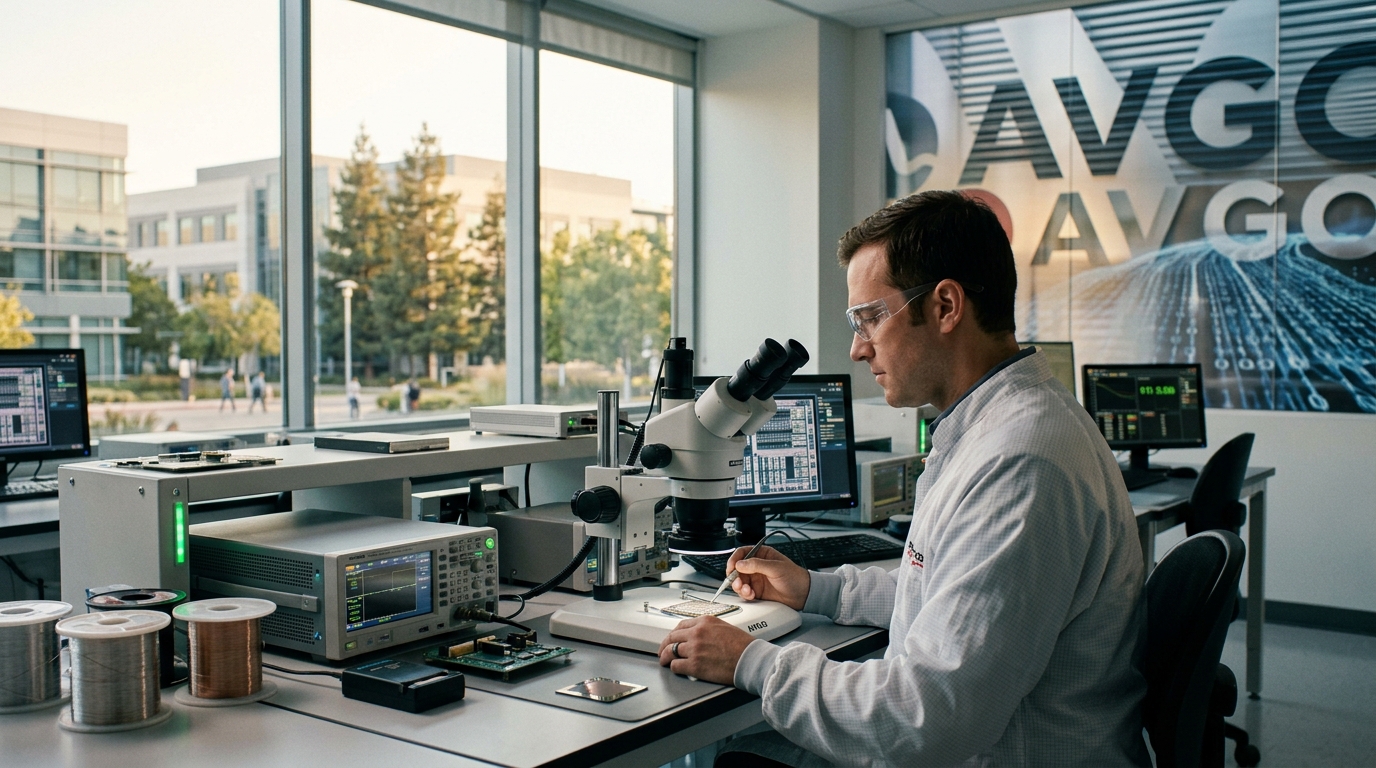
Broadcom Is Down 25% From Its High. The Business Has Never Been Better.
Broadcom just had one of the busiest months in its history. Record earnings. A landmark chip deal with OpenAI. A $35 billion AI compute financing platform backed by Apollo and Blackstone. And the stock is sitting roughly 25% below its peak.
That gap is worth understanding.
What actually happened
On June 3, Broadcom (AVGO) reported fiscal Q2 2026 results. Total revenue came in at $22.2 billion, up 48% year over year. AI semiconductor revenue hit a record $10.8 billion, up 143% year over year. Free cash flow reached $10.3 billion for the quarter. The company also guided Q3 total revenue to $29.4 billion, up 84% year over year, and reaffirmed its full-year AI semiconductor revenue target of $56 billion.
The stock dropped anyway.
Two things spooked the market. First, the infrastructure software division posted $7.18 billion in revenue, missing analyst expectations of $7.32 billion. Second, the Q3 AI semiconductor revenue guide of $16 billion came in below analyst estimates of $17.2 billion. Never mind that $16 billion would still represent over 200% growth year over year. The market had priced in perfection, and anything short of perfection was punished.
Then came the Jalapeño announcement.
July 9th: the deadline that reprices this stock
Three fuses are already lit.
10/14/25: Microsoft killed Windows 10. Over a billion PCs forced to upgrade to ghost-chip hardware.
1/9/26: Defense Secretary Hegseth signed the off-grid AI mandate.
7/9/26: Every defense contractor must demonstrate ghost-chip capability. That’s when the hardware orders become irrevocable.
Every single order pays a royalty to the same company.
The last time an architecture monopoly emerged at this scale, early investors turned $2,000 into $279,160.
See all three “Ghost-Chip Trinity” stocks before July 9th >>
The OpenAI chip changes the picture
On June 24, OpenAI and Broadcom unveiled Jalapeño, OpenAI’s first custom-built AI inference chip, designed and brought to production in collaboration with Broadcom, with Celestica helping industrialize the platform through board and rack system integration. The chip was built from scratch in nine months. Engineering samples are already running machine-learning workloads in the lab. Early testing shows performance per watt substantially better than current state-of-the-art alternatives.
Inference is where the real volume is. Training gets the headlines, but inference is what happens billions of times a day every time someone queries ChatGPT or runs a Codex task. Making inference cheaper and faster is the actual economic lever, and Broadcom is now OpenAI’s partner on that problem.
OpenAI has said it plans to start using Jalapeño to handle customer queries later in 2026.
Slight tangent, but it matters: the real question is not whether Broadcom can build the chip. It already did. The question is whether OpenAI keeps this chip exclusive to its own inference workload or eventually opens it to third-party customers. If the chips stay primarily internal, it limits the near-term revenue ceiling for Jalapeño specifically, even as it locks in a massive, growing customer.
The numbers that matter
- Q2 revenue: $22.2 billion (+48% YoY)
- AI semiconductor revenue: $10.8 billion (+143% YoY)
- Q3 AI semiconductor revenue guide: $16 billion (analyst estimate was $17.2 billion)
- Q3 total revenue guide: $29.4 billion (+84% YoY)
- FY2026 AI semiconductor revenue target: $56 billion
- FY2027 AI revenue target: more than $100 billion (reiterated)
- Q2 GAAP gross margin: 77.1% (guided down to roughly 74% in Q3 due to mix shift toward AI chips)
- Q2 free cash flow: $10.3 billion
- Market cap: approximately $1.8 trillion
- 52-week range: $262.66 to $495.00
- Current price (as of June 30): $372.45
- Trailing P/E: approximately 62.8x
- Custom chip customers confirmed: six, including Google, Anthropic, OpenAI, and Meta (two others not publicly named)
The valuation question
At roughly 62.8 times trailing earnings, Broadcom is not cheap by traditional metrics. That is the honest answer. But it is cheaper than it was at $495. JPMorgan maintains a $580 price target and has publicly called for investors to be aggressive buyers at current levels. The Wall Street consensus sits around $510 to $524, depending on the source. That implies somewhere between 35% and 40% upside from current levels.
What justifies the premium? The VMware software layer, which Broadcom absorbed through its 2023 acquisition, carries structurally higher margins than silicon. Every enterprise that renews a VMware Cloud Foundation deal converts legacy infrastructure spend into recurring software revenue. Infrastructure software revenue grew 9% year over year in Q2 to $7.2 billion, with Q3 expected to grow 31%. It is a large, recurring-revenue base alongside the AI semiconductor ramp.
The bear case is real though. As AI semiconductors climb toward a larger share of total revenue, gross margin gets squeezed. Broadcom itself guided Q3 gross margin down to roughly 74%, since custom AI silicon carries thinner margins than its software business. CEO Hock Tan has acknowledged that Google will likely draw on multiple chip suppliers going forward, and MediaTek has publicly raised its custom AI chip revenue forecast for 2026. None of that breaks the Broadcom story. But at 60-plus times earnings, any guidance softness is expensive.
A 64% Dividend from Gold?
One little-known fund tied to gold is quietly delivering 64% Yields – paid monthly. And almost no one is talking about it.
Click here to discover the secret gold income fund before the next payout.
What I’m watching
The next earnings report is expected September 3, 2026. Between now and then, the key variables are whether the VMware integration keeps expanding margins, whether any of the six custom chip customers announce delays, and whether Jalapeño’s technical performance holds up as production scales.
The stock peaked near $495 on June 3. It closed June 30 at $372.45. At that level, the market is pricing in continued AI revenue growth but demanding execution. Broadcom has executed. The question is whether it can keep doing it at a premium multiple when competition from Marvell, and increasingly from in-house hyperscaler silicon efforts, is intensifying.
If the Q3 guide converts cleanly and the Jalapeño timeline holds, this is a different stock by late 2027. If hyperscaler spending softens or Google keeps diversifying chip suppliers further, the multiple has more room to compress from here.
The business has never been better. The stock is cheaper than it was a month ago. Those two facts are worth sitting with.