
October 7, 2026
Bonus Content: Delivery Vans Are Becoming Power Plants. Wall Street Hasn’t Priced It.
Dear Reader,
You check your balance.
But how closely do you follow the systems behind it?
Four federal information collections touch bank deposits, financial customer-data security, securities-market activity and institutional trade settlement.
Each has a public-comment window closing October 26, 2026.
That gives you a specific reason to look beyond your account statement.
Start with what the proceedings actually cover.
Then watch a public FDIC discussion about explaining the resolution of major financial institutions while maintaining public confidence.
It includes a remark from former Goldman Sachs president Gary Cohn that deserves to be heard in context.
We’ve brought those materials together with our bank-branch closing counter so you can examine the details yourself.
See what the public can comment on before October 26.
Bill Brocius
Author of The Vanishing Dollar and Digital Dollar Exposed
Dedollarize News
Delivery Vans Are Becoming Power Plants. Wall Street Hasn’t Priced It.
The question institutional investors should be asking about Amazon’s electric delivery fleet is not how fast it decarbonizes. It’s how much money those vans make while they sit still.
The Arithmetic of Idle Batteries
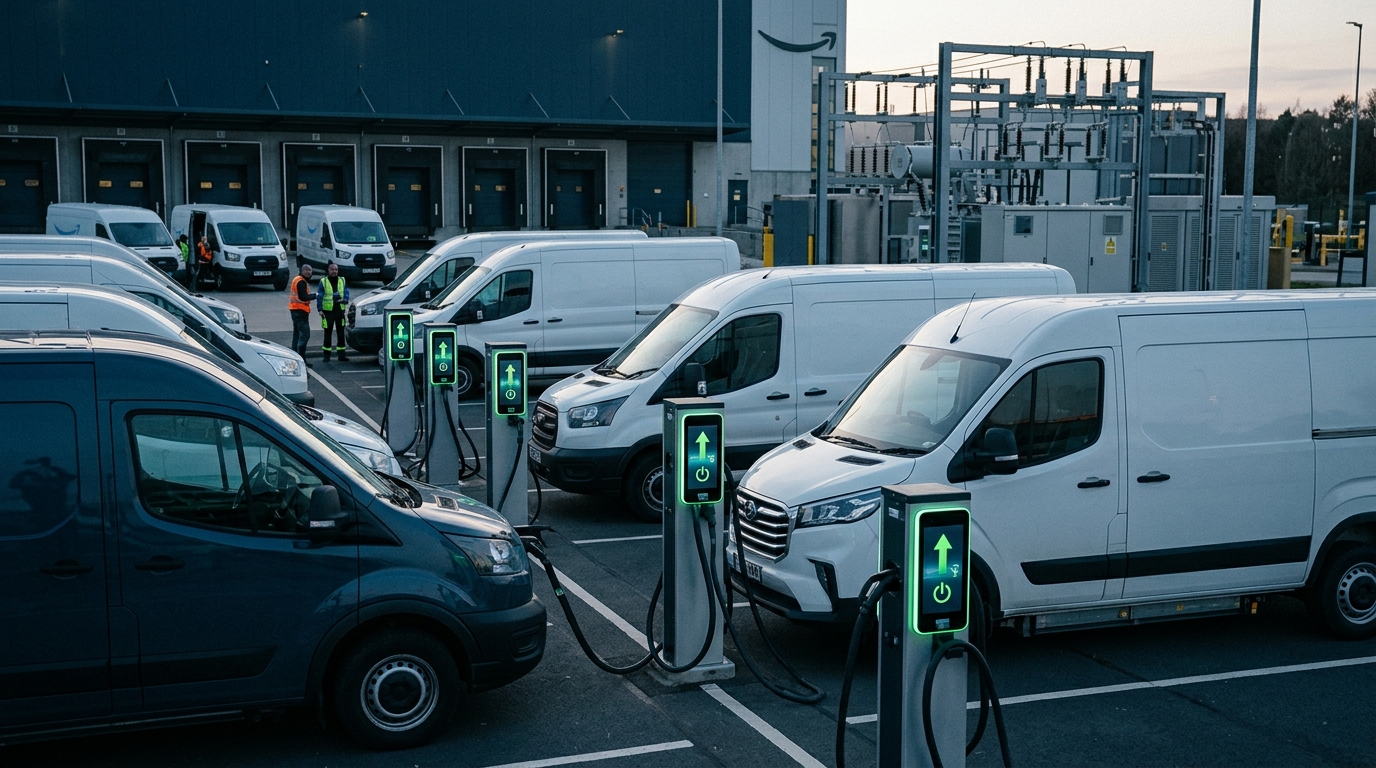
Commercial fleet vehicles are stationary for much of the week, even when running a full 40-hour operation. That idle window is the revenue opportunity. Vehicle-to-Grid technology lets bidirectional chargers pull stored electricity from parked vans and sell it back to the grid during peak demand, earning fees for frequency regulation, spinning reserves, and capacity payments. A University of Delaware pilot completed at Exelon’s Delmarva Power found that heavier fleet vehicles, delivery trucks included, could earn over $9,000 per vehicle per year in grid services revenue. Scale that across a 30,000-van fleet and the numbers get institutional-size fast.
Who Is Already Doing This
The pilot that matters most right now is not in the United States. Hanover-based energy supplier Enercity and Volkswagen Commercial Vehicles are feeding electricity from twelve ID. Buzz service vans into the public grid and trading it on the electricity market. Enercity described the result as a milestone showing that the technical integration of vehicles, charging infrastructure, software control, a virtual power plant, and power market trading works. Revenue in that first trading result was modest, but the milestone was structural: a commercial fleet in real-world operation functioned as a virtual storage system within the energy market.
Meanwhile, commercial EV builder Xos announced a V2G production rollout beginning in April 2026 on a major commercial vehicle platform, with a stated roadmap to extend bidirectional capability across its portfolio, including step vans and powertrains. The company is targeting the same depot-return cycle that makes delivery fleets ideal grid participants: predictable departure windows, overnight dwell time, centralized charging infrastructure.
What Investors Are Missing
Wall Street covers Amazon’s Rivian van rollout as a cost story, a capex bet on decarbonization. The V2G angle flips that entirely. Those vans are not just a liability on the balance sheet; they are a distributed energy asset that utilities will pay to dispatch. Europe is already leaning this way: Mordor Intelligence estimates commercial deployments represented 73.5% of the vehicle-to-grid market in 2024, citing the same basic logic that predictable parking schedules and large battery packs make fleets the most reliable grid resource.
The regulatory gap in the US is real. Bidirectional charger certification standards are still maturing, and utility compensation programs vary sharply by ISO market. But California, New York, and PJM are among the markets where ancillary services like frequency regulation can pay, and those are exactly the dense urban corridors where delivery fleets concentrate.
Stocks to Watch
- Rivian (RIVN): A key supplier of electric delivery vans for Amazon. If Amazon activates V2G across its growing fleet, Rivian’s vehicle architecture becomes a grid infrastructure input, not just a logistics one.
- Nuvve (NVVE): The aggregator platform connecting fleet batteries to ISO markets. Nuvve’s model depends on fleet scale reaching the point where dispatch becomes economically meaningful.
- Wallbox (WBX): One of the few charger vendors with commercially available bidirectional hardware. Depot-scale bidirectional charger adoption is the near-term catalyst.