
July 4, 2026
PepsiCo Reports July 9
The snack volume number matters more than the headline EPS.
First a note from Base Camp Trading
Dear Trader,
My top income trading expert, Dave Aquino, just released a 1-hour trading strategy designed specifically to help regular investors generate enough income to become financially independent…
Without taking on excessive amounts of risk.
I’m talking about having the opportunity to collect $500 on Monday…
$563 on Wednesday…
Then as much as $625 on Friday.
Week in. And week out.
To better trading,
– Drew Day
Partner
Base Camp Trading
Wall Street is going to spend most of July 9 staring at one number: the EPS consensus sitting around $2.19 to $2.21. That’s the wrong place to look.
The question that actually matters is whether North America snack volumes held up through Q2. Because that’s the hinge. Everything else — the dividend, the international growth story, the productivity gains — is already baked into a stock trading near its lowest forward multiple in years. What isn’t settled is whether Q1’s volume bounce was real or a one-quarter catch-up after an inventory reset.
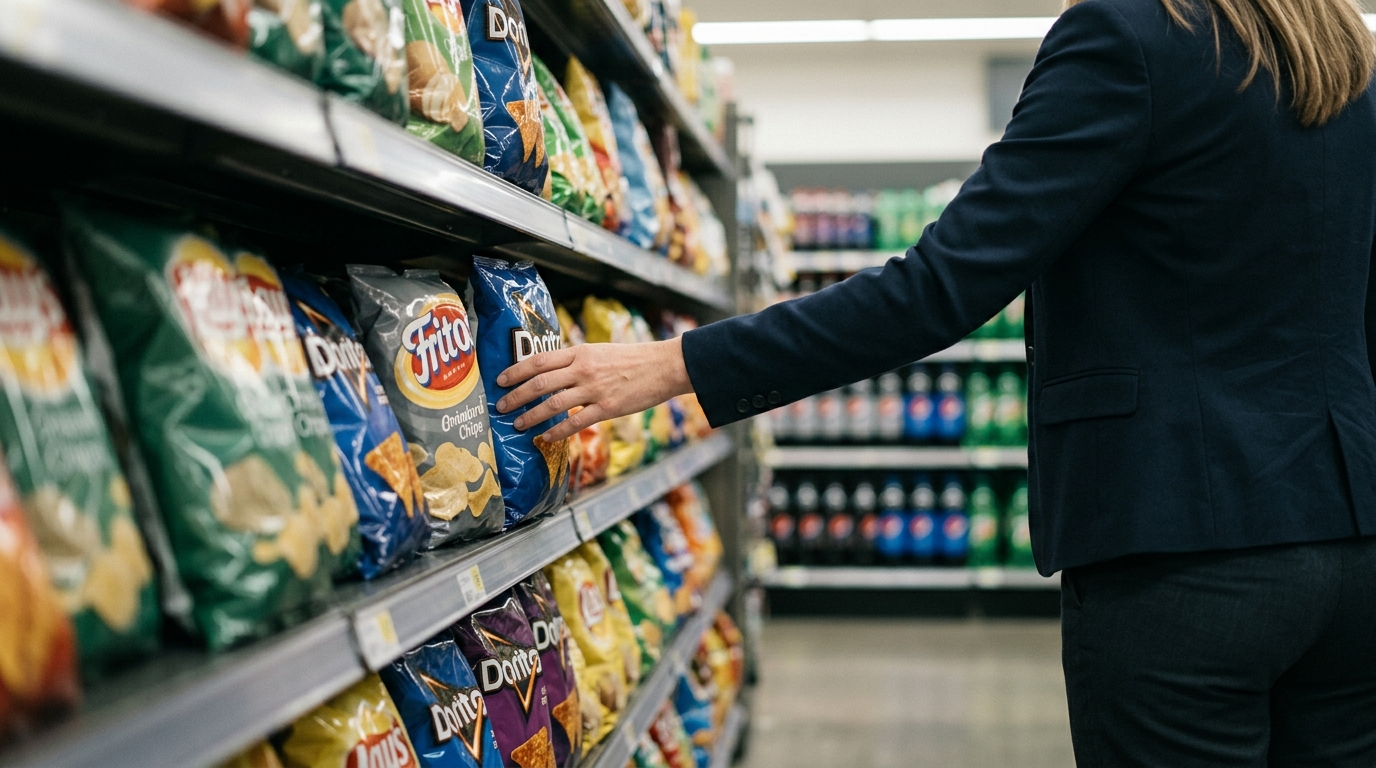
Here’s the thing about Q1. The key development wasn’t the revenue surprise but a turnaround in volume at PepsiCo Foods North America, which delivered 2% volume growth and 4% unit growth, adding around 300 million incremental consumption occasions year-over-year. That broke a long streak of declines and briefly lifted sentiment. Lay’s, Doritos, and Tostitos are being restaged globally, with shelf resets roughly 50% complete at the time of the earnings call. The argument from bulls is that distribution gains are still converting, meaning Q2 could show continuation. The argument from bears is that macro headwinds and a structural consumer shift are going to reassert themselves.
The structural shift part is worth sitting with for a second.
Run This 7-Point Check Before Your Next
Ever been right about a stock’s direction and still lost money on the trade?
It happens to almost every beginner. And it’s almost never bad luck – it’s a checkpoint you skipped before you placed the trade.
I put the 7 that matter most on one page.
It’s called the Smart Trade Options Checklist. Normally $29.97. Free today.
Run it before any options trade. About 30 seconds. You’ll catch the bad ones before they cost you.
FTI Consulting’s spring 2026 survey of 1,007 U.S. adults found that about 18% of American adults are now using a GLP-1 medication, up from approximately 14% in 2025. That’s a four-point jump in twelve months. Meanwhile, as of May 2026, roughly one in five U.S. households includes a current GLP-1 user, up from 9% in January 2025, based on PwC analysis of Numerator data. These aren’t rounding-error numbers anymore. Adults on GLP-1s consume 21% fewer calories and spend nearly a third less on grocery bills on average, according to KPMG.
Slight tangent, but it matters: the category-level damage is specific. Six months after beginning GLP-1 medications, consumer grocery spending had decreased 11% for chips and savory snacks, 9% for sweet bakery items, 7% for cookies, and 6.5% for soft drinks, according to a Kantar-SC Johnson study. That’s a pretty direct hit on the Frito-Lay portfolio. Among current GLP-1 users, 56% say they’re buying fewer salty snacks. And by 2030, more than 30 million Americans could be on a GLP-1 treatment, up from 10 million currently, based on J.P. Morgan estimates.
Now, the bull case is real and it deserves credit. International is carrying weight that the North America business can’t right now. Away From Home revenue within the North America Foods segment grew at roughly three times the segment average, and the permissible snack portfolio — including SunChips, Smartfood, and Siete — grew double digits. That’s exactly the product pivot that a GLP-1 environment should reward. Pepsi’s price-earnings ratio has fallen to around 16x, well below its 10-year historical average of about 21.5x. For a long-duration compounder with 54 straight years of dividend increases, that’s a historically wide discount to its own history.
But here’s where I’m at. Barclays and Citi recently lowered their price targets due to slowing consumption patterns in late April and May, with analysts expressing concern about persistent volume challenges in the core snacking business. And Evercore ISI has warned that PepsiCo’s Q2 performance may fall short of market expectations amid pressures from slowing consumer spending, cost inflation, and intensified competition. The firm forecasts organic sales growth of 2.3% year-on-year in Q2, lower than the market consensus of 2.8%, with EPS expected at $2.18 versus market expectations of $2.20.
None of that is catastrophic. The miss, if it happens, is measured in basis points. What matters more than the number itself is management’s tone on volume trajectory. One soft quarter is noise. Two in a row starts to raise the question of whether Q1 was a shelf-reset bounce that’s already fading rather than a genuine consumer behavior shift back toward Frito-Lay products.
Options Framework
If you think Q1’s volume recovery continues: A defined-risk bull call spread targeting a move toward prior resistance gives asymmetric exposure to the upside scenario without requiring the stock to reclaim its 2025 highs. Implied volatility tends to compress hard after earnings, so the long leg benefits from entering while premium is still elevated heading into the report.
Hoping to Retire Soon?
There’s a 73-minute “trading window” that is commonly exploited by retirees and those hoping to retire sooner. It works best if you can make this trade at a very specific time of day.
If you’re skeptical the bounce holds: A put spread structured just below current price captures downside if North America Foods disappoints again without needing a catastrophic number. The GLP-1 story is slow and directional. It doesn’t blow up in a quarter. It grinds. Approximately $95 billion of packaged food spend and $54 billion of foodservice spend are at risk by 2030 under current GLP-1 adoption trajectories. The multiple reflects some of that. Not all of it.
Neutral: PepsiCo’s past five earnings-timing announcements produced an average same-day move of about -0.24%, and the company has historically stayed within a tight surprise range. An iron condor ahead of the report captures that tight-range tendency. The risk is a guidance cut, not a revenue blowup.
What I keep returning to is this: PepsiCo has done a lot of the right things. Productivity improvements. Portfolio simplification toward permissible snacks. International expansion doing real work. The Q1 volume data was genuine. But GLP-1 medications introduce a fundamentally different mechanism — a biologically driven shift in appetite that alters dietary patterns independently of economic incentives or informational nudges. That doesn’t reverse because one quarter of shelf resets went well. July 9 tells us which force is winning right now. The stock is pricing something in the middle. Which might be exactly the most uncomfortable place to own it.