
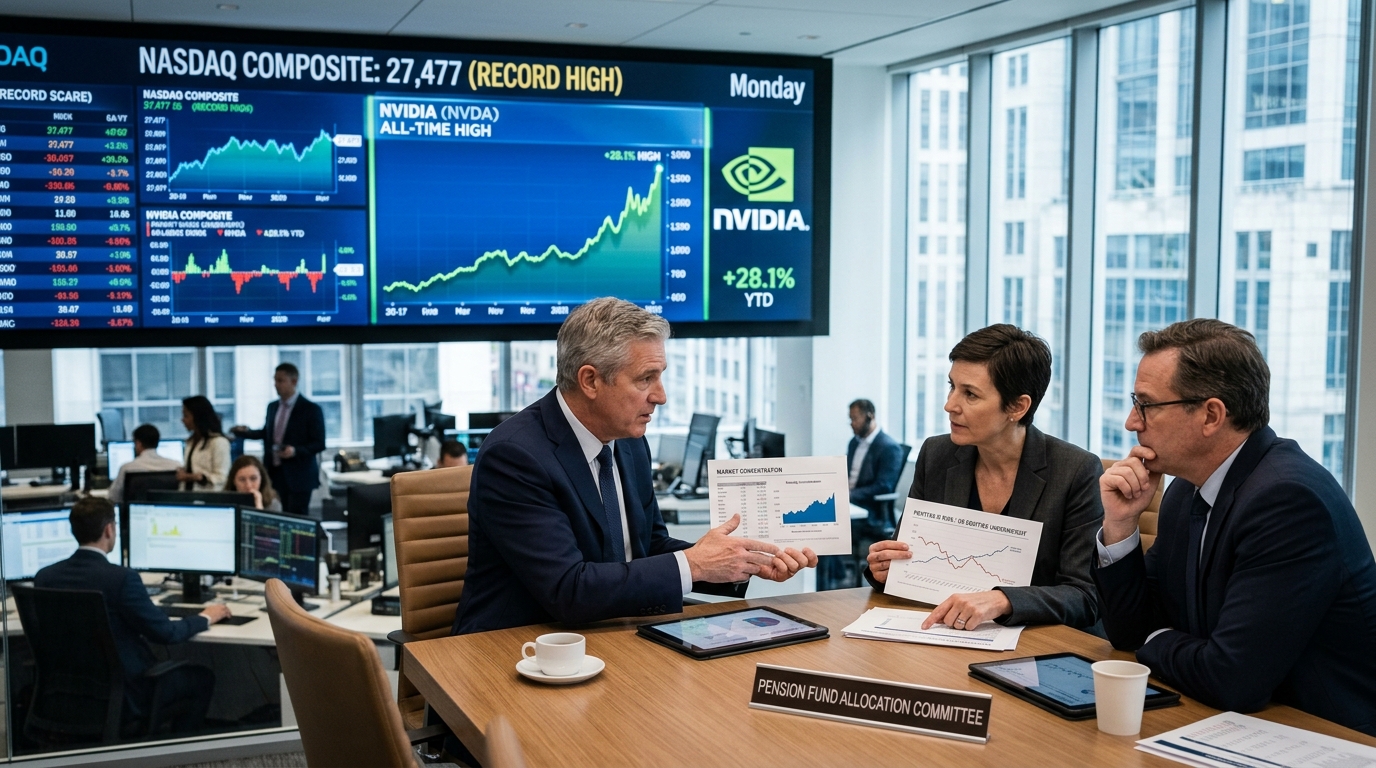
On Monday, the Nasdaq Composite closed at a record 27,477. Nvidia posted its first all-time-high close since May, up roughly 28% for the year. The AI trade, by every surface reading, is intact.
Inside the allocation committees of some of the world’s largest pension funds, the conversation was not celebratory. It was a warning about what records like this one actually mean.
The Concentration Problem
Australia’s Australian Retirement Trust, which manages around A$370 billion; Canada’s La Caisse, with $552 billion; and the UK’s People’s Pension, with more than £45 billion, all currently hold lower allocations to US stocks than the weights indicated by global benchmark indices. That is a deliberate choice, made by funds whose entire mandate is to protect long-term capital. Their reasoning is not that Nvidia is bad. Their reasoning is that Nvidia, Microsoft, and Alphabet have grown so large that buying a global equity index no longer means diversifying.
More than one-third of the S&P 500 is tied to the AI investment cycle, creating concentration risk. Major indices no longer provide the same diversification they once did. As tech giants’ market values rise, their index weights climb, forcing index-tracking funds to allocate more capital to the same stocks and amplifying their influence across portfolios.
What the Allocation Meetings Actually Sound Like
Jimmy Louca, a senior portfolio manager at Australian Retirement Trust, framed it plainly. “When you look at where we are in the cycle, we assess those US fundamentals as being more than fully priced. So the market’s moved more than what fundamentals would justify. So you need diversification around that.”
At La Caisse, the posture is more selective than outright bearish. Vincent Delisle said US exposure remains the fund’s largest, but the team is “diversifying outside of the megacap technology stocks. Valuations can be a trap right now, sustainability of earnings growth should be a focus. Outside of technology is where we find the best risk-reward opportunities.”
Denmark’s ATP has not cut aggressively, but its CIO has said something that should give any Nasdaq bull pause. Mikkel Svenstrup has said current valuations imply very strong earnings growth expectations in coming years, and that elevated valuations make stocks more sensitive to earnings disappointments than in more typical markets. That is a precise description of asymmetric downside risk: if Nvidia guides below $108 billion next quarter, the index has almost nowhere to hide.
Why Q3 Earnings Make This Urgent
Third-quarter earnings season begins next week with reports from large US banks. Analysts expect S&P 500 earnings to increase about 30% year over year, according to FactSet, a surge driven heavily by big technology and AI-linked names. That number is the exact problem the pension funds are pricing. If the AI names deliver, the underweight funds underperform. If they miss, the funds that trimmed look prescient. The bet is asymmetric. Nvidia reported second-quarter fiscal 2027 revenue of $96.2 billion, up 106% year over year, and guided third-quarter revenue to $108.0 billion. Sustaining triple-digit growth on a base that large is a different challenge from what the market priced two years ago.
Of 430 asset owners surveyed by Marsh, with more than $5 trillion in combined assets, about one-third said they plan to reduce US equity exposure over the next 12 months, roughly double last year’s level. That is not a contrarian fringe position. It is approaching consensus among institutional allocators.
Stocks to Watch
Nvidia (NVDA). The central node. Nvidia rallied after a record capital-return announcement coincided with renewed enthusiasm for AI spending. The board approved an additional $150 billion in share repurchases, which Nvidia said was the largest authorization increase on record. The buyback provides a floor. It does not resolve the earnings expectations embedded in a roughly $239 stock.
Microsoft (MSFT) and Alphabet (GOOGL). Nvidia and Microsoft are among the largest weights in major US equity benchmarks. Both report this earnings season. Any softness in cloud or AI infrastructure spend lands directly on the indices that pension funds are already underweighting. La Caisse has explicitly moved away from megacap technology; Microsoft and Alphabet are the precise names that framing targets.
The overlooked angle. The shift among large pension funds looks more like deep rebalancing than an exit from the US market. The US remains the world’s largest equity market and a core allocation for global institutions, but the rising dominance of AI-linked megacaps is challenging traditional diversification frameworks. That creates a rotation, not a collapse. The beneficiaries are international equities and US sectors the AI trade has ignored. La Caisse has talked about looking outside megacap technology. Where that capital lands next is the trade worth tracking.