
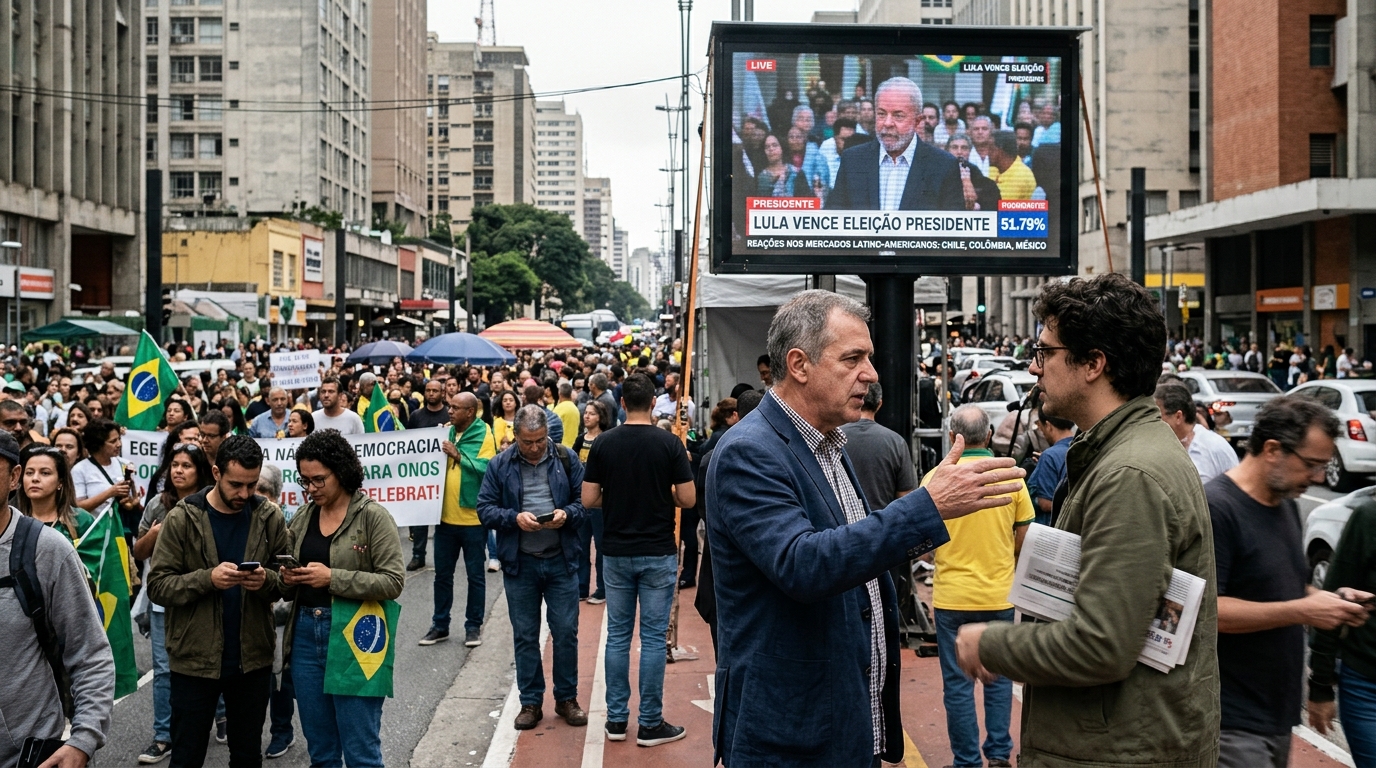
Lula da Silva defied prediction markets that had priced his defeat at roughly 80% and won Brazil’s presidential runoff on Sunday with 51.79% of valid votes to Flávio Bolsonaro’s 48.21%. The result was the first time since Brazil’s runoff system was introduced in 1988 that a candidate won the presidency after finishing second in the first round. Markets had spent three weeks pricing the opposite outcome, and Monday’s open is collecting the bill.
The numbers from overnight trading are severe. Real futures fell about 10%, implying roughly R$5.56 per dollar against Friday’s spot close of R$4.98. The Tokyo-listed NEXT FUNDS Ibovespa ETF dropped 15.07%. EWZ, the iShares MSCI Brazil ETF, fell nearly 20% in overnight trading. In U.S. premarket, Petrobras (PBR) plunged roughly 22%, while Itaú Unibanco (ITUB), Banco Bradesco, and Nu Holdings (NU) fell between 23% and 29%. Trading desks in São Paulo warned of circuit-breaker risk when B3 opened.
Bolsonaro has refused to concede, citing a Supreme Court decision to extend voting hours by two hours after some polling stations had already closed. Electoral court president Cassio Nunes Marques, himself a Bolsonaro-era nominee to the Supreme Court, confirmed Lula’s victory and said the extension did not affect the result. The annulment bid faces a 4.4 million-vote margin and almost no legal path forward, but the uncertainty adds a headline risk layer that traders will monitor through the week.
The Regional Calendar Is What Makes This Week Different
Lula’s win snaps a streak of seven straight conservative presidential victories across Latin America in 18 months, a run that included Ecuador, Bolivia, Honduras, Chile, Costa Rica, Colombia, and Peru. Brazil, the region’s largest economy, was the right’s biggest remaining prize. Now three of those same countries move policy this week, and the direction each takes will show whether Lula’s survival reshapes the region’s policy tone or stays quarantined inside Brazil’s borders.
Chile’s central bank decides Tuesday. The rate has been held at 4.5% through every meeting of 2026, and prediction markets price a hold at 96%. But inflation in Chile reached 4.1% in September, above the 3% target, and six of 62 surveyed traders expect a hike before year-end. Any hawkish signal from Santiago will drag on rate-sensitive Chilean equities and copper names precisely as Brazil’s contagion risk is live.
Colombia’s central bank meets Friday. It delivered an unexpected 25-basis-point hike on September 30, its fourth consecutive policy surprise, lifting the rate to 12.25%. The question this week is whether it pauses or extends the tightening cycle into a market environment already on edge.
Mexico reports third-quarter GDP on Friday, with consensus at 1.7% growth. President Claudia Sheinbaum governs from the left, and a weaker-than-expected print alongside Lula’s victory would draw fresh attention to the region’s fiscal fragility broadly, not just Brazil’s.
What the Opportunity Looks Like and What the Risk Is
The trade is not simple. Vontobel’s Thierry Larose flagged that a sharp sell-off in Brazilian bonds and the real was probable but bounded: much of the pre-election move in assets reflected positioning for Bolsonaro, not a fresh assessment of fundamentals. By Friday’s close, the Ibovespa stood nearly 7% above its pre-first-round level and the real had gained close to 5% against the dollar. That positioning unwind is partly mechanical, not entirely a verdict on Lula’s economic program.
The structural problem does not go away whoever won. Brazil’s gross public debt sits at 82.9% of GDP, and the Selic, now at 13.75% after five cuts from a 15% peak, still runs one of the highest real rates in the emerging world. Goldman Sachs, in its pre-election scenario work, estimated that a Lula win with expansionary fiscal policy could push USD/BRL 3% higher in rates alone. The downside is not the election result: it is the fiscal signal Lula’s incoming economic team sends in the next two to three weeks.
For traders, B3 circuit-breaker levels and the R$5.00 psychological line in spot USD/BRL are the first monitors. PBR’s pricing policy remains structurally different under Lula than under a Bolsonaro government, and that discount should persist. ITUB and NU offer optionality on a mean reversion trade once the initial flush clears, but the Selic path is the variable that actually drives bank earnings, and that path now depends on whether Lula’s team presents a credible fiscal anchor. Until that team is named and a budget framework is confirmed, the bias on Brazilian financials stays defensive.