Wall Street is focused on Linde plc’s electronics contracts. Its Q2 2026 results showed a record $8.1 billion sale-of-gas backlog, a 29.5% operating margin, and a $1 billion commitment to expand ultra-high-purity gas supply at a Phoenix semiconductor complex. That is the story analysts are pricing at roughly a low-30s earnings multiple.
There is a second story forming in construction materials, and Linde sits at its upstream end.
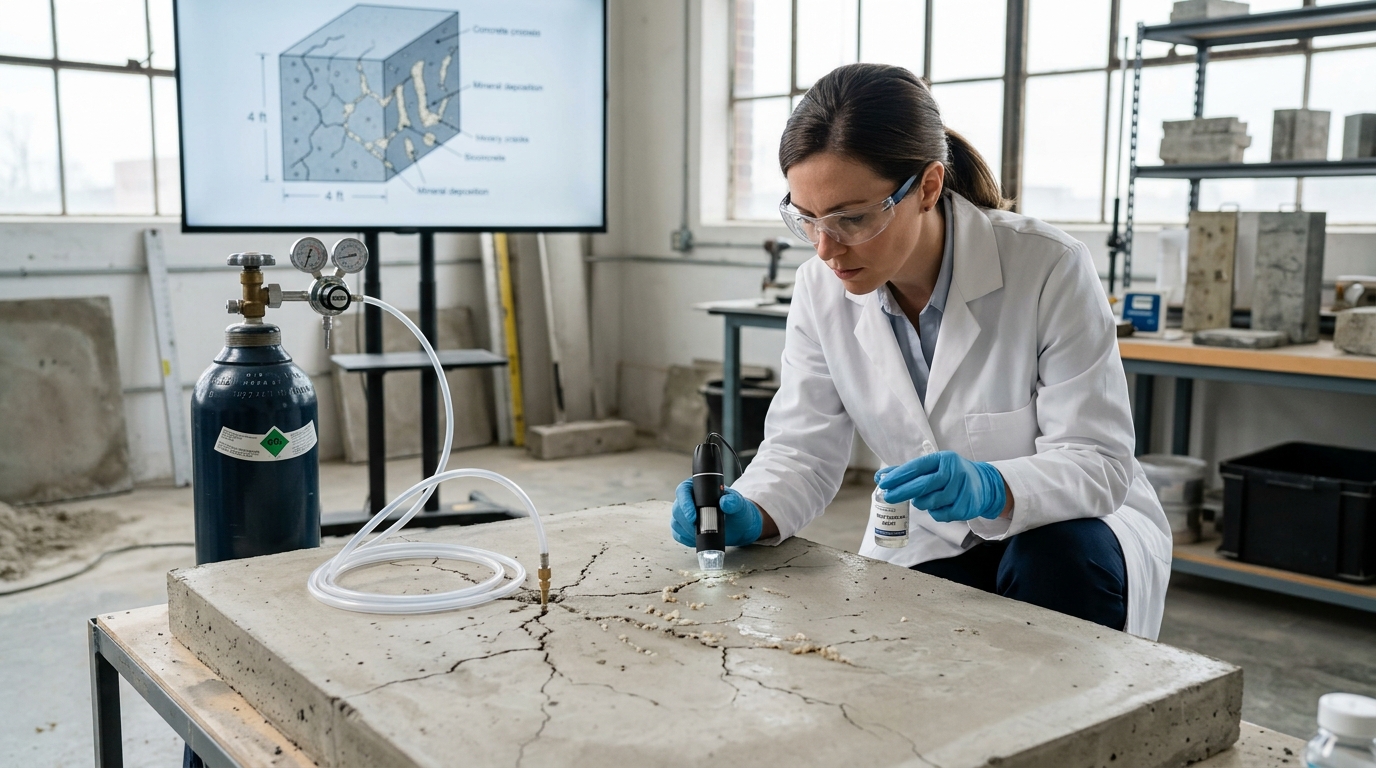
Bacterial self-healing concrete has cleared the laboratory. The technology embeds dormant spores of bacteria such as Bacillus subtilis inside the concrete matrix. When a crack forms and water infiltrates, the bacteria activate and precipitate calcium carbonate to seal the fracture. Lab trials have reported crack-closure results in the high double digits under controlled conditions. One commercial pioneer, Basilisk, founded from TU Delft research, says its products can seal cracks up to one millimeter wide and reduce shrinkage reinforcement needs by up to about 40%.
The gas dependency is the part most investment commentary misses entirely. Oxygen can matter for aerobic bacteria-driven mineralization pathways, and research on oxygen-releasing systems shows oxygen availability can materially increase microbial calcium precipitation. Separately, CO2 can accelerate carbonate formation through carbonation-related healing and CO2-rich curing regimes. However, the draft’s specific 2025 claim that “at least 80% relative humidity and 20% CO2 concentration” produces “over 90% crack closure within six weeks” for microcracks up to 0.5 millimeters could not be verified as stated. It is fair to say controlled humidity and elevated CO2 conditions are commonly used in accelerated-curing and CO2-rich healing studies, and those conditions can meaningfully affect healing rates.
Linde is the world’s largest industrial gas company with 2025 sales of about $34 billion, and it already operates inside the cement sector. Its joint venture with Heidelberg Materials, the CAP2U project, is designed to capture CO2 from cement production at the Lengfurt plant in Germany and liquefy it for industrial reuse, with a stated capture capacity of around 70,000 tonnes per year. That infrastructure and the expertise behind it transfers naturally into curing environments where precise CO2 delivery is the rate-limiting input.
The market sizing is contested but directionally unambiguous. Multiple research firms have forecast rapid growth for self-healing concrete, but the claim that it is already above $100 billion in current global value could not be verified and is likely overstated versus commonly cited market estimates. What is clear is that infrastructure applications, bridges, tunnels, marine structures, can be among the more economically attractive use cases because reduced inspection cycles and longer service life can justify a premium over conventional concrete.
The investment thesis here is not that Linde is pivoting to bioconcrete. It is that Linde’s existing product portfolio, oxygen, nitrogen, CO2, specialty gas delivery infrastructure, and on-site plant engineering, is exactly what the biomanufacturing layer of construction materials requires at scale. The same take-or-pay contract structure that locks in semiconductor customers for 10 to 20 years applies identically to an on-site gas plant serving a bioconcrete manufacturing facility.
With Q3 2026 earnings due October 29 and Wall Street expecting $4.52 EPS, the electronics backlog will dominate the call. But the question worth asking ahead of that report is how many of Linde’s new engineering inquiries are coming from industries, construction, infrastructure, advanced materials, that the market is not yet treating as part of the LIN growth thesis.
The concrete is already healing itself. The gas that makes it possible is a quiet lever in the value chain, and Linde is positioned to supply it.