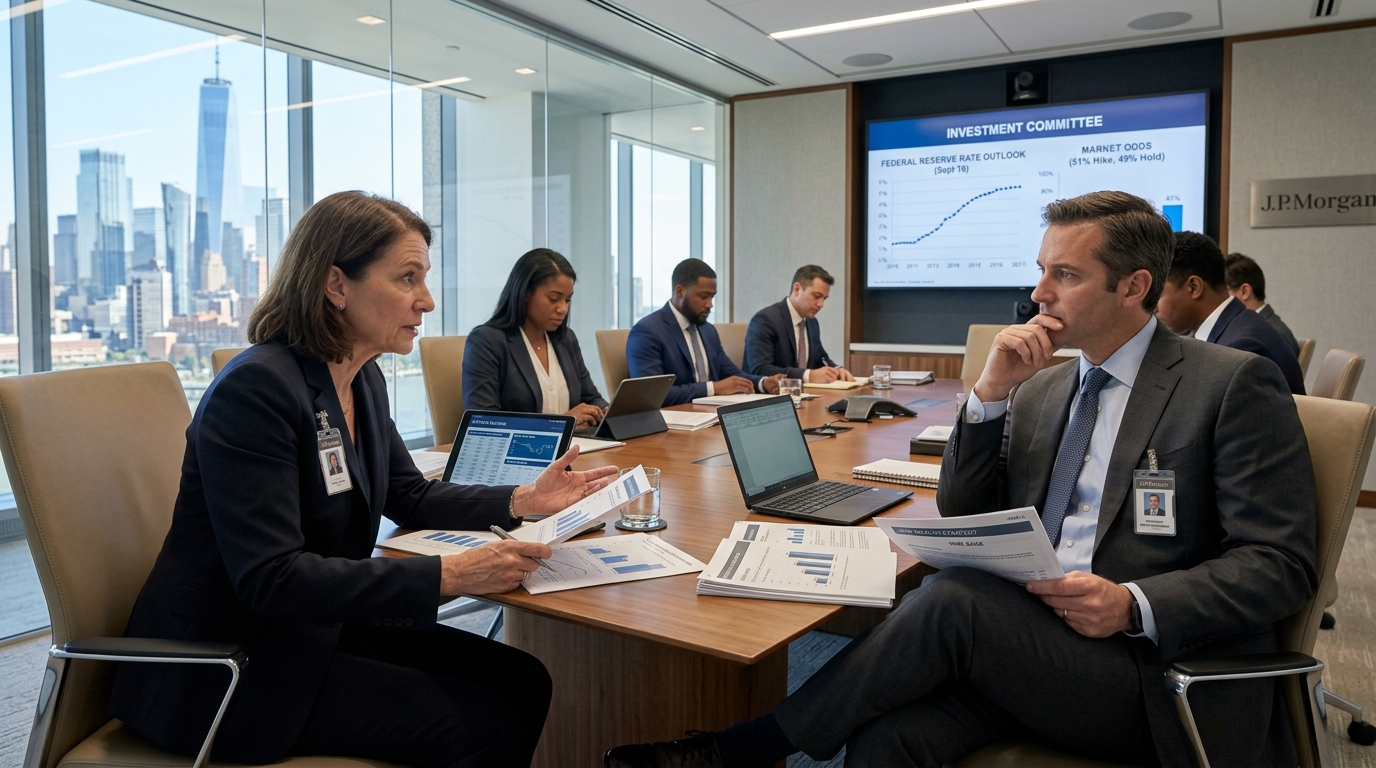
The most telling conversation in any investment committee meeting this morning is not about a stock. It is about what JPMorgan Chase itself believes ahead of the September 15-16 FOMC, and how that view sits roughly 20 percentage points apart from Goldman Sachs.
The Big Question
Does the Federal Reserve raise rates on September 16, and is the market right to price it as a coin-plus-flip? Odds for a move at the September 15-16 meeting jumped to roughly the mid-60s after Warsh spoke, according to CME FedWatch. Fed Chairman Kevin Warsh used his Jackson Hole speech to deliver a clearer warning that stubborn inflation could push the Fed toward a rate hike. One carefully chosen phrase did most of the work.
Why Wall Street Cares
The federal funds rate currently sits in a target range of 3.50% to 3.75%, following what the Fed and markets broadly framed as a hawkish hold at its July 28-29 meeting. Two drivers lowered the bar for a September hike: continued supply-chain disruptions around the Strait of Hormuz that have kept energy costs elevated, and increased investor doubt about the Fed’s willingness to keep inflation contained after it left rates unchanged in July. That is the framework JPMorgan’s wealth arm used to flip its own base case.
J.P. Morgan Wealth Management strategists now expect the Federal Reserve to raise interest rates by 0.25 percentage points at its September meeting, a shift from their prior base case of no rate changes in 2026. Chief Investment Strategist Phil Camporeale cited the Strait of Hormuz supply-chain drag and eroding Fed credibility after July’s hold as the decisive combination.
The Bull Case for a Hike
The consumer price index shows prices have risen 3.4% over the twelve months ending in July, while the Fed’s preferred measure puts inflation at 3.7% during that period. Warsh’s message at Jackson Hole was pointed: he acknowledged that recent inflation numbers have been soft but said the progress does “not tell me that underlying trends have meaningfully improved.” He also argued that financial conditions do not look particularly restrictive, pointing to strong capital investment and resilient consumer demand.
The Bear Case
Goldman Sachs landed on the other side weeks before Warsh spoke, and has not moved. Goldman chief economist Jan Hatzius has told clients that a rate hike at the September 15-16 meeting has become very unlikely, arguing that markets remain too hawkish even as the economic data softens. Goldman expects the Fed to hold the federal funds target range at 3.50%-3.75% through the remainder of 2026, with its baseline expecting cuts in 2027. Then Warsh spoke, and hike odds that had fallen to around 30% earlier in August moved back into the 60s. Goldman’s call has not followed them up.
The skeptics have company inside the administration. Treasury Secretary Scott Bessent told CNBC that the U.S. has seen a supply shock and that policymakers traditionally do not raise rates into a supply shock unless second- or third-order effects show up, adding that core inflation has remained restrained.
The Evidence
JPMorgan’s team points out that this week’s nonfarm payroll data and next week’s CPI reading on September 11 will be key inputs, with CPI being more important. September has become a crowded risk window: a live Fed meeting, key CPI data, heavy post-Labor Day credit issuance, and weak seasonality are all arriving at once. Andrew Tyler, who leads JPMorgan’s market intelligence team, did not call this a bear market trigger. “Equity bull markets tend to end with either a hiking cycle or a recession,” Tyler wrote, while noting that “a recession is highly unlikely to manifest over the next few quarters.”
What Investors Are Missing
The headline debate, hike or hold, is obscuring the more durable signal: Jamie Dimon himself will not touch either asset class at these levels. Dimon said he “wouldn’t buy” the S&P 500 or long-dated Treasuries at today’s prices, warning that markets are underpricing geopolitical and fiscal risks that are “probably bigger than other people think.” He argues that even if inflation settles around 2%, the 10-year bond should probably yield 4% to 4.5%, roughly where it already sits, which leaves little room for those bonds to rise in value. That is a structural view, not a tactical one. It was true before Jackson Hole and it holds after it.
The implication is that the September 16 outcome may matter less than investors currently believe. Whether Warsh hikes or holds, the shift that really counts could already be baked in.
Stocks to Watch
- JPMorgan Chase (JPM): Internally conflicted but institutionally coherent. The bank benefits from a steeper rate environment, but its own equity desk is telling clients to pull back. Watch for any change in tone from Tyler’s team following Friday’s jobs report.
- Goldman Sachs (GS): Committed to the pause call and positioned for hawkish bets to unwind. If September produces a hold, Goldman’s read of the cycle looks vindicated; a hike would pressure the position significantly.
- iShares 0-3 Month Treasury Bond ETF (SGOV): The fund has attracted large inflows this year. Short-duration cash equivalents are where the smart money is actually sitting, not in the debate.
- Energy sector: The Middle East energy shock has kept inflation risk in play, even as markets debate whether the supply-chain hit proves persistent. If the hike lands and energy costs remain sticky, integrated producers stay in the conversation as an inflation hedge regardless of what the Fed decides.