Israel voted Tuesday and got no answer. Exit polls and early counting on Wednesday pointed to a deadlock between the blocs led by Benjamin Netanyahu and his chief rival, Gadi Eisenkot, with neither side on track to reach the 61-seat majority needed to govern. Netanyahu remains caretaker prime minister while coalition talks begin, and another election cannot be ruled out.
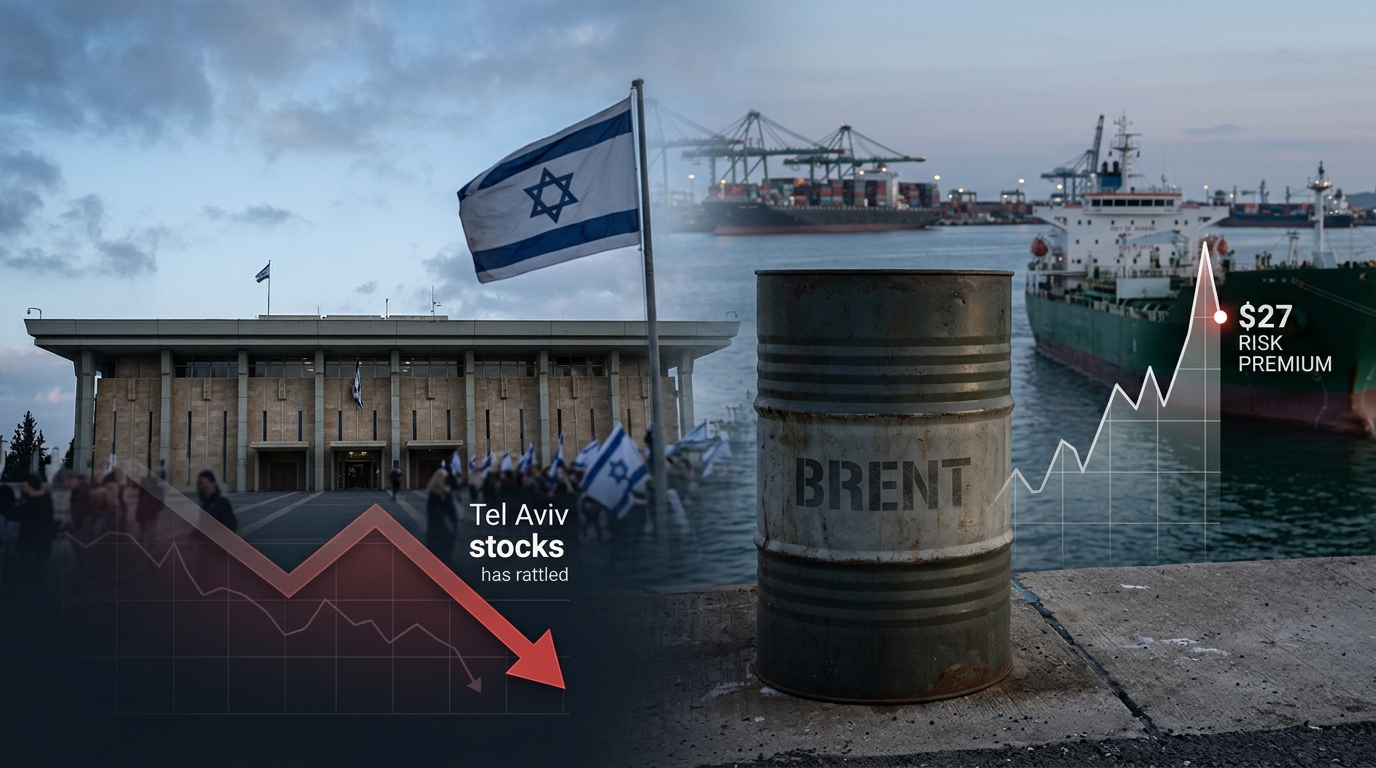
Markets did not wait for the final count. Israeli stocks and the shekel were under pressure Wednesday as traders digested the prospect of weeks of coalition arithmetic. The shekel was down about 1% against the dollar on the day, based on widely tracked USD/ILS pricing. Pre-election, the index had closed at 4,206 on October 26 with oil and gas shares leading a 2% rally on hopes for a decisive result. That optimism is being unwound.
The more important signal for global traders sits in Brent. Brent crude traded around $115 on Wednesday, near multi-year highs. Goldman Sachs has said it estimates the current geopolitical risk premium in Brent at roughly $27 per barrel, and a hung Knesset does nothing to compress that number. The coalition outcome is a direct input into how Israel’s war with Iran continues or ends: a Netanyahu government reliant on far-right partners sustains the current military posture, while an Eisenkot-led coalition could eventually open a diplomatic path, though any supply consequence would take months to materialise.
The Strait of Hormuz carried roughly 25% of the world’s seaborne oil trade in 2025. Prolonged political deadlock, with Netanyahu as caretaker and no settled war policy, keeps that chokepoint risk priced in. Some banks have lifted their Brent targets in recent weeks as attacks in and around Hormuz intensified, and strategists have flagged substantial premium tied to the possibility of fresh US-Israeli strikes on Iran in coming weeks. A drawn-out coalition process, perhaps stretching into early 2027, means that premium does not dissolve quietly.
Where to Position
Energy exposure remains the clearest trade. Brent holding near $115 with political resolution still weeks away is not a coincidence. Energy majors with Middle East leverage benefit from sustained elevated prices; the risk to the long is a sudden diplomatic breakthrough, which current vote arithmetic makes unlikely before any government is seated.
Global defence names deserve attention alongside Israeli ones. Elbit Systems carries a record backlog, with roughly three-quarters attributable to orders outside Israel, giving it some insulation from domestic political noise while still benefiting from elevated regional tension. Lockheed Martin, RTX, and Northrop Grumman are the names to watch for any post-election gap if strike expectations against Iran escalate. During periods of regional escalation, smaller Israeli defence companies tied to drones and surveillance have posted one-day moves exceeding 10%.
The TA-35 itself is a more complicated position right now. Global fund ownership of Israeli equities sits at a record low; foreign capital has largely missed the 130% rally from October 2023 lows. A clean government could unlock inflows. A caretaker administration grinding through months of coalition arithmetic keeps that capital on the sidelines.
The Risk Dashboard
The primary risk to energy longs is a surprise coalition deal that signals de-escalation, which would compress the Brent premium faster than markets expect. The risk to any TA-35 dip-buy is another election, which would extend uncertainty well past Q1 2027. For now, the deadlock verdict keeps the war premium alive and makes energy and defence the highest-conviction exposures in a market that just got a lot more complicated politically.