
Silver and gold are obliterating all previous profit records with next-level gains now on-deck for well-timed investors.
We’re talking early-stage, small-cap discovery stories that are only just beginning to unfold.
The early-stage opportunity is taking shape across a historic North American silver-gold district that helped build early fortunes but was never explored as a unified system.
For generations, the district produced high-grade metals at surface.
Yet, the deeper story was never told – not because the metals weren’t there but because the land package was highly fragmented and never explored as a single system.
That has now changed.
For the first time ever, this exceptionally well-run small-cap explorer has brought the entire district under one roof – enabling modern geology and drilling to finally test the system properly from surface to depth across kilometers of previously untouched mineralization.
And the timing couldn’t be better.
Phase-2 drilling is accelerating as you read this… setting up a near-term flow of potential needle-moving results as the discovery picture sharpens.
And that’s not all.
Add in a second nearby district-scale silver-gold asset… and the exploration runway expands even further for this emerging small-cap.
We’ve put together a FREE online report with all the details, including:
✔ A newly unified district-scale silver-gold system in North America
✔ What the first drill results are already confirming
✔ Which targets will see drilling next
✔ How a second district-scale asset expands the discovery upside
✔ Key 2026-27 catalysts as drilling intensifies
Inside, you’ll also find our exclusive, in-depth interview with the company’s president & CEO who brings a true firsthand look at where this discovery is headed next and why the timing is so critical.
Click here to access our FREE online report and see why this Sub-US$1 silver-gold stock is setting up to be one of the most compelling early-stage opportunities of 2026-27.
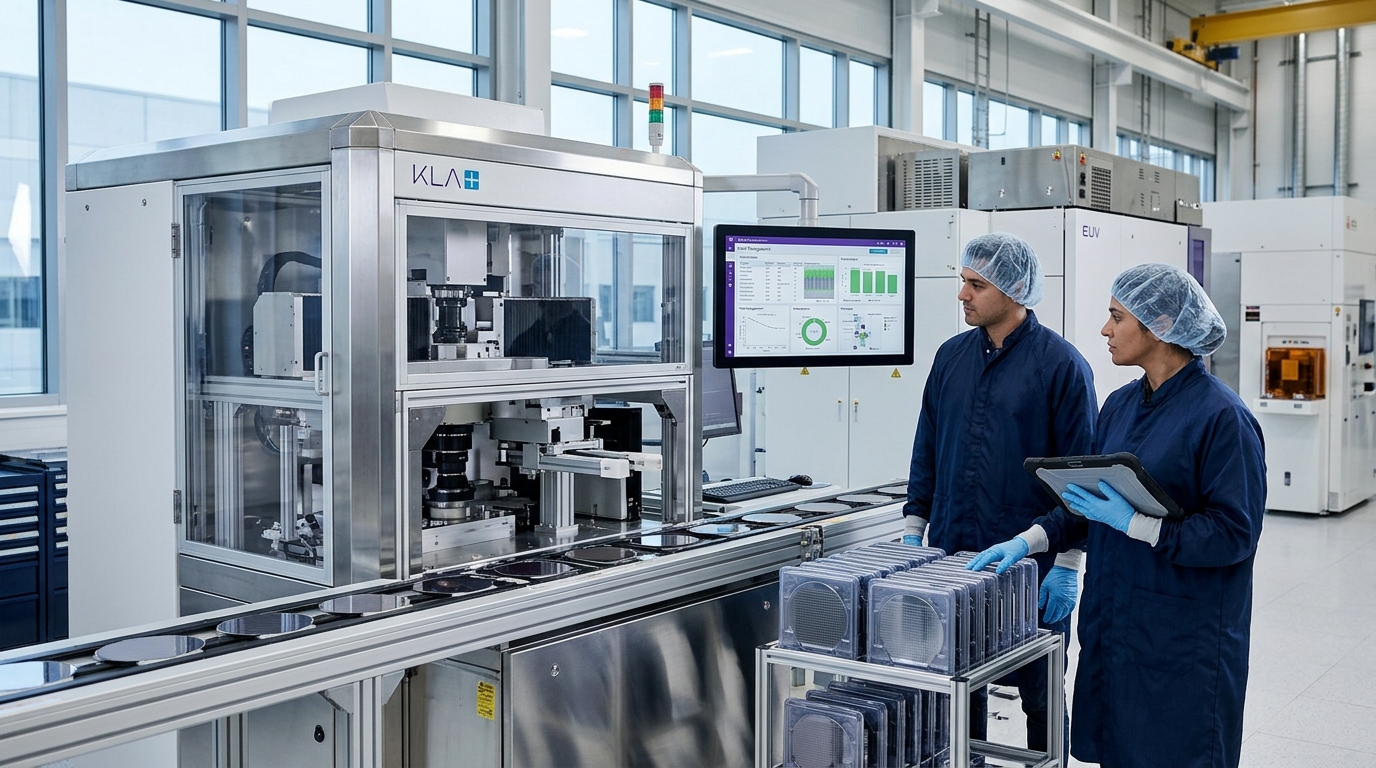
KLA’s $190bn Equipment Outlook Meets Memory’s Capital Restraint
Three months ago, KLA Corporation told the chip-equipment industry something that made portfolio managers sit up: KLA raised its calendar 2026 wafer fabrication equipment expectation from more than $140 billion to the low-$150 billion range, described an industry planning case near $190 billion for calendar 2027, reported approximately $12.5 billion of backlog, and indicated that certain product lead times extend to 18 to 24 months with customer discussions already focused on deliveries in the second half of 2027. That was the Q4 fiscal 2026 call on July 28, 2026. Tonight, after the close, KLA reports Q1 fiscal 2027. The question is not whether the quarter beats. It is whether the $190 billion framework survives contact with a memory market that is now showing real capital restraint.
Why Wall Street Cares
The $190 billion number sits at the center of every institutional model covering equipment. KLA CFO Bren Higgins described it as a consensus view, noting that $190 billion translates into a mid-20% type growth rate, similar to the growth rate in 2026. But consensus views have a way of aging poorly. In just the weeks since KLA’s last call, Lam Research reported its own Q1 and pushed the forecast higher still: Lam’s preliminary calendar 2027 wafer fabrication equipment outlook exceeds $200 billion, driven by DRAM, NAND, and foundry/logic demand. Barclays’ Thomas O’Malley went further, predicting strong spending on DRAM, NAND, foundry, and logic chip equipment, pushing his 2027 WFE estimate to $209.5 billion, up from his earlier estimate of $159 billion. The range of credible forecasts has widened considerably. That makes tonight’s commentary from KLA, the company closest to process-control intensity at the leading edge, unusually important for anchoring where the group actually trades.
The Bull Case
KLA’s Q1 results are expected to have benefited from accelerating investments in AI infrastructure, particularly advanced semiconductor manufacturing, as demand for AI processors and high-performance computing chips drives adoption of KLA’s inspection and metrology solutions. The transition toward 2-nanometer manufacturing and gate-all-around transistor architectures is increasing process control requirements. The backlog is structural, not a spike: KLA expects revenues in the second half of calendar 2026 to increase approximately 20% from the first half, reflecting accelerating customer demand, and a backlog of approximately $12.57 billion at fiscal 2026-end is providing substantial revenue visibility. KLA is planning for significant growth in calendar 2027, driven by investment in leading-edge logic and foundry, conventional DRAM, high-bandwidth memory, NAND, and advanced packaging.
Memory’s role in the bull case depends on whether the largest buyers are still committing capital. Micron’s record quarter revealed a capex plan that raises the question of structural shift versus the seed of the next glut.
The Bear Case
The bear argument is concentrated in one word: memory. The bull case for this cycle behaving differently rests on two structural points, and the first is that Samsung, SK Hynix, and Micron are showing more capital discipline than in past cycles, resisting the urge to race each other into speculative overbuilding. Capital discipline is good for memory pricing but it limits the equipment orders that support a $190 billion-plus WFE market. The principal negative read-throughs concern gross-margin conversion, fixed-price backlog exposure, working-capital intensity, competitive share shifts within process control, China localization, and the risk that an exceptionally strong 2027 spending level is already embedded in sector valuations. That last point deserves attention: KLAC’s trailing twelve months P/E ratio is about 42, which means the stock is pricing in an enormous amount of the good news already.
The Evidence
KLA is expected to issue its Q1 2027 results after the market closes on Wednesday, October 28, 2026, with analysts expecting earnings of $1.18 per share and revenue of $4.04 billion for the quarter. KLAC’s earnings have surpassed the Zacks Consensus Estimate in all the trailing four quarters, the average surprise being 2.75%. Peer data already in hand adds context. Lam’s preliminary outlook calls for more than $200 billion of calendar 2027 wafer fab equipment spending, and CFO Doug Bettinger also described that more than $200 billion figure as constrained. Supply-constrained optimism cuts both ways.
Supply-constrained optimism has a physical ceiling that peer data cannot fully capture. ASML’s lithography shipment capacity is the hard governor on how much of a $190-billion-plus WFE market can actually be served.
What Investors Are Missing
The debate is framed around whether WFE hits $190 billion or $210 billion in 2027. That framing misses the more consequential question: composition. WFE growth is being driven by multiple simultaneous investment categories rather than a single isolated technology transition, with management citing leading-edge foundry and logic, conventional DRAM, HBM, NAND, advanced packaging, greenfield fabs, and additional technology ramps. Breadth matters because it determines durability. A $190 billion market that is 70% foundry/logic is a different risk than one where memory contributes a third. Tonight’s call will reveal how KLA reads that composition heading into 2027, and whether memory’s current discipline is a temporary pause or a structural shift in the planning case.
Stocks to Watch
- KLAC: The primary read. Watch guidance and any revision to the 2027 WFE framework. KLA is planning capacity for more bullish scenarios by investing in long-lead-time components such as optical systems, which carry lead times of 12 to 24 months. Any softening of that commitment would reset the whole group.
- LRCX: The most attractive implications favor companies with direct volume exposure to DRAM and HBM. Lam’s etch franchise sits at the center of both, which is why it issued the most aggressive 2027 outlook. It also took the most damage when supply constraints showed up in its own results.
- AMAT: Applied Materials has benefited from wafer fab equipment orders as hyperscalers, foundries, and memory makers race to expand advanced logic, high-bandwidth memory, and advanced packaging. Breadth is its strength; it is also why any mix shift toward a single segment creates asymmetric risk.
- ASML: ASML Holding stock is up roughly 53% year to date, with the shares recently around $1,636. Lithography remains a bottleneck in advanced logic and DRAM ramps, and ASML has been planning for higher capacity in response to customer demand. The highest operating leverage to a $190 billion market, but also the most constrained by its own shipment capacity.