July 16, 2026
GD: Boring Name, Serious Business
A $131B backlog and Q2 earnings due this week.
First a note from Stansberry Research
Editor’s Note: Financial expert Dr. David Eifrig has guided his readers through just about every market scenario you can imagine: Including the financial crisis of 2008… the COVID-19 crash of 2020… the inflation crisis of 2022 – the worst year for stocks in more than a decade… the volatility we saw in 2023 with the bank failures, and even the tariff turbulence of 2025. But today: Dr. Eifrig warns a strange D.C. plan is underway, and it could send one particular type of investment absolutely soaring.
Dear Reader,
A dramatic story – which started as a wild rumor – is now playing out at the highest levels of finance…
In fact, this plan has all been laid out point-by-point by one of President Trump’s senior advisers.
And even though it’s the most-read story on Bloomberg terminals, a computer that professional investors pay $25,000 per year to access…
Nobody on Main Street seems to be aware of the blindsiding event that’s rushing toward them.
In London, staff at the Bank of England are being forced to work OVERNIGHT to enable the world’s richest people to move their money, according to Bloomberg.
And wealthy investors are loading up their suitcases with precious metals on commercial flights.
Hedge-fund managers are now briefing clients on the potential impact to their wealth, too…
And earlier this year, $2 TRILLION was pulled out of stocks in one week.
Take it from my colleague Dr. David Eifrig, a 40-year stock market veteran:
This is all extremely strange.
He wants to help pull back the curtain for you and your loved ones, too… at no cost.
Click here to watch his new urgent briefing before July 28.
Regards,
Matt Weinschenk
Publisher, Stansberry Research
P.S. Dr. David Eifrig has guided his readers through just about every market scenario you can imagine:
Including the financial crisis of 2008… the COVID-19 crash of 2020… the inflation crisis of 2022 – the worst year for stocks in more than a decade… the volatility we saw in 2023 with the bank failures, and even the tariff turbulence of 2025.
But make no mistake: Dr. Eifrig warns a huge event is underway, and it could send one particular type of investment absolutely soaring.
In his latest update, he lays out exactly how to position yourself.
He’s not talking about AI or crypto…
But if you act now, you have the chance to make 1,000% gains or more.
GD: Boring Name, Serious Business
Nobody gets excited about General Dynamics. That’s kind of the point.
While the investing crowd spent the first half of 2026 arguing about AI chip valuations and hyperscaler capex projections, something methodical and large was happening inside a defense contractor headquartered in Reston, Virginia. General Dynamics quietly put up its strongest order quarter in the company’s history. It booked $26.6 billion in new contracts in a single three-month stretch. It raised its full-year earnings outlook. It generated $2.2 billion in operating cash flow on $1.1 billion in net earnings — meaning cash came in at nearly twice the rate of reported profit. And the stock barely moved on the news, which is exactly the kind of moment worth paying attention to.
Q2 2026 results are due late this month, with the earnings call webcast set for July 29. The analyst consensus is sitting at roughly $4.06 EPS on $13.87 billion in revenue. The company has beaten Wall Street’s bottom-line estimates in each of the last four consecutive quarters. Five straight beats would not be surprising.
The Numbers First
Q1 2026 revenue came in at $13.48 billion, up 10.3% year over year, with diluted EPS of $4.10 against a Street estimate of $3.67 — a beat of nearly 12%. That surprise sent the stock up roughly 8% on April 29. Operating cash flow hit $2.2 billion, representing 192% of net earnings. Free cash flow was just shy of $2 billion in a single quarter.
Total backlog reached a record $131 billion, up 48% year over year and 11% sequentially. Total estimated contract value, which includes unexercised options and indefinite-delivery contracts, climbed to $188 billion, up 33% year over year. Management raised full-year 2026 EPS guidance to $16.45 to $16.55 from $16.10 to $16.20. Analysts now forecast full-year EPS of approximately $16.63, up 7.6% from $15.46 in fiscal 2025, with another 9.9% jump projected in 2027.
A 2-to-1 book-to-bill for the quarter. That means GD is signing new work twice as fast as it’s completing existing work. For a defense manufacturer running multi-year, multi-billion dollar programs, that is the kind of revenue visibility most businesses spend their entire existence trying to achieve.
This Is What Modern Warfare Looks Like Now
One operator controlling multiple drones… AI identifying targets in seconds… Technology is rapidly changing the battlefield and creating new opportunities in defense.
This exclusive research highlights five companies at the forefront of this shift and explains why they are gaining attention.
What Actually Drives This Company
Four segments. Each one telling a different part of the same story.
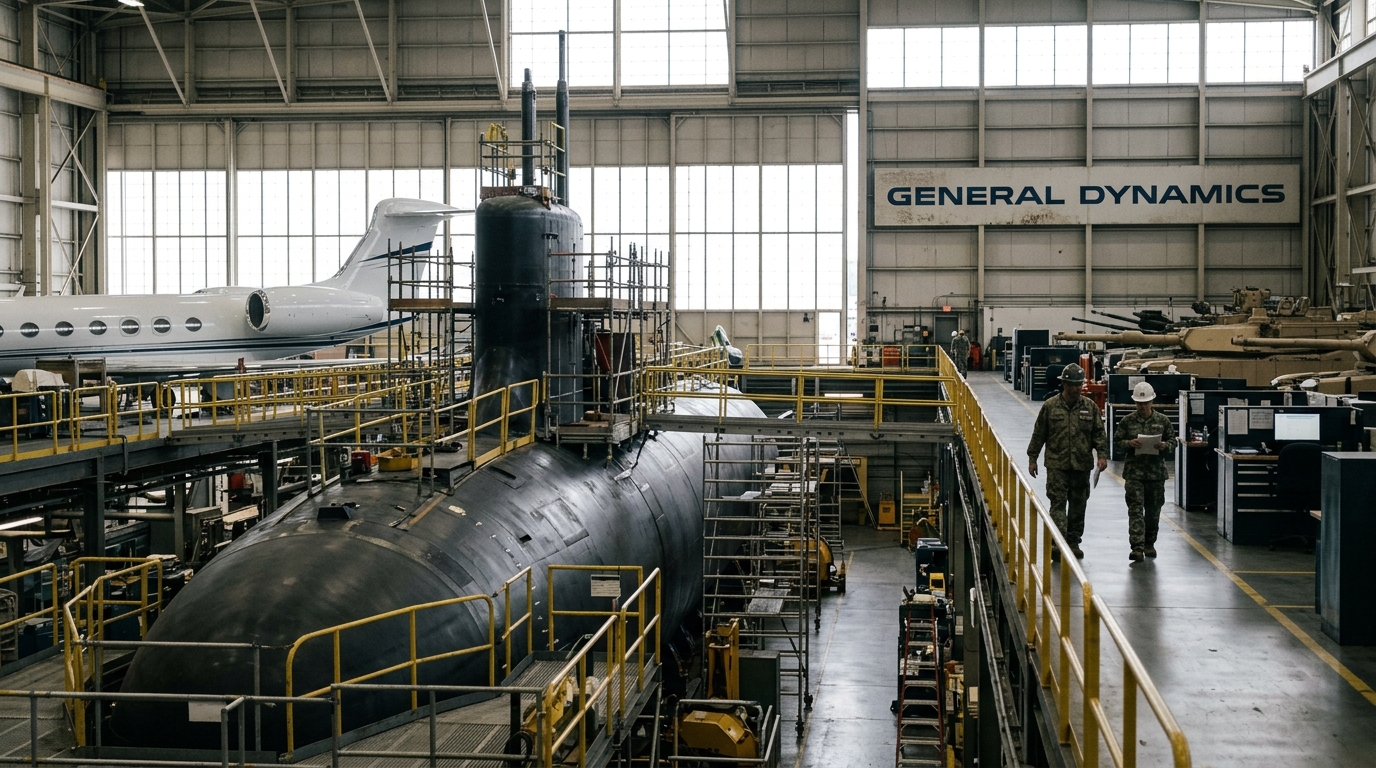
Marine Systems is the engine right now. Revenue grew 21% year over year in Q1, with operating earnings up 26.4%. In March 2026, General Dynamics Electric Boat received a $15.38 billion contract modification from the U.S. Navy to accelerate production and long-term support for both the Columbia-class and Virginia-class submarine programs through 2035. The Columbia-class boats are expected to remain operational into the mid-2080s. Twelve are planned in total. These are not short-cycle contracts. They are generational commitments measured in decades, not quarters.
Worth noting: Electric Boat is actively hiring thousands of workers and expanding production facilities at Quonset Point in Rhode Island, alongside its primary yard in Groton, Connecticut. Defense manufacturing doesn’t scale on a spreadsheet. Physical shipyard capacity is the true constraint, and GD is building it out now against contracts that are already signed. That combination of funded backlog and scarce production capacity is one of the more durable competitive positions in American industry.
The Aerospace segment, which houses Gulfstream business jets and Jet Aviation services, is doing something surprising. Aerospace orders jumped 63% year over year in Q1. Gulfstream delivered 38 aircraft, up from 36 in the year-ago period. The Aerospace backlog alone stood at $21.83 billion entering 2026. Full-year guidance calls for roughly 160 Gulfstream deliveries and Aerospace segment revenue of approximately $13.6 billion. Demand for large-cabin jets has held up better than expected, particularly from international buyers.
Combat Systems and Technologies round out the portfolio — armored vehicles, Abrams tank upgrades, defense IT, intelligence systems, AI and cloud services for the federal government. Both segments grew in Q1. GD Land Systems recently received a $43.5 million modification for Abrams M1A2 tank production. The UK also restarted acceptance of Ajax armored vehicles from GD following earlier delivery complications, adding another international revenue stream back into the mix.
The Investment Case in Plain Language
Here’s where I land on this. General Dynamics is not a story about a stock doubling. It never was. It’s a story about a business with $131 billion in contractually committed future revenue, a government customer that doesn’t go bankrupt, a geopolitical backdrop that keeps pushing defense budgets higher across NATO and beyond, and management that has now beaten earnings estimates four quarters running while expanding margins and raising guidance.
The stock trades near $373 as of mid-July 2026. Analyst price targets range from Citi’s $364 (Neutral) on the low end to Jefferies’ $440 and BofA’s $415 on the high end, with an average across roughly 33 analysts near $396. That’s not a screaming bargain. But it is a business compounding earnings at 7% to 10% annually, returning cash through dividends (28 consecutive years of increases, current yield roughly 1.7%) and buybacks, with a beta of 0.34 that holds up when the broader market gets choppy.
The part people skip: a $131 billion backlog does not represent hope. It represents contracts already awarded and funded, work that will be performed and paid for regardless of what the S&P 500 does next month. That is a fundamentally different risk profile than most growth stocks at comparable valuations.
Risks Worth Taking Seriously
- Valuation is stretched by GD’s own history. The trailing P/E near 23x sits roughly 26% above the company’s 10-year average. The stock is not cheap relative to itself.
- Single-source supplier risk. Management flagged this on the Q1 call. Certain components come from sole suppliers, and any disruption creates margin pressure in Marine Systems specifically — the segment with the most momentum.
- Government concentration. Approximately 70% of revenue flows from the U.S. government. A real defense budget contraction or prolonged continuing resolution would hit the order pipeline quickly.
- Insider selling. GD insiders have sold roughly $27 million in shares over the past three months. Most appear to run through pre-scheduled trading plans, but the pace is worth monitoring heading into earnings.
- Backlog-to-revenue conversion. A $131 billion backlog only matters if it converts on schedule. Supply chain bottlenecks and labor constraints at the shipyards remain a real execution risk, particularly for the Columbia-class program timing.
Watch List for Late July
- The EPS number vs. the $4.06 consensus. GD has beaten by at least 5% in each of the last four quarters. A fifth consecutive beat would be a meaningful signal about the earnings trajectory.
- Marine Systems operating margin. Q1 was the quarter where productivity finally improved after post-pandemic labor and supply chain headwinds. Watch whether that improvement is holding or whether single-source supplier risks are starting to show up in the margin line.
- Book-to-bill. Two consecutive quarters above 2.0x would be extraordinary. Even a healthy 1.3x to 1.5x confirms the demand picture remains intact. A drop below 1.0x would be the clearest warning sign available.
- Full-year guidance. The company raised after Q1. A second consecutive raise — even a small one — would tell you that management has real confidence in the second half, not just strong Q1 momentum.
- Gulfstream commentary. Aerospace orders surged 63% in Q1. Watch whether that pace reflects genuine sustained demand or a timing pull-forward that could soften in coming quarters.
General Dynamics is a $94 billion company that most investors couldn’t describe in detail. It builds the submarines carrying the United States’ sea-based nuclear deterrent. It builds the business jets that executives and heads of state use to cross oceans. It supports the Army’s armored vehicle fleet. It runs classified IT infrastructure for intelligence agencies. And it does all of this while generating free cash flow at a pace that funds a growing dividend and consistent buybacks.
The world keeps providing demand. NATO allies are rearming. The U.S. Navy’s submarine ambitions outpace what existing shipyards can produce right now. Gulfstream’s backlog suggests business jet demand is not fading. None of that is guaranteed to persist forever, but the contracted evidence suggests it runs for years, not months.
The earnings call is July 29. The results come before that. This is worth understanding before the market gets another reason to pay attention.
— WSM Research Desk