
September 26, 2026
Bonus Content: The Off-Price Land Grab Has a New Timetable
Dear Reader,
Amazon wants touch-enabled robots to handle 80% of relevant work across roughly 14 billion warehouse items a year. Its plan points toward one overlooked company at the center of AI’s next phase.
I’m Matt McCall, a former Fox Business host who called the 2009 market bottom and later recommended Nvidia at around $6 a share.
Watch why Amazon’s warehouse robot matters to the AI split.
AI is leaving screens for machines that can see, sense, lift, sort and build.
The hidden company owns the business described in my research as the world leader in collaborative robots, with a cited 31% share of the cobot market.
Amazon supplies the customer-side proof. Its Vulcan robot can use touch to pick and stow goods, and the company in my research supplies an important component.
The source analysis estimates a roughly $400 million revenue opportunity if Amazon’s plan unfolds as expected. That would be enough to more than double the company’s prior-year robotics revenue.
Nvidia supplies the technology-side proof. This robot maker uses Nvidia’s Isaac platform to help machines adapt and learn instead of following only rigid instructions.
See why Amazon and Nvidia both strengthen the case for this robot leader
On September 14, the robotics business introduced Gen 7 – a platform designed to move physical AI from the lab into industrial operations.
Its parent company had already reported $100 million in quarterly Robotics revenue, a fifth consecutive quarter of sequential growth and a 33.4% increase from the year-earlier period.
The launch is public. The revenue trend is already moving. Yet the market is unlikely to reward every AI story equally forever.
I believe three hyped AI names are especially exposed when investors begin demanding proof instead of promises. Waiting for the split to become obvious could mean reacting only after both sides have been repriced.
Reveal details why I believe physical AI could outlast the hype for free by clicking here.
No email or credit card required
The opportunity is not simply “more AI.” It is owning businesses doing useful work before the market fully separates them from companies selling expensive promises.
To your wealth,
Matt McCall, Head Innovations Strategist
Monument Traders Alliance
P.S. The most urgent part of this briefing is the split itself. Why the story-driven Ai shares may be vulnerable as the market shifts toward revenue, deployments and real-world utility. Watch before it is too late.
The Off-Price Land Grab Has a New Timetable
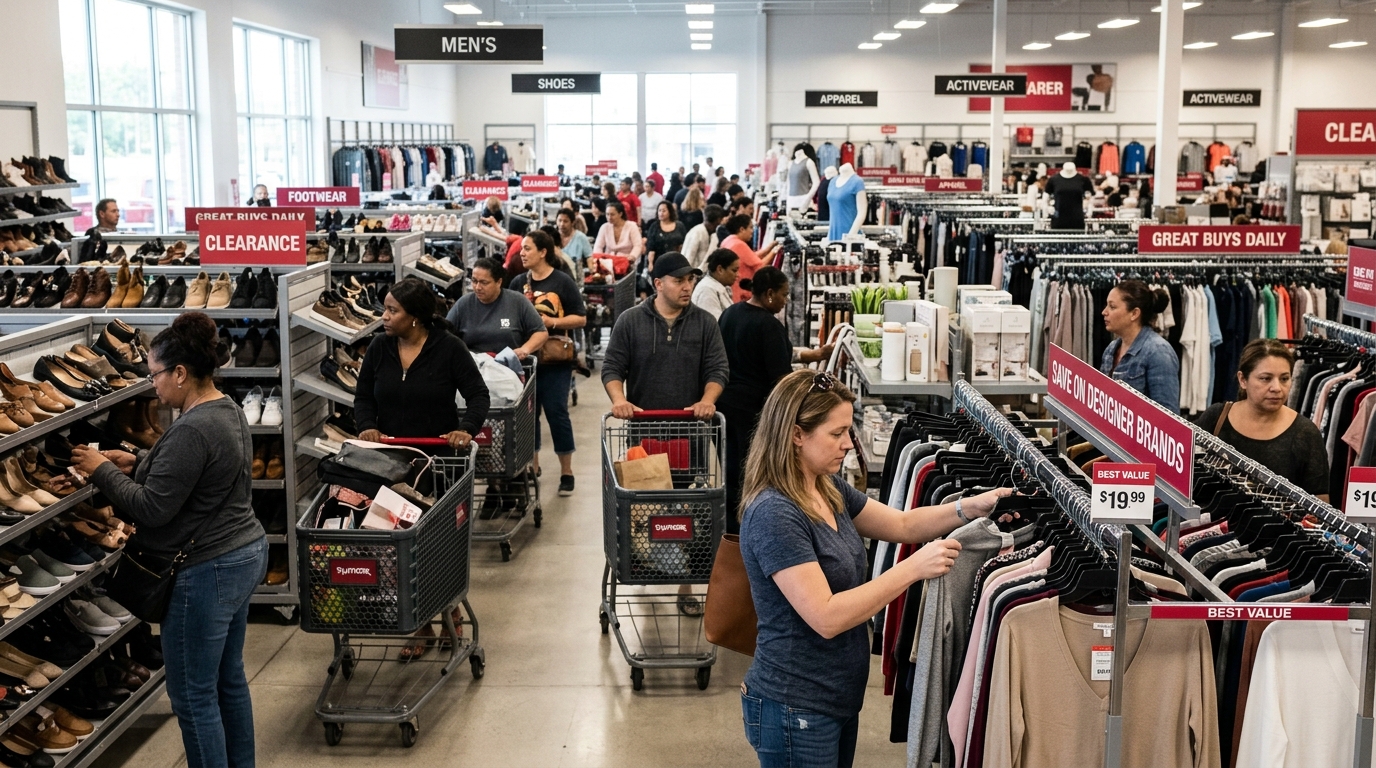
For a long time, portfolio managers treated off-price retail as a recession hedge: useful when times got hard, dispensable when they improved. That framework is obsolete. The two most important earnings reports in August rewrote the sector’s investment case from cyclical to structural, and the numbers are specific enough to take seriously.
The Big Question
The debate among institutional investors is no longer whether off-price is outperforming. It clearly is. The real question is whether the channel has enough physical runway left to justify the kind of capital commitment TJX and Burlington are now making. If demand is structural, the answer determines how much of the long-term upside is already priced in.
Why Wall Street Cares
TJX reported Q2 fiscal 2027 results on August 19, posting net sales of $15.2 billion, up 5% year over year, with comparable sales growth of 4%. Those numbers were fine. What moved the conversation was the strategic announcement layered on top: TJX raised its long-term global store count target by 500 locations to 7,500. The company ended the quarter with 5,285 stores, meaning the revised target implies more than 2,200 additional locations still to open. Beginning in fiscal 2028, TJX plans to lift its annual store-opening pace to 4%, up from the 3% rate previously discussed.
CEO Ernie Herrman told analysts the company is “very confident in the long runway for growth ahead,” pointing to strong product availability and vendor relationships as supporting conditions. The revised ceiling covers TJX’s existing banners across its current 10 countries. TJX has also said it expects TJ Maxx and Marshalls to reach a combined 3,300 stores longer term, and raised HomeGoods’ longer-term target by 200 stores to 2,000. That is a footprint expansion plan, not a guidance tweak.
The Bull Case
Burlington’s August 27 results reinforced the same thesis from a different angle. Total revenue rose 11% to $3.00 billion. Net income came in at $184 million. Excluding the impact of $55 million in tariff refunds and certain expenses associated with bankruptcy acquired leases, adjusted EPS landed at $2.37, a 38% increase versus the prior-year quarter. That followed 39% adjusted EPS growth the quarter before, marking Burlington’s 15th consecutive quarter of double-digit EPS growth. Burlington raised its full-year adjusted EPS guidance to $11.77 to $11.97 and continues targeting 135 gross store openings in fiscal 2026.
The tariff dynamic deserves attention. Rather than letting the $55 million windfall flow through to earnings, Burlington said it plans to reinvest the tariff refunds into lower prices in the second half. That decision trades near-term margin for customer traffic, a reasonable bet when the consumer is already gravitating toward value formats. The Big Three collectively added roughly $2.5 billion in quarterly topline revenue at a time when overall retail sales grew less than 4%.
The Bear Case
TJX’s quarter carried a notable soft spot. Marmaxx, which includes TJ Maxx and Marshalls and is the company’s largest division, delivered comparable sales growth of just 1%. HomeGoods jumped 7%, TJX Canada rose 6%, and TJX International gained 7%, providing enough cover to keep the consolidated number above plan. Management described the Marmaxx shortfall as a self-inflicted merchandise mix problem rather than a demand issue, and guided for improvement by the holiday season. That framing is meaningful. Companies that own execution missteps tend to fix them. Companies that blame the environment do not.
Burlington’s rapid physical expansion is creating its own friction. Management said new-store cannibalization reduced second-quarter comparable sales by approximately 1.5 percentage points, above the company’s historical drag of around 1 point. Management expects that headwind to persist through year-end before normalizing as the opening schedule stabilizes.
What Investors Are Missing
Tariff volatility, which most investors view as a risk, may function as a supply advantage for the off-price model. Vendors responding to tariff pressure tend to accelerate production and pull goods forward, creating inventory surpluses that TJX, Ross, and Burlington can acquire at favorable prices. Herrman has made this point explicitly to analysts. Market disruption in individual merchandise categories historically expands the available buying pool. The model that benefits from chaos needs chaos to keep performing, but the current macro environment is generating plenty of it. The PCE price index rose 4.1% year over year as of May 2026, eroding real purchasing power and pushing consumers toward formats that offer 20% to 60% discounts off full-price retail.
Stocks to Watch
- TJX Companies (TJX): At a market cap around $145 billion, the clearest expression of the structural thesis. The 7,500-store target, combined with a planned acceleration to 4% annual growth in fiscal 2028, locks in long-term revenue capacity regardless of short-term Marmaxx fluctuations.
- Burlington Stores (BURL): Smaller, growing faster on a percentage basis, and targeting at least 1,500 stores by end-2028. Fifteen consecutive quarters of double-digit EPS growth is not a streak that happens by accident. More upside than TJX if its expansion plan holds, more execution risk if it does not.
- Ross Stores (ROST): Reported Q2 results the day after TJX’s August 19 release, beating on both top and bottom lines and raising full-year EPS guidance to $8.61 to $8.77. Raised its 2026 store-opening plan to 115 locations. The report helped stabilize investor sentiment across the entire sector after the Marmaxx miss raised brief concerns about off-price demand.
- Macy’s (M) and Kohl’s (KSS): Not companies to own here. Department stores have ceded sales and earnings to the off-price channel for more than a decade. As TJX specifically identifies markets where department stores are closing as a growth opportunity, that pressure intensifies rather than eases.