
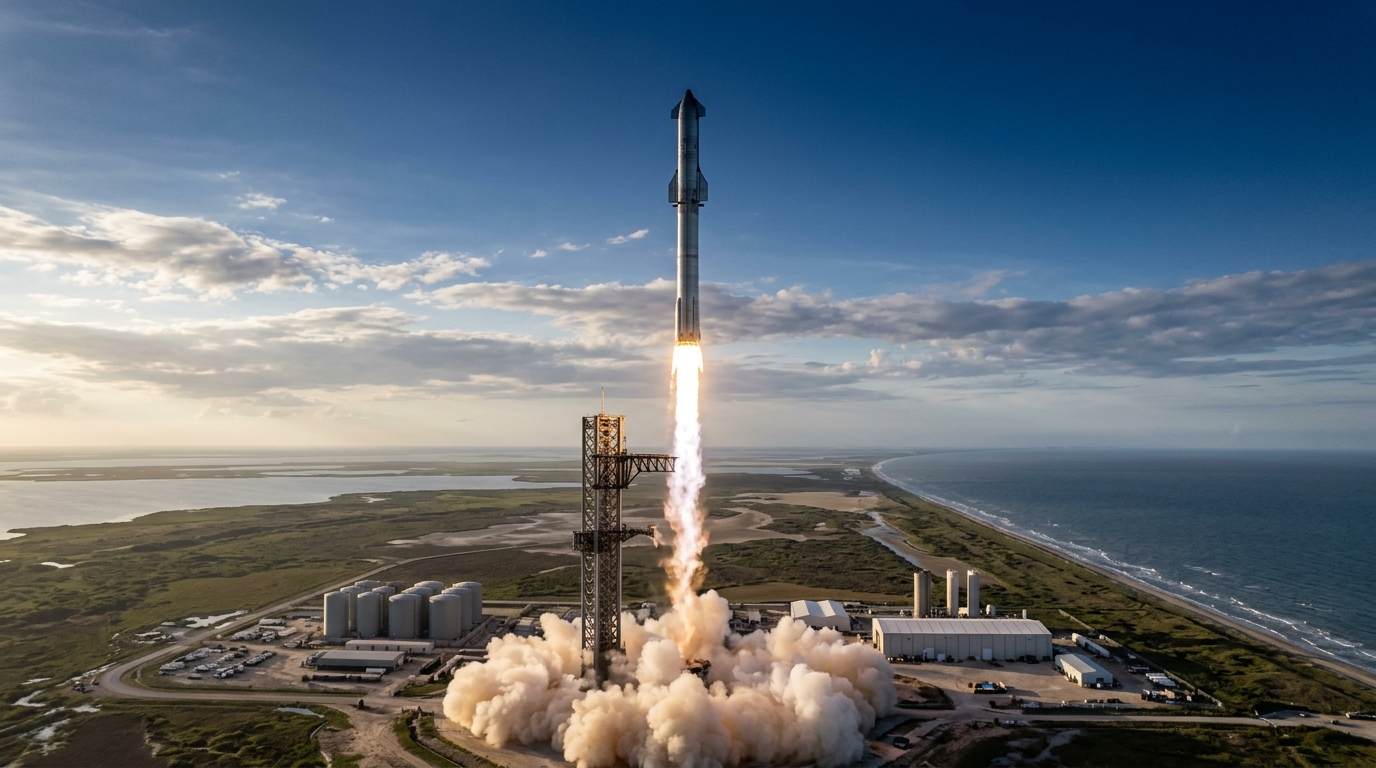
Sometime this morning, a 124-meter rocket called Starship is attempting something it has never done across thirteen previous flights: reach orbit. The Federal Aviation Administration authorized SpaceX’s launch and reentry operations on September 26. The 75-minute window opens at 8:15 a.m. ET from Starbase, Texas. The mission profile calls for roughly ten hours circling Earth at 275 kilometers before splashdown near Chile. Every publication covering space will tell you this is a landmark for engineering. That is true, and it is also the wrong frame for evaluating SPCX.
The right frame is cargo.
SpaceX aims to send its spacecraft into orbit for the first time and deploy 26 of its newest Starlink satellites. Those 26 satellites are the actual investment event. Each V3 satellite is designed to support 1 terabit per second of downlink capacity, an approximately ten-fold improvement over the V2 generation. Put that in launch economics: each Starship V3 mission carrying a full batch is designed to add about 26 terabits per second of downlink capacity to the Starlink network, several times what a single Falcon 9 launch of V2 Mini satellites adds. That ratio, not today’s altitude, is what changes the unit economics of satellite broadband.
The V3 satellites are equipped with solar arrays that generate approximately twice as much power as prior generations. Propulsion shifts to argon Hall thrusters, and at approximately 2,000 kilograms each, they are more than three times the mass of a V2 Mini, which is precisely why Starship is the only vehicle capable of carrying them. Starship and V3 are not separate programs running in parallel. They are one compounding system, and each depends on the other to work at scale.
The Business Underneath the Launch
Revenue from Starlink’s connectivity segment hit $11.387 billion in 2025, making it the first satellite internet service to clear $10 billion in a single year. Per the Q2 2026 earnings release, connectivity revenue was $4.29 billion for the quarter, against consolidated SpaceX revenue of $7.81 billion, with a $47.5 billion backlog. Starlink reached 12.0 million subscribers as of the end of Q2 2026. Subscriber growth of that magnitude at that pace would be extraordinary for any terrestrial telecom. Doing it from orbit makes the competitive moat structurally deeper with each launch.
There is a tension in the numbers, though. Average revenue per user was $66 per month in Q1 2026, down from $85 a year earlier. SpaceX is buying geographic expansion by lowering prices for emerging markets. The question long-term investors need to answer is whether V3’s capacity leap reverses that compression by unlocking high-margin enterprise and government contracts, or whether ARPU continues drifting lower as the subscriber base widens.
What Could Go Wrong
As of the most recent close (September 25), SPCX closed at $148.68, against a 52-week high of $225.64. That gap reflects real concerns: SpaceX’s first earnings report disclosed $28.455 billion of capital expenditures in the first half of 2026, implying roughly negative $25 billion of first-half free cash flow. The constellation burns cash at a rate that would concern most investors in any other industry. Starship failures are not hypothetical either. The program has missed prior schedule goals, and setbacks remain a recurring feature of rapid-iteration rocketry. A failure today would not end the program, but it would reset the V3 deployment timeline by months and further pressure a stock already trading well below its post-IPO peak.
Citi analysts hold a $200 price target, while also outlining a longer-term path toward a $900-plus valuation if major milestones are hit. That conditional structure tells you something important: the long-term value creation story is real, but every chapter depends on the rocket working. Orbital flight today unlocks V3 at scale. V3 at scale is the only version of this business that justifies a generational holding.
Watch the cargo, not the altitude.