
From the man who tabbed NVIDIA before it soared 6,271%
over 7 years at its peak
Wall Street’s Hottest Stock Has a Waiting List. Here’s How to Skip It.
Wealthy investors are lining up for Anthropic shares and coming up empty. Tech Visionary, Matt McCall, says you can get into a backdoor opportunity today for less than $100 a share.
Anthropic, the company behind Claude, is set to go public at a record $2 trillion valuation.
It could top SpaceX as the biggest IPO in history.
And right now, almost nobody can buy a single share.
One Wall Street broker, whose firm trades about 1,000 private stocks, told TechCrunch:
“The hardest stock to source in our marketplace is Anthropic. There’s just no sellers.”
Even Goldman Sachs is charging clients 15% to 20% of their profits just for a way in.
The Line Is Out the Door
Meanwhile, people who already own a piece of Anthropic are holding on tight.
While everyone else is stuck in line. Even wealthy investors are struggling to get shares.
And it’s all leading to the most anticipated IPO in history.
When Anthropic finally goes public, millions of regular folks will rush to buy whatever they can get.
But tech legend Matt McCall isn’t getting in line.
“Most people are going to wait for Anthropic to go public and then buy as many shares as possible,” he says. “But I think that’s a huge mistake.”
Who Is Matt McCall?
There is a short list of analysts in America who were early on the AI boom.
Matt McCall is one of them.
He’s the Head Innovation Strategist at Monument Traders Alliance and editor of The McCall Innovation Report.
Over the past two decades, McCall has written about 50 stocks that went on to peak gains of 1,000% or more. Including:
- Tesla, before it climbed as high as 3,129%
- NVIDIA, before it soared a peak 6,271% in 7 years
- AMD, which he singled out in 2009
That’s why people call him “Mr. 1,000%.”
On March 6, 2009, McCall went on FOX Business and gave away nine stocks. One was AMD, trading around two dollars. By 2026 it rose 25,000%, enough to turn a $5,000 stake into more than $1.28 million.
No Waiting List Required
McCall’s play isn’t Anthropic. It’s a stock linked to Anthropic that you can buy right now in a regular brokerage account.
No waiting list. No special broker. No fighting Wall Street for scraps.
He calls it a “Second IPO.”
It may sound too good to be true. But it has happened before.
When Rivian went public in 2021, Ford owned a 12% stake. In the six months around Rivian’s IPO, Ford shares roughly doubled.
Yahoo quietly built a huge stake in Alibaba. In the two years around Alibaba’s IPO, Yahoo shares could have tripled your money.
It happened again shortly after EchoStar acquired $8.5 billion in SpaceX shares. In the months leading up to the SpaceX IPO, its shares soared 600%.
Now it’s happening again!
Anthropic’s “Silent Partner”
Years before the IPO frenzy, a much smaller firm took a $100 million stake in Anthropic. It beat Apple, NVIDIA, Amazon and Google to the punch.
Today, the entire company is valued at less than $15 billion. That’s 100x smaller than Anthropic.
McCall believes its early stake could cause it to double or triple in the years ahead.
And you can buy it for less than $100 a share.
We sat McCall down in front of our cameras to get the whole story. He even gave away the name and ticker.
For the time being, you can watch it free.
|
“If history repeats… investors could double or triple their money in the years ahead.” – Matt McCall
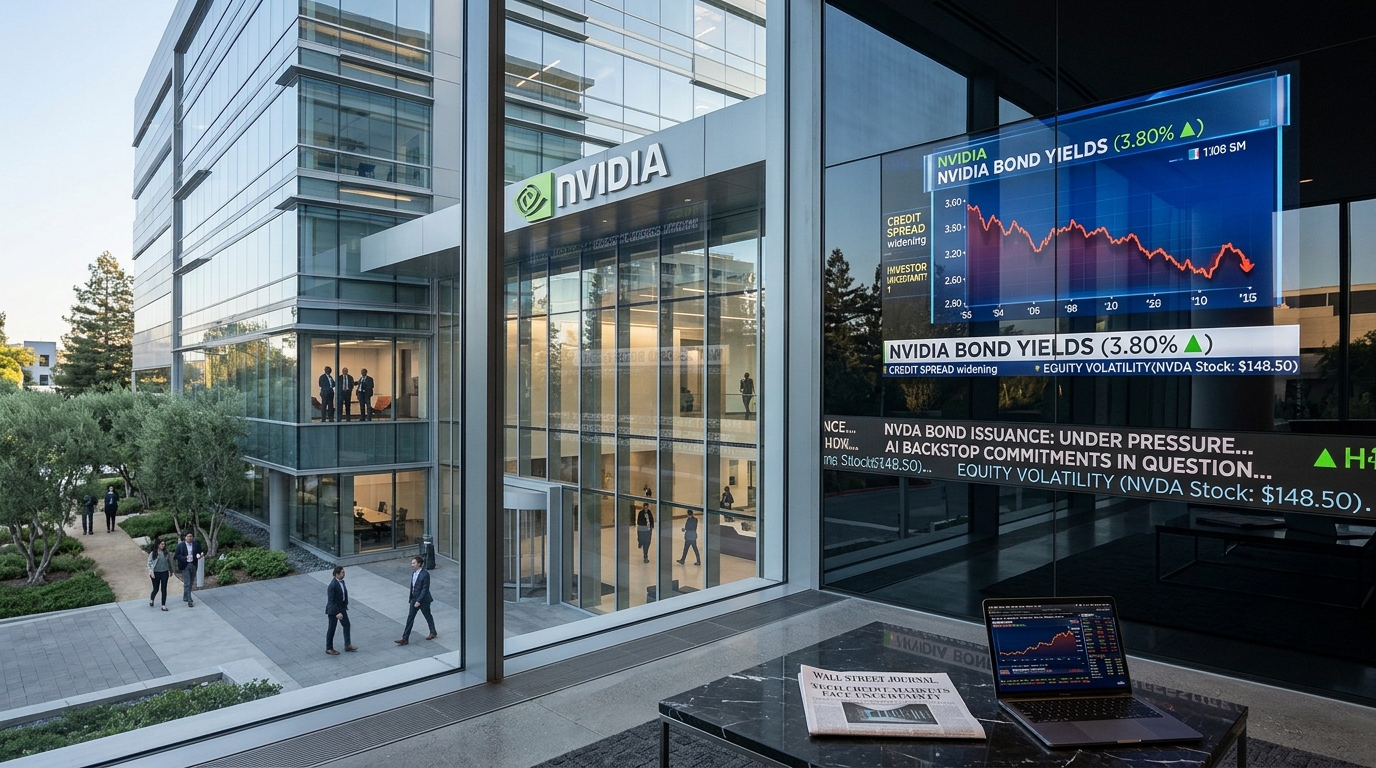
Nvidia’s Bond Market Is Asking a Question the Stock Price Is Ignoring
Jensen Huang’s departure from Nvidia on November 12 was treated by equity markets as a governance shock. The credit desk reads it differently.
Nvidia carried $36 billion in off-balance-sheet AI cloud agreements, or backstops, for neoclouds, as of its last quarterly filing in late July. Nvidia has also disclosed far larger ecosystem commitments elsewhere in that same filing, including hundreds of billions of dollars of supply and capacity commitments, a scale that has fueled the market’s “bank of AI” framing and fears of circular financing. That system was built by one person. He is gone.
What the Bull Case Still Says
Some on the Street still expect Nvidia to fulfil previously announced commitments. CoreWeave CEO Michael Intrator offered the same reassurance. He told CNBC, before Huang’s departure, that Nvidia “is not one person.” And the bond market itself has pulled back from its worst levels: CoreWeave’s bond yields retreated after its quarterly earnings on Tuesday eased investor concerns, with its 9.75% senior notes due 2031 yielding roughly the mid-14% range on Friday after trading at higher yields earlier in the month.
CoreWeave is already back at the borrowing table with a $4 billion loan ask, backing it this time with contracts from Meta, aiming for an all-in rate of roughly 7.5%, far cheaper than the yield its unsecured bonds have been trading at. The secured-versus-unsecured gap in that price is itself the story: lenders are still willing to lend, but only when the collateral is a hyperscaler’s balance sheet, not an Nvidia backstop.
What the Bear Case Actually Says
The bear case is not that Nvidia defaults on existing commitments. It is that nobody replicates Huang’s deal-making at anything close to prior scale.
Some analysts expect Nvidia to honour existing commitments, but argue new multi-party ecosystem deals at the same scale will be harder to arrange. Others have made a similar point: the creative deal-making and the pace of equity and credit support are likely to moderate.
Over the last several years, Nvidia has become a prolific venture investor, with PitchBook tallies showing it participating in a triple-digit number of venture rounds in 2026. Estimates have also put Nvidia’s share of U.S. venture dollars in the mid-teens in the second quarter. One investor described incoming interim CEO Colette Kress as far more conservative and unlikely to write the same checks. Infrastructure startups needing $100 million to $500 million of GPUs often raised a meaningful portion of it from Nvidia.
What Investors Are Missing
The equity market has focused on Nvidia’s chip franchise and whether a new CEO can maintain product momentum. The credit market is asking a different question: who fills the role of anchor investor and guarantee-writer for the neocloud complex?
Nvidia does more than sell GPUs to neoclouds. It invests in them directly, and it has also offered revenue-share style support that functions like a floor, including promises to pay a guaranteed rate for unsold GPU capacity, specifically to make banks more willing to lend. That floor is what made the circular financing machine function. Remove the floor’s architect, and lenders price a wider margin for error.
CoreWeave’s own disclosures highlight why credit investors are so sensitive to that margin. In its third-quarter materials, CoreWeave reported interest expense near $846 million for the quarter, alongside adjusted operating income of $200 million to $260 million. At mid-teens yields, any new unsecured debt refinancing becomes existential math.
Stocks to Watch
CoreWeave (CRWV): CoreWeave’s leverage is high. The secured loan backed by Meta contracts is a constructive sign, but each incremental dollar of unsecured refinancing will come at a punishing cost until the Nvidia backstop question is resolved.
Nebius (NBIS): Nebius reported third-quarter revenue up 571% year over year to $981 million, but said its 2026 revenue outlook was now expected at the low end of its prior range while capital intensity remains elevated. With Nvidia tied into neocloud financing structures across the ecosystem, any shift in Nvidia’s investment posture matters for Nebius’s own cost of capital.
IREN (IREN), Oracle (ORCL), Broadcom (AVGO): Credit markets have been marking up AI-linked financing risk. Recent market data has shown Nvidia’s five-year CDS widening sharply over the past month, with Broadcom also wider, and Oracle and CoreWeave trading at far higher levels. The contagion has not broken the larger balance sheets, but the direction of travel is clear. If neocloud cost of capital stays elevated, the downstream pressure reaches every company whose AI revenue depends on that infrastructure getting built.
The CDS widening described here fits a broader pattern credit desks have been tracking all year. AI bonds have been pricing a spread premium over the broad investment-grade market, a gap that has widened as long-term government yields climbed.