
October 13, 2026
Bonus Content: The Laser Inside the Switch Is Now the Investment
Ian Cooper here,
Alert!
If you still haven’t saved your copy of “The $50-to–$500 Options Strategy”…
… do it right now before the download link expires.
We’ll be moving this book behind a paywall in the near future so grab it now while you still can.
You’ll thank me.
FREE: The $50-to–$500 Options Strategy
To your success,
Ian Cooper
Tradewins
Reminder: Grab your copy of “The $50-to–$500 Options Strategy” before we move it behind a paywall.

The Laser Inside the Switch Is Now the Investment
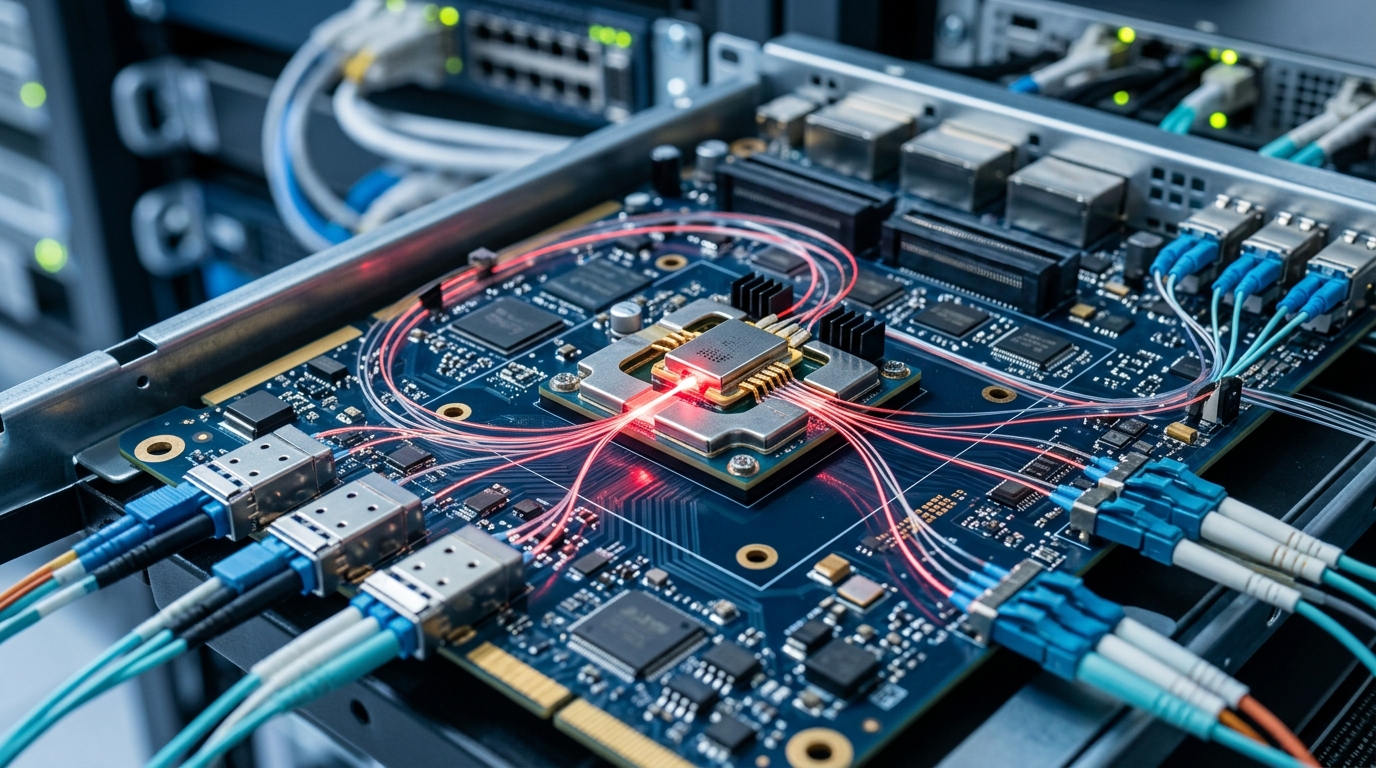
The debate over whether silicon photonics would ever leave the research lab is over. The question now is who captures the money as it scales.
At the signaling speeds AI clusters now demand, a passive copper cable can only carry a clean signal for less than a meter before it degrades, and pushing it further means pumping in more electrical power just to keep the data intact, which generates heat and drives up the energy bill. That is not a future constraint. Data center operators were already warning by 2025 that interconnect power was becoming a material share of total cluster consumption, but the exact percentage varies by architecture and is not consistently reported as a single industrywide figure.
The fix is co-packaged optics, and it is arriving in volume now. The cutting edge of this shift is co-packaged optics, where the optical components are built right next to the switch chip rather than plugged in at the edge of the box, slashing the power lost in translation and packing far more bandwidth into the same space. Nvidia says its Spectrum-X Ethernet Photonics platform delivers 5x better network power efficiency, higher resiliency, and 5x longer sustained AI application runtime versus traditional pluggable transceiver-based networks.
The standardization layer is also closing. In August 2026, the Open Silicon Photonics for AI Systems initiative launched as an official workstream within the Open Compute Project, with a 19-company coalition that includes Dell Technologies, Qualcomm, Flex, and Foxconn Interconnect Technology. The effort published a foundational architecture-vision document aimed at a shared CPO blueprint, including multi-vendor interoperability and scaling from 72 to more than 1,024 nodes. Open standards, when they arrive, accelerate procurement cycles and compress the timeline from pilot to production.
What most investors are still underweighting is where the real supply constraint sits. It is not the silicon. It is the laser. Investors often point to indium phosphide wafer and related epitaxy capacity as a potential bottleneck for high-volume laser supply, but reliable industrywide supply-and-demand data is limited, making it difficult to underwrite how long any deficit lasts. That opacity is risk priced into the wrong companies.
Industry forecasts have called for optical-transceiver sales growth of roughly 50% in 2026, driven by AI infrastructure expansion, and for silicon photonics to take a majority share of optical transceivers in 2027. The revenue is already appearing in filings: Coherent delivered record fiscal year 2026 revenue of $7.12 billion, up 22.5% year over year, with Datacenter & Communications revenue growing 40% to $5.27 billion. Lumentum reported $808.4 million in fiscal Q3 2026 revenue, up more than 90% year over year.
The scale of that revenue growth also reflects how capital is being mobilized across the AI hardware supply chain. Broadcom arranging private financing for custom AI silicon illustrates the debt-driven mechanism pulling forward hyperscaler hardware spend.
Stocks to watch: Coherent (COHR) and Lumentum (LITE) are the two laser suppliers most directly exposed to CPO volume ramps. Nvidia (NVDA) is both a CPO customer and a system architect, with its Spectrum-X Ethernet Photonics switches integrating CPO directly onto the ASIC and delivering up to 409.6 terabits per second of bandwidth. Broadcom (AVGO) is the other CPO switch heavyweight. The less-covered name is Tower Semiconductor (TSEM), whose silicon photonics platform is used in optical transceivers and is developing support for near-packaged optics and co-packaged optics. At current valuations, the laser moat is not fully priced.
Broadcom sits on the other side of the same CPO buildout. Broadcom’s custom silicon and networking fabric business is built around the same hyperscaler capex wave driving CPO adoption.