
On July 22, 2026, a single transmission line fault in Ashburn, Virginia set off one of the clearest warnings yet for American computing infrastructure. Data centers across Northern Virginia’s dense server corridor sensed the disturbance and switched to backup power almost simultaneously, dropping more than 3 gigawatts of load, roughly 3% of PJM’s entire demand at that moment, within seconds. The incident was not a blackout. It was something more structurally dangerous: a demonstration that modern AI facilities are now large enough to destabilize the very grid they depend on.
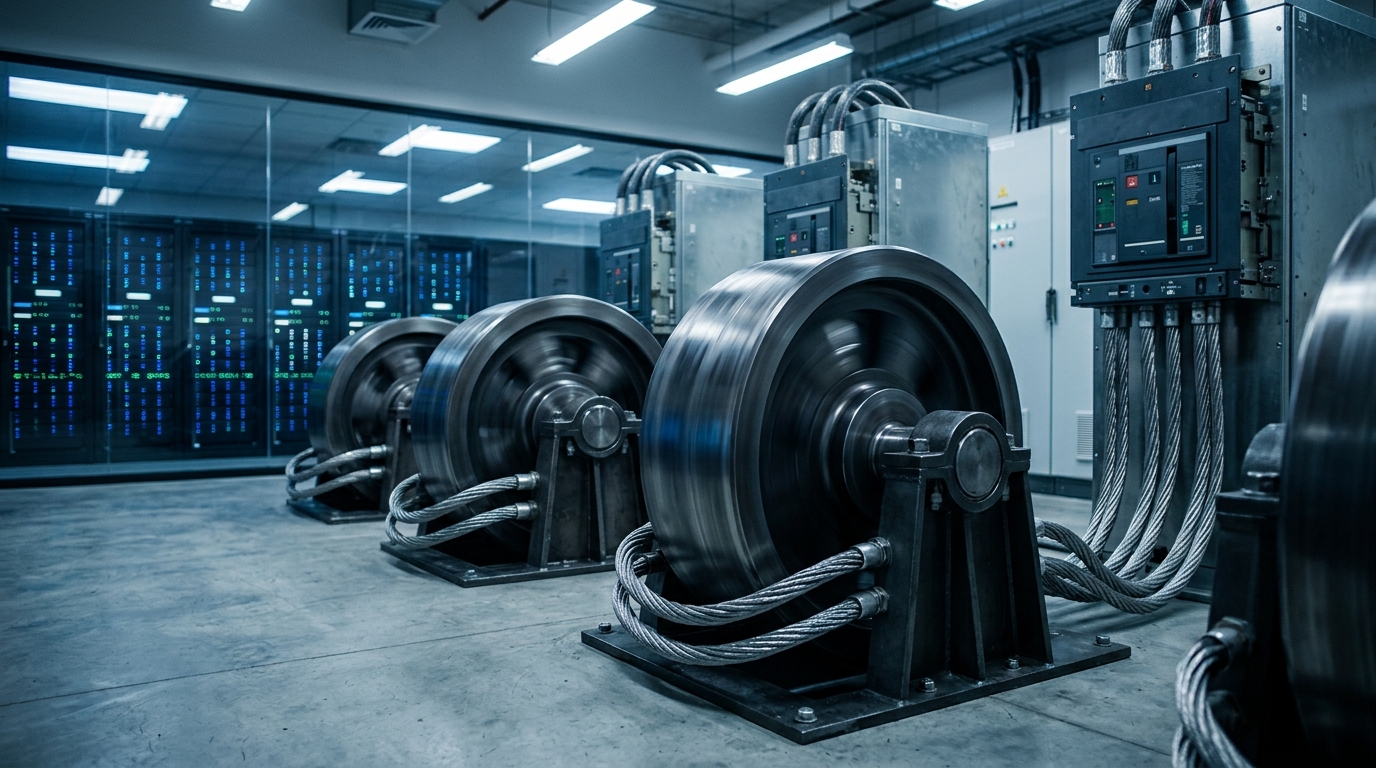
The underlying physics make flywheels a logical answer for ride-through. Individual AI accelerators can exhibit very large, fast power swings at the device level, and rack-level configurations are now commonly discussed in the 120–150 kW range. In production environments, synchronized AI workloads have been observed to drive step-like jumps that overshoot steady-state ratings by 50% or more. Not every chemical battery is optimized for absorbing that kind of transition cleanly at very short timescales, especially when the objective is repeated, high-cycle buffering rather than minutes-to-hours energy shifting. Flywheel systems deliver instant charge-discharge capability, high cycle durability, and minimal performance degradation, making them well suited for frequency regulation, uninterruptible power supply, and grid stabilization applications.
Flywheel UPS systems store energy mechanically rather than chemically and are commonly described as providing roughly 15–40 seconds of ride-through power to bridge the gap until generators come online. Some vendor and trade literature also cites operating efficiencies up to about 98% in certain configurations, along with very high cycle capability relative to batteries. That lifespan matters enormously in capital planning. In many situations, flywheels cost more upfront, but over long service lives they can deliver lower total cost of ownership by avoiding periodic battery replacement and much of the associated maintenance.
The highest-security operators are not waiting for the economics to improve. Piller said in February 2026 that the United States Government had again selected its rotary UPS technology for an expansion of a classified data processing facility in Langley, Virginia, and that two further systems using the same configuration as a 2017 installation were to be commissioned. Piller’s POWERBRIDGE kinetic storage is marketed as a way to support frequency stability under dynamic load conditions.
The investment angle is not Piller directly, which is privately held. The angle is the supply chain that feeds these systems: carbon fiber rotor manufacturers, magnetic bearing specialists, and the power electronics firms integrating flywheel arrays with rotary UPS and generator-based backups. One widely cited market estimate puts the global flywheel energy storage systems market at about $580.8 million in 2026 and about $1.15 billion by 2033, implying roughly a 10.3% compound annual growth rate. Meanwhile, grid operators are moving from informal concern to formal process. PJM has described the July 22 event as a driver for proposed reliability standards to manage large load disconnection events, and it has also advanced work that could make curtailment risk a real underwriting variable for some large new loads starting in 2027. Curtailment risk creates a powerful commercial incentive for operators to install ride-through technology before policy and interconnection terms force the decision. The flywheel market is not growing because energy storage is fashionable. It is growing because the alternative is losing grid connection reliability when it matters most.