October 12, 2026
Bonus Content: A Solar Airship Just Crossed the Pacific. Now Comes the Hard Part.
Editor’s Note: On September 24, Elon Musk dropped a bombshell announcement, and nobody noticed. Famed Wall Street investor Louis Navellier saw it – and he says he hasn’t been this excited since he recommended Google in 2004. The full story below…
Few people know this story…
In January 2019, Elon Musk broke ground on a Tesla plant in Shanghai. By the end of the year, it was delivering cars.
That’s how fast he moves. And along the way, he’s minted countless “Teslanaires”… and more than 4,400 SpaceX millionaires.
But what he quietly announced just before noon on September 24 could become his boldest and most lucrative move yet.
It hinges on the fastest-growing part of his SpaceX empire…
And the little-known supplier powering its explosive growth.
Elon has $912 billion riding on it.
That’s how big he thinks this could be.
But here’s why buying SpaceX or even Tesla is NOT the best way to play it
Regards,
Louis Navellier
Senior Investment Analyst, InvestorPlace
P.S. I found this stock using my Stock Grader. This proprietary system cost $9 million to build and maintain. And since 1998, it’s returned 13,126% in back tests. That’s 13X the market. It’s now flashing bullish on this critical SpaceX supplier. Click here to get its name and ticker now.
A Solar Airship Just Crossed the Pacific. Now Comes the Hard Part.
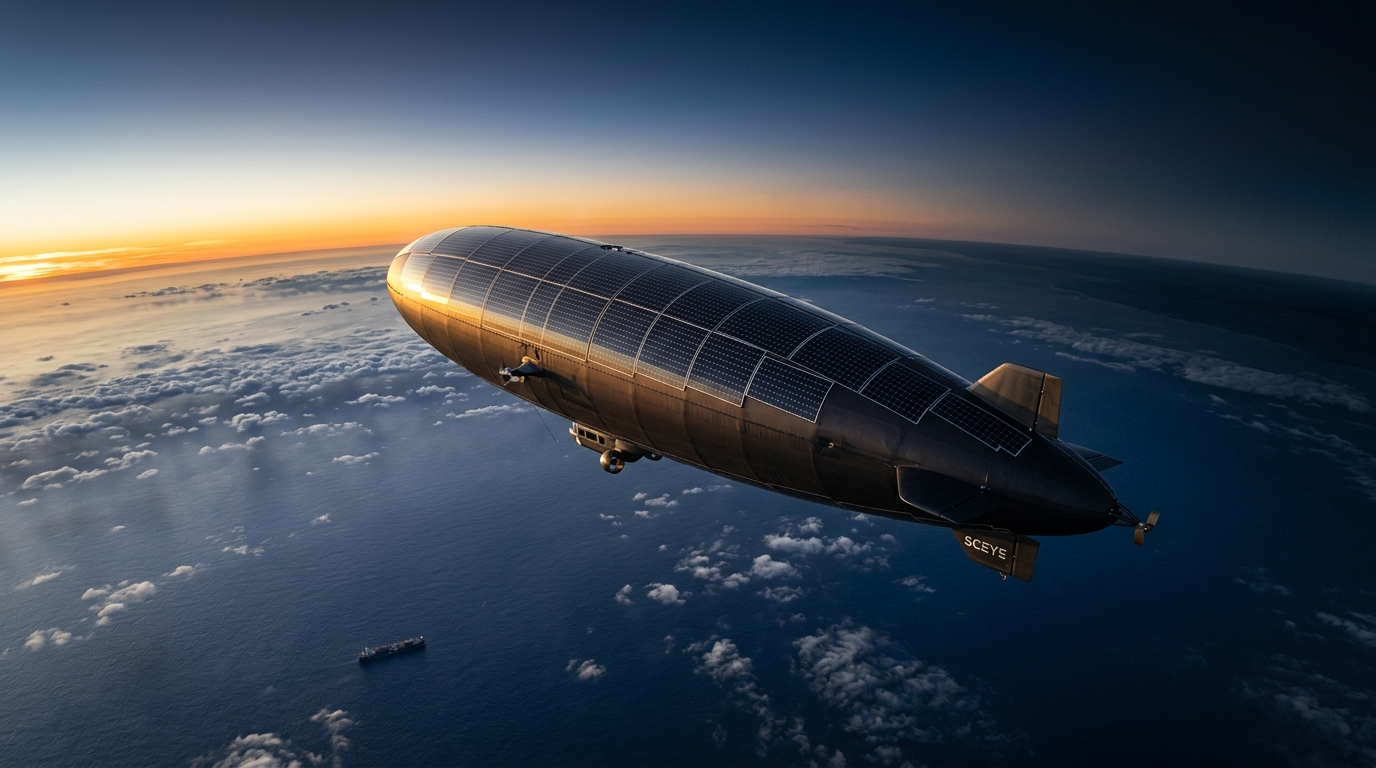
In early September, a solar-powered airship launched from New Mexico, crossed more than 15,000 kilometers of open ocean, and spent over a week above Japan before flying home. The vehicle, developed by Sceye, launched on August 9, 2026, and reached Japan 13 days later, where it operated in Japanese-managed airspace for more than seven days before returning toward the U.S. The mission served as a proof-of-concept for integrating High Altitude Platform Stations into existing global communications architecture.
That is genuinely remarkable engineering. It is also not the debate institutional investors should be having.
The real question is whether HAPS can ever become infrastructure at scale, or whether it remains a premium solution chasing a problem that cheaper alternatives keep solving first.
A single operational HAPS could provide coverage equivalent to roughly 500 ground-based cell towers, which is the headline figure every company in this space leads with. What gets less attention is the cost per subscriber at current production volumes, or the fact that the addressable market keeps shifting as LEO satellite constellations expand coverage of the same remote geographies HAPS is built to serve.
Upon arrival over Japan, ST1 demonstrated mobile broadband connectivity to unmodified devices through SoftBank’s core network, which was the key technical milestone. The new component that should draw attention is SoftBank’s test of HAPS-enabled edge computing, processing smartphone traffic high above the waters off Cape Muroto without routing through a terrestrial network. Airborne edge computing changes the cost model, because it reduces backhaul requirements that have historically made HAPS economics awkward.
Two camps are forming among the operators writing checks. SoftBank is building a mixed fleet, combining Sceye’s lighter-than-air platforms with fixed-wing heavier-than-air vehicles, deliberately spreading technology risk. NTT DOCOMO and Space Compass, a joint venture between NTT and SKY Perfect JSAT, committed $100 million to AALTO in 2024 as part of Japan’s HAPS consortium, backing the Airbus Zephyr lineage instead.
Neither bet is wrong. But they signal something important: the operators closest to commercialization are hedging across platforms rather than converging on a standard. That is what early infrastructure cycles look like before one architecture wins.
Pierre-Antoine Aubourg, CTO of AALTO HAPS, has argued that the commercial hurdle is making remote connectivity pencil out for mobile operators. If that argument holds at commercial scale, HAPS becomes a margin story for operators, not just a coverage story. That reframes who benefits most: not the platform manufacturers, but the telcos that can convert hard-to-serve subscribers into revenue without the capital burden of tower grids.
Stocks to watch: SoftBank Group (9984.T) is the most direct commercial bet, with trial services now demonstrated in Japan and the company targeting commercialization from 2027 onward. Airbus (AIR.PA), through AALTO, has the NTT DOCOMO relationship. AeroVironment (AVAV), which has been a key development partner on SoftBank’s Sunglider program through HAPSMobile, stands to benefit if fixed-wing HAPS moves from trials to scaled manufacturing. For investors who think the edge computing angle matters more than coverage, the names to watch are the hyperscalers and telecom equipment vendors whose architectures get embedded in whatever flies.