

October 10, 2026
Bonus Content: The Veto Is Not a Strategy: Why $5 Trillion in AI Spending Needs More Than a Presidential Backstop
Attention Traders…
If you’re willing to be at your computer between 9 am and 10:45 am on most weekdays…
I can show you one simple trade that can potentially bankroll your retirement.
Hi… I’m Dave Aquino and I help everyday Americans go after their retirement goals sooner… by teaching them how to master the retirement trade.
The Retirement Trade is designed to be used every morning between 9am and 10:45am eastern time.
Why this window?
Well… I can’t share that information here on this page…
But don’t worry because you’ll discover the exact reason why inside the free report you see pictured below…
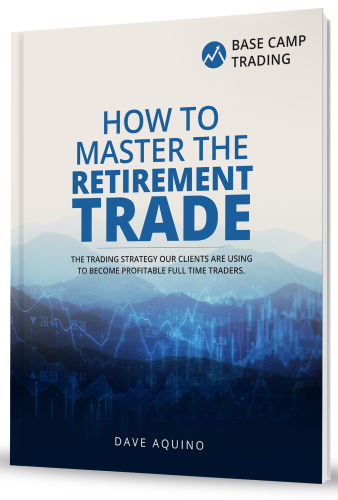
And it’s yours – for FREE!
But please don’t delay, because it might not be free for long.
Just click here to claim it today…
– Dave Aquino
Partner, Base Camp Trading
The Veto Is Not a Strategy: Why $5 Trillion in AI Spending Needs More Than a Presidential Backstop

Every investment committee running long exposure to Nvidia, Microsoft, Alphabet, Amazon, or Meta is now doing something that would have seemed strange two years ago: modeling midterm election scenarios. The November 3 vote is 24 days out, and the question being asked in those rooms is not whether the AI buildout continues. It is whether the policy environment that enables it survives a shift in Congress.
Why Wall Street Cares
The numbers are too large to ignore. Wall Street has committed to an AI infrastructure expansion with total capital expenditures expected to exceed $5 trillion through 2030. That spending is accelerating even as the technology remains largely unproven in terms of profitability and productivity. Meanwhile, public opposition to data center construction has escalated from a local nuisance into a national political issue. About two-thirds of likely midterm voters say they oppose new data center construction, according to a September New York Times/Siena poll. Voters across eight states will decide 38 data center-related ballot measures in 2026, and most of them, 34 of 38, are scheduled for the November 3 general election, according to Ballotpedia.
The Bull Case
The consensus view on desks right now is that the presidential veto provides a durable floor. If Democrats take one or both chambers, a Republican White House can block any aggressive legislation outright. Trump has been unambiguous: communities opposing data centers will be, in his words, “backwards and poor.” His administration has pushed executive orders to streamline federal permitting and positioned AI infrastructure as a national security priority against China. A divided government, the bulls argue, produces gridlock, and gridlock leaves the buildout intact.
What QE Infinity Means for Gold Securities
The US Treasury and Fed are now increasing their bond purchases in an effort to suppress yields. It’s not working. Inflation is persistently high. Gold is reacting… And one specific gold security is now paying up to 10% yields. It’s creating a very real alternative to monetary assets like US Treasury bonds… And it’s backed by the world’s best gold mine. How can you own this security today?
The Bear Case
Ed Mills, Raymond James’s Washington policy analyst, made the counterargument to CNBC on Friday, and it deserves more attention than it is getting: “What I consistently hear from investors is that the opposition to data centers is really about the political backlash and that after the midterms things get a lot better. But I think that after the midterms, things get worse. That is a huge blind spot for the market.” The mechanics support that view. An estimated $156 billion in data center projects were blocked or delayed in 2025, and another $130 billion in the first quarter of 2026 alone, based on third-party trackers cited by Morgan Stanley. A presidential veto stops a federal moratorium. It does not stop Harrisburg, Columbus, or Sacramento.
What Investors Are Missing
The veto backstop argument assumes federal legislation is the primary threat. The evidence says the threat is already distributing itself below the federal level, where veto power does not reach. Wells Fargo’s utility research team has warned of a sharp jump in active local moratoriums heading into November, identifying the independent power producers, including Vistra, Constellation Energy, and Talen Energy, as among the most exposed to state-level political risk. Morgan Stanley noted that a full Democratic sweep would be most damaging for data center assets, while a slim Democratic majority would actually produce less regulatory follow-through. That is a more precise distinction than the simple veto-backstop framing allows. JPMorgan analyst Ariana Salvatore flagged a potential near-term market reaction if Democrats outperform expectations, even under divided-government conditions. The market is pricing a binary outcome when the actual risk is a gradient.
Stocks to Watch
- Nvidia (NVDA): The clearest expression of data center capex. Any policy-driven slowdown in hyperscaler construction timelines hits GPU demand first.
- Microsoft (MSFT) and Meta (META): Both carry announced capex around $116 billion and $130 billion to $145 billion respectively for fiscal 2026, making them the most exposed hyperscalers if permitting delays compound.
- Constellation Energy (CEG) and Talen Energy (TLN): Long-term nuclear power agreements with Microsoft and Amazon Web Services give both companies durable revenue visibility, but Wells Fargo places them among the names most exposed to state-level political pressure. CEG holds 20-year supply contracts with both Microsoft and Meta. TLN’s expanded deal with AWS covers up to 1,920 megawatts through 2042. These are the contracts the market is pricing as permanent. A post-midterm moratorium wave is the scenario in which that assumption gets tested.
- Vistra (VST): One of the largest competitive power generators in the United States, operating through PJM territory, where the data center buildout is densest and political resistance has been loudest.
Twenty-four days is a short window. The veto is real. But markets that treat it as the whole answer are running an argument that stops at the federal border.