
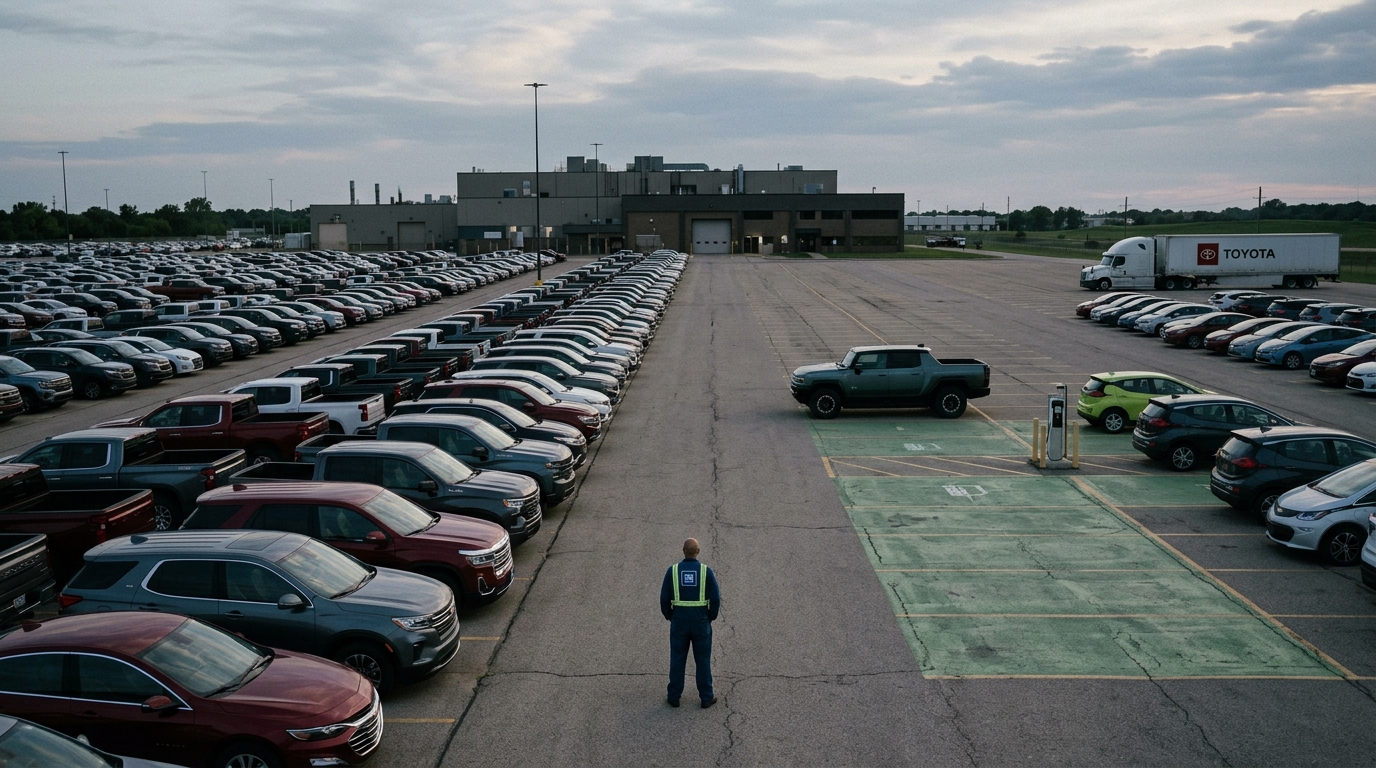
General Motors built its electric-vehicle ambitions on a federal subsidy. When Washington pulled that subsidy on September 30, 2025, the market answered fast. GM sold 25,213 EVs in the United States in Q3 2026, compared with 66,501 units a year earlier, a 62.1% decline. The result: only about 3.8% of everything GM sold in America last quarter was electric.
That single figure reframes the entire GM investment question heading into October 20, when the company reports Q3 earnings. The EV collapse did not happen in a vacuum, it happened because GM bet its electrification timeline on government money that no longer exists, and the infrastructure it built for that bet is now sitting half-empty.
What the Q3 Numbers Actually Say
GM reported 670,974 U.S. vehicle sales in Q3 2026, down 5.5% from the same period a year ago. Gas vehicles held their own. Strip out the EV shortfall and GM’s remaining U.S. sales actually ticked up by 1,655 units year over year. The truck business is not broken. The EV business is.
The biggest declines came from models that had formed the core of GM’s EV strategy: Equinox EV deliveries fell 92.4% to 1,905 units, while Blazer EV sales dropped 84.4% to 1,261 units. Reuters reports GM will now build roughly 35,000 Bolts, about 75% fewer than planned, before production ends in the first quarter of 2027.
The Write-Downs That Follow a Sales Collapse
The Q3 sales data is the leading indicator. The financial damage was already recorded earlier in the year. GM warned in January that it expects significantly lower EV volume in 2026 and recorded $6 billion in EV-related charges during 2025 tied to unwinding some EV investments, including scrapping EV production plans and canceling supply contracts.
The Ultium Cells factory in Warren, Ohio, the joint venture between GM and LG Energy Solution, was idled at the beginning of 2026 due to a drop in EV demand. Roughly 1,330 employees were laid off. The company said the facility would be closed for six months due to weak demand after the cancellation of the $7,500 federal tax credit, and that timeline was later extended. The Ohio plant has since restarted, but at volumes far below original plans.
The Toyota Problem GM Cannot Ignore
While GM’s EV line contracted, a rival running a completely different playbook kept growing. Toyota’s electrified sales rose 28.5% in Q3 2026 and now make up 57.4% of its U.S. volume. GM sells just one hybrid, the Corvette. Toyota offers 32 electrified options across its Toyota and Lexus brands.
Toyota is now less than 136,000 units behind GM year to date, compared with a gap of roughly 335,000 for all of last year. That gap is closing entirely because of hybrids, not battery electrics, which exposes the structural flaw in GM’s product mix. Consumers who wanted electrification without the range anxiety found Toyota. GM had almost nothing to offer them.
The Farley Warning and the Bigger Threat
Ford CEO Jim Farley added a blunter frame on September 29. Speaking in Detroit, Farley said it is “too late” for Europe to fend off Chinese automakers, though America still has time to be careful, according to CNBC. China is expected to export roughly 12 million vehicles in 2026, compared with about 3 million in 2022. Tariffs currently block Chinese brands from the U.S. market, but the European precedent is instructive: Chinese brands captured roughly 12% of Europe’s market by August.
Detroit’s Big Three have collectively fallen from a global market share of 21.4% in 2019 to an estimated 15.7% in 2025, according to S&P Global Mobility. GM does not need BYD inside the U.S. to feel that pressure. It is already losing ground to Toyota at home while Chinese automakers absorb the global EV volume GM was supposed to capture.
Bull Case, Bear Case
The bull argument rests on GM’s truck franchise and its gas-vehicle profitability. Analysts expect GM to report $3.41 per share in Q3 earnings, up 21.8% from $2.80 in the year-ago quarter. The company also raised its full-year 2026 adjusted EPS guidance to $12–$14 from $11.50–$13.50. At roughly six times forward earnings, the stock prices in a lot of pessimism about EVs already.
The bear case is that the EV retreat is not a one-quarter reset. Battery plants retooled or idled, models canceled, market share in electrification ceded to Toyota and Tesla, these are not items that reverse in a single product cycle. And if U.S. import policy shifts toward allowing Chinese production domestically, as President Trump suggested in late September, the tariff wall GM depends on for protection shrinks.
What to Watch
The October 20 earnings call will tell investors whether GM’s gas profitability is genuinely offsetting the EV losses or merely papering over them. The metric that matters most is free cash flow, which GM has guided to $9.5 billion to $11.5 billion in adjusted automotive free cash flow for full-year 2026. If GM can sustain that while rebuilding a credible electrification path, one grounded in consumer demand rather than tax credits, the discount valuation starts to make sense. If the hybrid gap versus Toyota widens further through Q4, it does not.