

When news broke overnight about China’s Moonshot AI unveiling its new model…

The market gapped down 1% before most traders even poured their morning coffee…
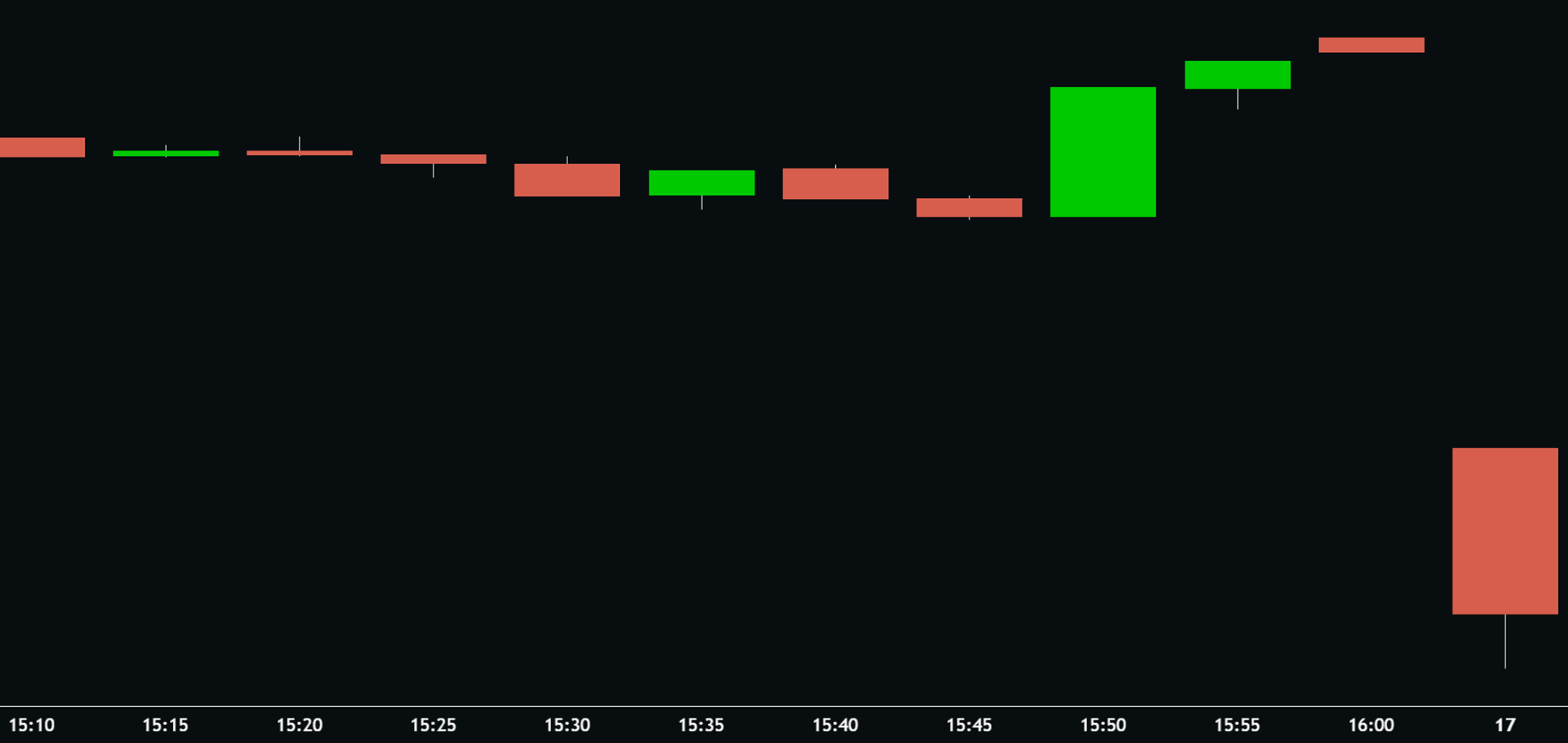
For standard portfolios, it looked like the start of another stressful day…
And over the next two hours, the market barely crawled higher… moving a tiny 0.2%…
To traditional buy-and-hold investors, a 0.2% move is practically useless…
Yet, according to our research, anyone who ignored the overnight headlines and waited until exactly 9:50 AM Eastern could have locked in a $529 payout before lunchtime… on a simple $1,000 starting stake…
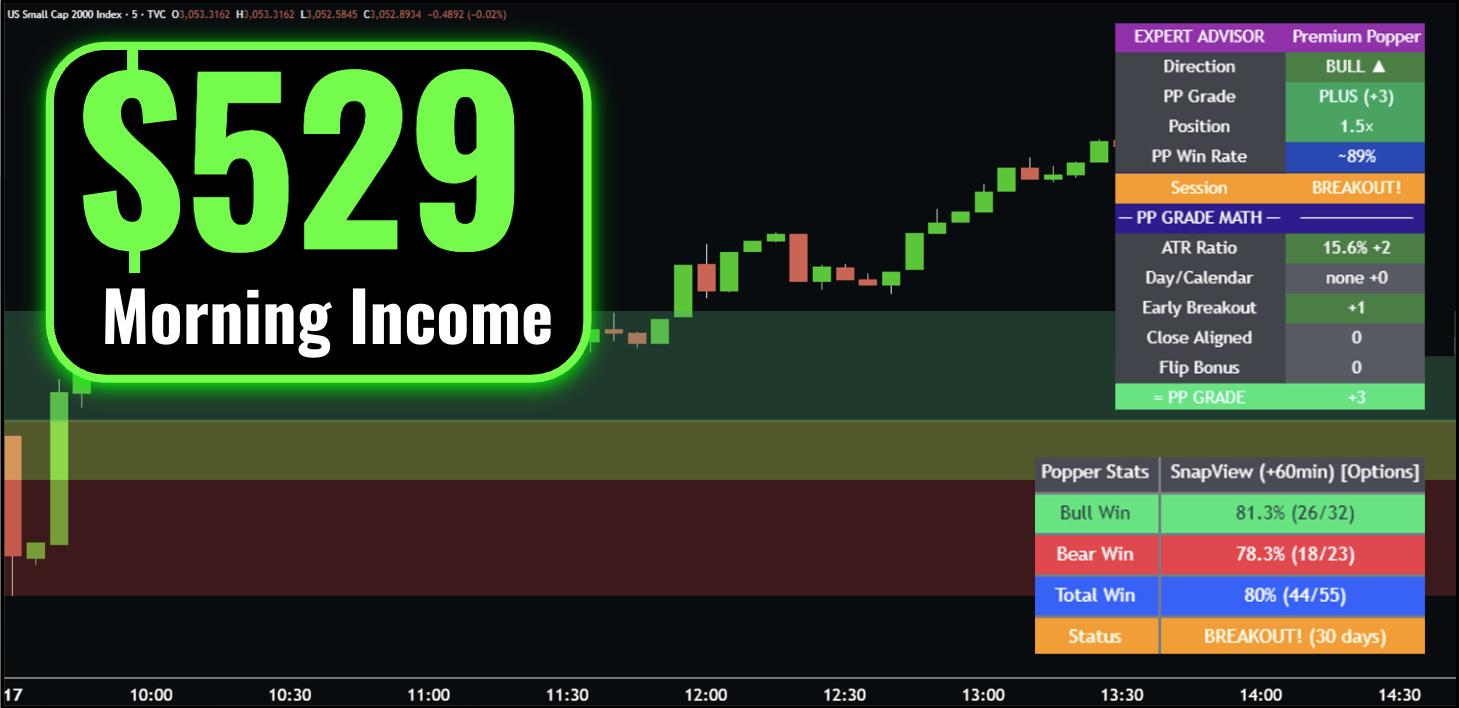
That would not have been an isolated fluke either…
Back on June 25th, when inflation surged past 4%…
And panicked investors expected a massive market beatdown… the market moved just 0.3% after the open… yet that exact same morning setup yielded another $526 payday before lunch…
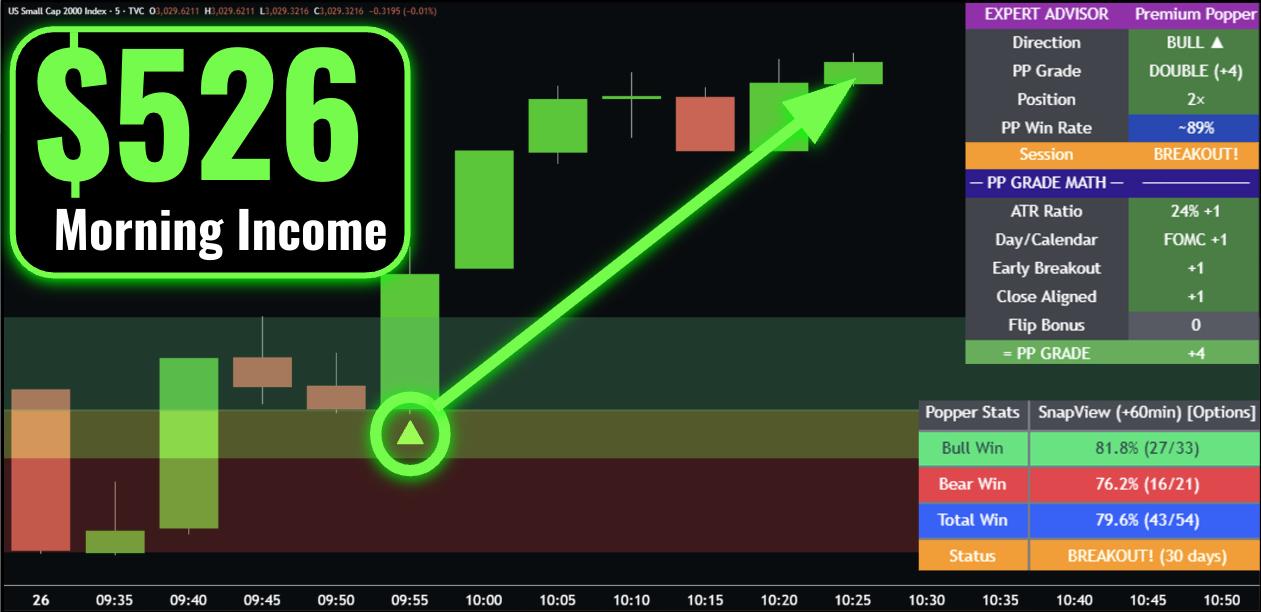
Of course, there would have been smaller gains and some that did not work out, but…
How would it have been possible to pull $500+ out of the market on a tiny fraction-of-a-percent crawl… while traditional traders are getting chopped to pieces?
It all comes down to an institutional phenomenon that happens during the first 20 minutes of every trading day…
Between 9:30 AM and 9:50 AM, Wall Street heavyweights enter a massive brawl to settle block orders… pushing nearly 25% of the entire day’s volume into a brief 20-minute window…
Right around 9:50 AM, the brawl ends… the dust settles… and the market literally hands us its direction for the rest of the morning…
By placing just one simple trade on one ticker right as that direction becomes clear…
You give yourself a shot to walk away with $500 in hand before lunch, leaving you completely free for the rest of your day…
While I cannot make any guarantees in the market…
Recently, I sat down live on camera with a former money manager to lay out the floor data behind this 9:50 AM morning phenomenon…
And how anyone with a normal brokerage account can take advantage of this step-by-step…
Tap here to watch the complete video breakdown before access is taken down.
See you there,
Silas Peters
Two Medicare Pricing Shocks Land on Pharma Within 48 Hours

Pharma investors woke up this week to two government actions landing within 48 hours of each other. CMS finalized GLOBE, a mandatory model linking Medicare Part B drug inflation rebate amounts to cost benchmarks in 19 reference countries. One day earlier, Section 232 tariffs on certain patented pharmaceuticals took effect for the broader universe of companies on September 29, 2026. The investment committee question is not whether either rule matters. It is which one matters more to 2027 earnings, and for which names.
What GLOBE Actually Does
The mandatory model tests an alternative calculation for manufacturer inflation rebate amounts under the Medicare Part B Inflation Rebate Program, using a benchmark derived from international pricing information instead of the current domestic benchmark. The model selects drugs from oncology, rheumatology, immunology, ophthalmology and endocrinology. The model starts January 1, 2027, with voluntary manufacturer data submission. The model performance period runs from April 1, 2027 through March 31, 2032.
Before anyone assigns GLOBE a starring role in 2027 earnings calls, the fiscal math deserves attention. The proposed rule had estimated $11.9 billion in overall Medicare Part B net-spending savings over the model’s seven-year payment period. The final rule reduces those estimates to $440 million. Both measures fell by about 96 percent between proposal and finalization. A rule that shrinks its own projected savings by that margin is not, on its own, an earnings story. It is a precedent story.
Because the GLOBE Model applies to only about 25 percent of Original Medicare Part B beneficiaries, leaving commercial, Medicare Advantage, and ex-U.S. revenues unaffected, the model’s design provides a meaningful safeguard for innovation. In response to public comments, GLOBE excludes biosimilars and their biologic reference treatments, orphan-only drugs, plasma-derived products, and certain cell and gene therapies. Those carve-outs meaningfully narrow the field.
Which Names Are Actually in the Crosshairs
Included products are high-spend, single-source Part B drugs and biologics exceeding $100 million per year in the covered therapeutic classes. That threshold points directly at a handful of blockbusters. Merck’s Keytruda and Regeneron’s Eylea and Dupixent sit at the top of Part B spending by dollars. Keytruda posted $29.5 billion in global sales in 2024. The Part B channel represents a meaningful slice of that, concentrated in oncology infusion settings. Regeneron’s exposure is arguably more acute: Dupixent profit-share collaboration revenue and Eylea family sales together represent a large share of Regeneron’s revenue base. Both products fall squarely in therapeutic areas GLOBE targets.
For AbbVie and J&J, the more relevant near-term variable is that Stelara has already faced biosimilar competition in the U.S. GLOBE excludes biosimilars and their reference biologics, which limits the model’s direct bite on drugs already losing exclusivity. Amgen’s exposure centers on its oncology and inflammation portfolios, particularly drugs like Prolia and XGEVA, where combined annual sales have run above $6 billion in recent years and face loss-of-exclusivity risk. Eli Lilly’s core growth engine, tirzepatide, is a Part D and commercial story, not a Part B one, which insulates Lilly’s 2027 growth trajectory considerably.
The Tariff Variable Is Harder to Model
This is where the institutional debate gets real. The Section 232 tariffs took effect in phases beginning July 31, 2026, with added provisions effective September 29. For covered products, the duties can be as high as 100% ad valorem. These tariffs are limited in scope and do not apply to all pharmaceutical imports, primarily affecting patented pharmaceutical products and their associated ingredients. Generic pharmaceuticals and biosimilars are excluded.
What makes the tariffs a harder 2027 earnings variable than GLOBE is cost-of-goods exposure. Unlike a rebate model that clips revenue at the margins of one government channel, a 100% import duty on in-scope patented APIs and finished products manufactured abroad hits gross margins directly, in every channel, for every payer. Companies with offshore manufacturing footprints in Ireland, Singapore, or India face a materially different cost structure beginning now, not in April 2027.
What the Professionals Are Actually Debating
Sophisticated investors are less focused on GLOBE’s $440 million in projected savings, a figure that rounds to noise against sector revenues, and more focused on what it signals. A mandatory international benchmark for Part B inflation rebates, even a narrow one, is infrastructure. It normalizes the mechanism. The more consequential question is whether GLOBE expands in future rulemaking to cover Part D or a broader set of drugs, which would put names like Lilly’s Mounjaro squarely in range.
Stocks to Watch
Merck (MRK): Keytruda’s Part B oncology volume makes it one of the most directly exposed assets to GLOBE’s benchmark. The tariff risk is secondary, but both are live simultaneously.
Regeneron (REGN): Eylea and Dupixent face GLOBE’s ophthalmology and immunology reach. The revenue concentration in those two products makes REGN the name to watch most closely.
Amgen (AMGN): Section 232 tariff exposure on manufacturing can be meaningful given its biologics and API footprint. GLOBE adds pressure in oncology and inflammation, on top of existing loss-of-exclusivity headwinds.
AbbVie (ABBV): Skyrizi and Rinvoq are immunology products growing fast and large enough to matter in any Washington-driven risk discussion. Management’s longer-term framework has pointed to Skyrizi above $20 billion and Rinvoq above $10 billion annually by 2027, making them too large to ignore.
Eli Lilly (LLY): The least direct exposure here. Tirzepatide lives outside Part B, and Lilly’s endocrinology dominance centers on commercial channels. But the precedent GLOBE sets for international benchmarking keeps LLY on any watchlist where Washington is the risk factor.