
September 19, 2026
Up 120% in 2026, crude carriers are priced for a closed Hormuz. The bet is whether that holds.
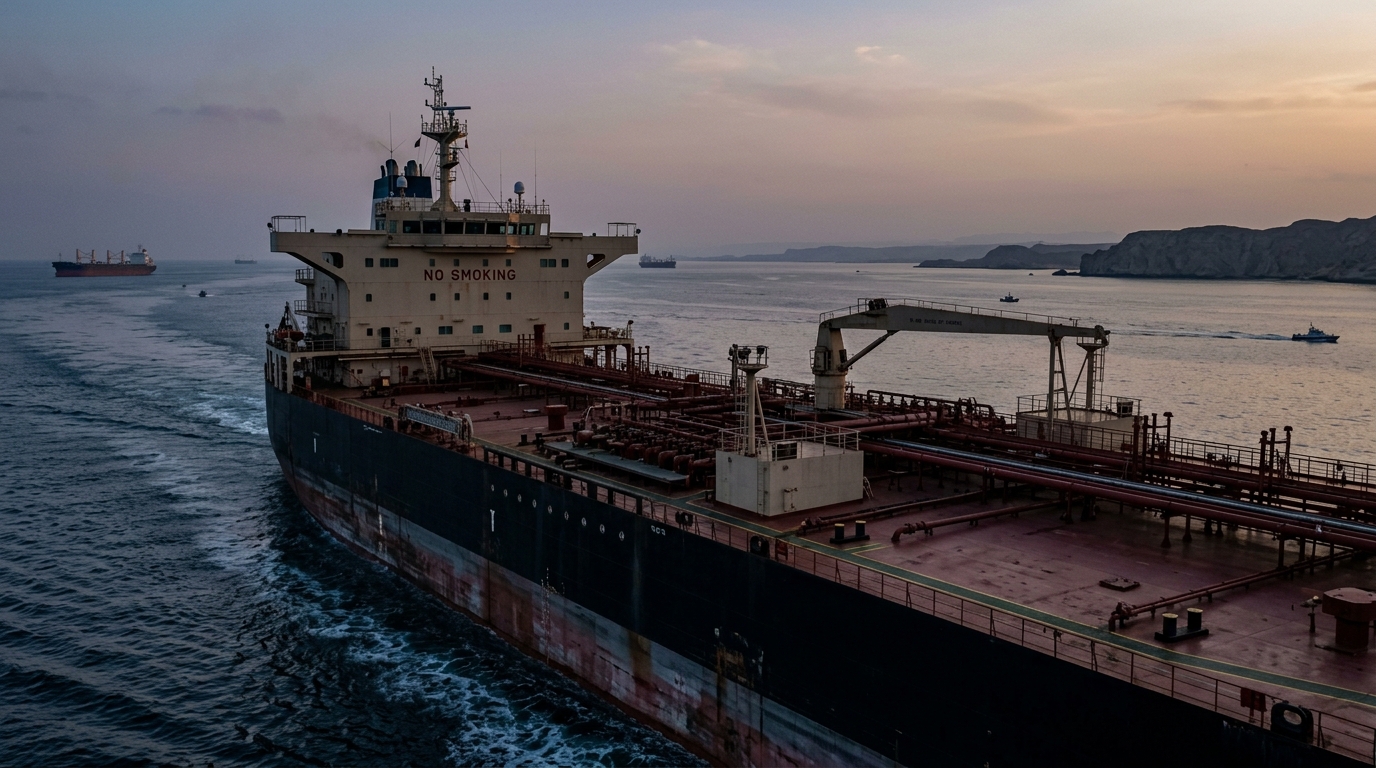
The investment committee question used to be whether the Hormuz crisis was real. That debate is settled. The daily rate for hiring a tanker topped $1 million for the first time in history, driven by a tightening supply of vessels whose owners are willing to dare the Strait of Hormuz. Now the question is harder: with crude-tanker equities already up 120% in 2026, how much of an ongoing or permanent closure is already in the price?
IPO Insider Warns: “Avoid OpenAI and Anthropic’s IPOs! Until You See This”
IPO insider, Jason Bodner, reveals how ordinary investors could risk their retirement if they invest in OpenAI and Anthropic’s IPOs the wrong way.
But if you make this one small change, you could potentially set up a six-figure nest egg.
Six months into the U.S.-Israel war on Iran, traffic through the 33-kilometer chokepoint has fallen from more than 100 vessels a day to about five. Crude exports from the Gulf region have dropped by nearly half compared with before the war, down from about 17 million barrels a day in 2025 to roughly nine million barrels per day as of August 2026. That supply dislocation is the engine behind every number in this trade.
The Bull Case
Vessels hauling oil from inside the Persian Gulf to China were being hired at $1.035 million a day, based on Baltic Exchange data. The benchmark route has become less relevant during the war because the main means of exporting Persian Gulf oil has shifted to shuttling barrels through Hormuz for collection just outside by tankers that do not want to navigate the strait. Even so, transporting crude to China from the Gulf of Oman costs the equivalent of about $644,000 a day. Both numbers are unprecedented. The fleet is not shrinking on paper, but when ships are forced to take longer routes to avoid conflict zones, the duration of each voyage increases significantly. A ship that takes weeks longer to complete a delivery cannot be used for other contracts. This effective reduction in the active tanker fleet is driving prices to levels previously unseen in the industry.
Even before the war, tanker and dry-bulk markets were already primed for a strong 2026 after a decade of underinvestment. The Iran war, in the words of one analyst, “poured gasoline on the fire of an already strong market.” Earnings reflect it. Scorpio Tankers posted Q2 2026 EPS of $8.47, up from $1.59 a year earlier, on revenue of $408.7 million, up about 78%, with net income rising about 427%. International Seaways reported blended spot time charter equivalent rates of about $79,000 per day in Q2 2026, versus $27,500 per day in Q2 2025.
The Bear Case
The numbers are extraordinary. That is precisely the problem. The main risk is that tanker strength can change quickly. Spot rates are highly volatile and can fall if vessel supply increases or demand softens. Analysts who have modeled INSW at current rates note that INSW derived about 82% of total time charter equivalent revenues from the spot market in the first quarter of 2026, which means earnings can rise quickly in strong markets but fall just as sharply when rates normalize.
Musk’s Hidden AI Play Could Be the Next Big Thing
While tech giants dominate headlines…
Elon Musk is quietly building a formidable AI enterprise.
This under-the-radar stock offers a unique entry point into his latest venture.
Don’t miss out on this potential game-changer.
Forward consensus already embeds a rate retreat. Revenue for Scorpio Tankers is forecast to decline by 33% in two years, with earnings expected to fall by 62% over the same period. The sector as a whole, per Nortilus research from July, trades at roughly 4.0x forward EV/EBITDA and 1.2x price-to-net asset value. Those multiples are not demanding if disruption persists. They are expensive if Hormuz reopens faster than the market expects.
What Investors Are Missing
The debate is framed as binary: Hormuz stays closed, tankers earn cash; Hormuz reopens, rates crater. The structural point getting less attention is the orderbook. A decade of underinvestment left the global tanker fleet thin on modern tonnage, and vessel supply is unlikely to grow meaningfully until 2027 through 2030 even if rates stay elevated enough to incentivize newbuilds. That means even a partial reopening of Hormuz may not collapse rates as quickly as the bear case assumes. Longer voyages around Africa have already become normalized for some trade lanes. The tonne-mile demand added by rerouting does not disappear overnight.
Stocks to Watch
Frontline (FRO) operates more than 70 crude carriers and has moved to its strongest price level since 2011. FRO carries a relative strength rating of 98 out of 100, meaning it is outperforming 98% of the market. Its VLCC concentration gives it maximum leverage to the Persian Gulf rate spike and maximum downside if it reverses.
International Seaways (INSW) offers a more diversified fleet across crude and product tanker segments. INSW reported record second quarter net income, supported by higher time charter equivalent revenues, profit sharing from time charters, and surging tanker rates linked to Middle East maritime disruptions. Its mix of spot and fixed-rate contracts gives it partial insulation in a normalization scenario.
Trump Just Changed 401(k) Rules Forever
Your 401(k) may be about to change in a way most Americans haven’t heard about.
President Trump’s Executive Order #14330 is pushing a major shift in how retirement plans can invest – and it has now reached the Department of Labor for approval.
Get the full story and see how your retirement could be impacted.
DHT Holdings (DHT) is a pure-play VLCC operator. Analysts have been raising earnings and revenue forecasts in recent months. The fleet modernization underway adds efficiency but requires investors to think carefully about capital allocation at peak rates.
Scorpio Tankers (STNG) focuses on product tankers rather than crude, giving it differentiated exposure. Its Q2 profit margin reached 95%. The company increased its quarterly dividend by 12.5% to $0.45 per share and has daily breakeven levels near $11,000, operating with wide margins even if rates pull back.
Teekay Tankers (TNK) runs one of the world’s leading mid-sized crude fleets with heavy spot market exposure and trades at low earnings multiples despite record profitability. That combination makes it the highest-beta name in the group, in either direction.