
Jabil is not a household name. It builds the hardware the hyperscalers run their data centers on, and right now that is precisely the kind of business institutional capital is willing to overpay for in better-known companies but undervalue here. Jabil trades at about 19 times forward earnings, a meaningful discount to the Nasdaq-100’s higher forward multiple. The gap is unlikely to persist if September 30 delivers what the prior three quarters suggest it will.
The Business
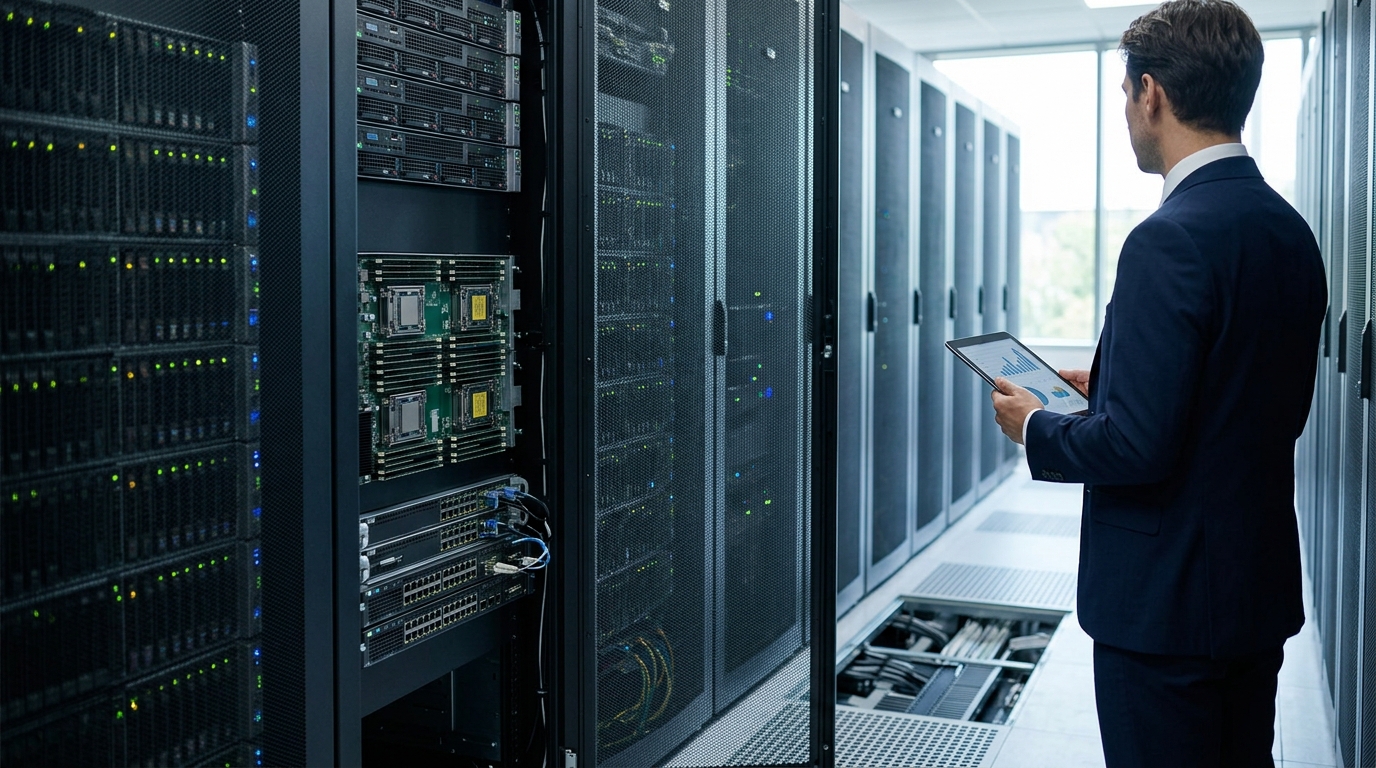
Jabil, a Florida-based contract manufacturer that makes components for companies like Apple and builds products across tech, automotive, healthcare, and storage, is positioning itself as a key supplier to data-center expansion. The pitch to investors is straightforward: you cannot build an AI data center without the power systems, server racks, cooling hardware, and related infrastructure that Jabil manufactures at scale.
Revenue in Jabil’s Intelligent Infrastructure segment increased 21% from a year earlier.
Why Wall Street Is Paying Attention
Over the prior three quarters, Jabil beat EPS estimates in each one, and its full-year fiscal 2026 guidance now stands at $35 billion in revenue and $12.70 in core EPS, with fiscal Q4 earnings expected September 30 and fiscal 2026 AI-related revenue raised to approximately $13.6 billion.
The company expects $13.6 billion in AI-related revenue in fiscal 2026, up from about $9 billion in fiscal 2025. Jabil originally anticipated roughly a 25% increase in AI-related revenue for fiscal 2026. Strong AI infrastructure demand has led to repeated upward revisions. A company that keeps raising guidance that was itself raised from a number that was already raised is telling you something about visibility.
What’s Driving the Opportunity
Jabil’s revenue target moved up by $1 billion, but its adjusted profit target rose by $0.45 per share, a bigger step on the bottom line than the top line. That gap is operating leverage: when factories run fuller and the product mix shifts toward higher-value programs, extra revenue tends to come with relatively smaller added costs, so profit grows faster than sales.
PwC expects data center spending to reach $31.6 trillion by 2050, with annual data center capital expenditures on track to jump from $800 billion in 2026 to $1.8 trillion in 2050. Jabil does not need to win all of that spending. It only needs to keep its three largest hyperscaler relationships and execute on a bill of materials that scales with the infrastructure buildout.
The key question on September 30 is what FY2027 guidance looks like. That single number will tell the market more about Jabil’s pipeline confidence than any trailing metric.
What Could Go Wrong
Jabil’s overall Q3 result beat consensus, but the stock slipped briefly after the announcement, a reminder that the market has already priced in significant AI execution. Supply chain challenges in high-bandwidth memory and high-density interconnect PCBs remain a constraint.
The automotive segment is still volatile, and Connected Living and Digital Commerce face a mixed consumer environment. Any signal that hyperscaler customers are delaying orders or that AI infrastructure spending is pausing would reset the FY2027 growth expectations that underpin the current thesis. Concentration risk is real: the AI revenue story is anchored to a small number of very large customers whose capex decisions are not within Jabil’s control.
The Bottom Line
Jabil is the AI infrastructure trade without the AI multiple. Its fiscal 2026 core EPS outlook is $12.70 per share, and the company has raised guidance this year. September 30 is the moment the market decides whether that pattern extends into fiscal 2027 or whether peak AI capex has finally showed up in the order book. At about 19x earnings for a contract manufacturer growing revenue at double-digit rates, the risk-reward argument does not require perfection, just continuation.