
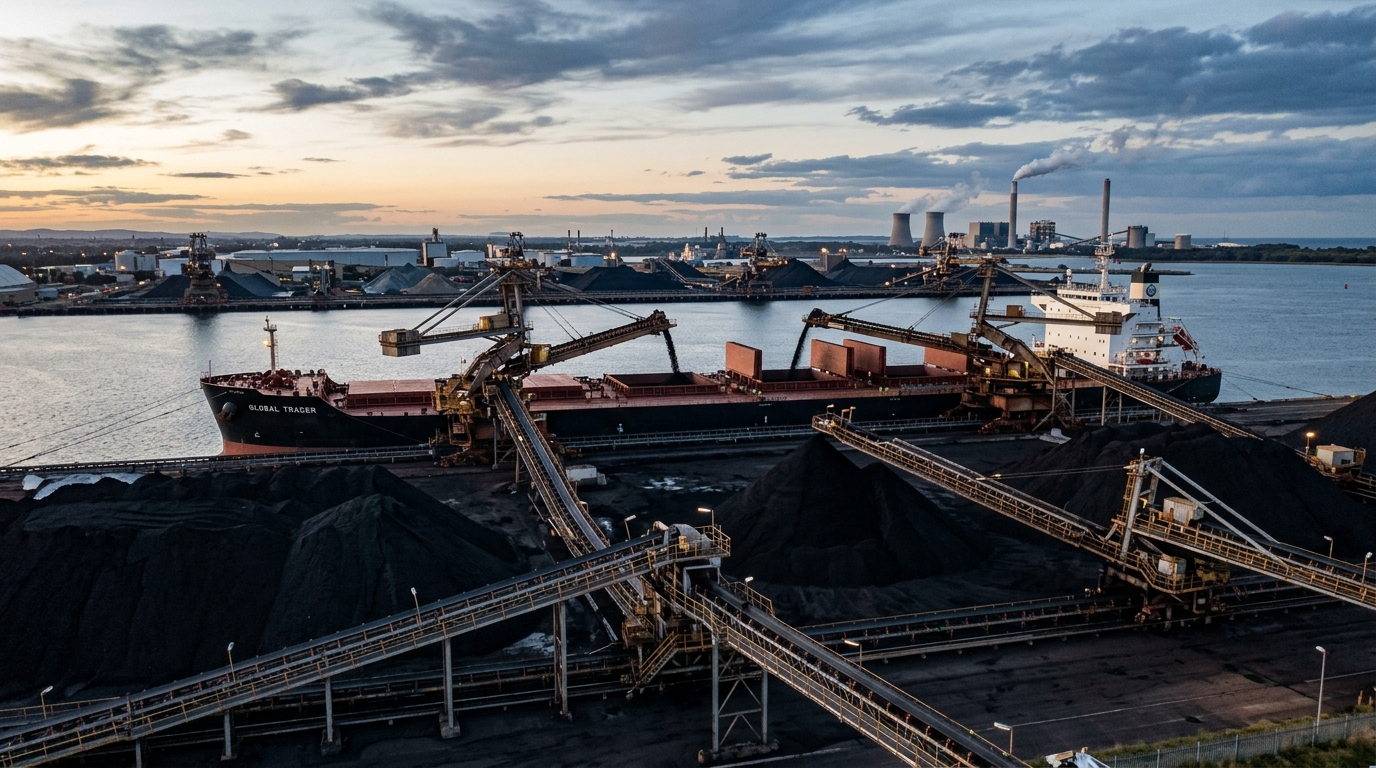
The Strait of Hormuz carries almost no coal. That is precisely what makes this week’s IEA finding so striking.
The IEA’s Coal Mid-Year Update, published September 10, reversed a forecast for a slight year-over-year decline and now sees global coal demand rising 1.2% to a record 8.94 billion tonnes in 2026. The mechanism is indirect and, for that reason, harder for the market to price quickly: disrupted LNG shipments through Hormuz drove gas prices high enough that utilities in China, India, Japan, South Korea, and Europe moved down the merit order and ran coal plants harder. Coal power generation accounts for about two-thirds of coal consumption globally, so a shift in dispatch math ripples through the entire market.
This is the clearest, most fully quantified second-order consequence of the Middle East conflict yet put to paper by a major agency. And it arrives at exactly the moment when the investment committee conversation about thermal coal producers should be most uncomfortable.
The Consensus That Built the Discount
For the better part of three years, institutional capital has treated thermal coal producers as managed-decline assets. ESG mandate exclusions structurally reduced the buyer base. The standard 13F read on names like Peabody Energy (BTU) and Arch Resources (ARCH) frames thermal exposure as a liability offset by metallurgical coal upside. Peabody, for instance, is marketed to investors as returning 65% to 100% of available free cash flow to shareholders. That is not how you price a company with pricing power.
The bear case has always rested on a simple assumption: demand peaks, then structurally declines. The IEA itself held that view heading into 2026. The midyear update does not rewrite the decade-long arc, but it does rewrite 2026 and still points to a modest decline in 2027 if tensions ease. If the Strait remains disrupted for longer, the agency says another record year is possible. If LNG flows recover, demand falls back. The range of outcomes is wide, and the market appears to be pricing mostly the recovery scenario.
What the IEA Actually Found
Qatar and the UAE together accounted for almost 20% of global LNG trade in 2025. From early 2026, tanker traffic through Hormuz was disrupted. Delivered gas prices rose. In dual-fuel power systems with spare coal capacity, operators switched. Thermal coal benchmarks reached roughly $150 per tonne in the first half of this year.
The switching potential Bloomberg Intelligence estimated earlier this year was 40 to 60 million tonnes across Europe, Japan, South Korea, and Taiwan. That volume is meaningful relative to a roughly one-billion-tonne seaborne thermal market, and it disproportionately tightens the high-calorific segment where Australian and Colombian exporters compete for prompt cargoes.
What Investors Are Missing
The structural decline thesis assumes a world where gas replaces coal in the power stack. The Hormuz disruption inverted that relationship in months. The real question is not whether coal demand eventually falls, it almost certainly does. The question is whether the duration risk is being correctly priced when a single geopolitical variable can flip a forecast decline into a record year.
Supply is also constrained in ways that compound the pricing effect. China’s domestic output fell in mid-2026 after safety inspections following a deadly mine accident. New mine financing remains scarce. The IEA expects global coal production to remain above 9 billion tonnes for a third consecutive year in 2026, then edge higher again in 2027.
Stocks to Watch
Peabody Energy (BTU) is the most direct expression of the thesis. Its seaborne thermal segment is a major revenue contributor, and much of its 2026 seaborne exposure is under contract, which limits near-term upside but also insulates against a price reversal. The Centurion met coal ramp adds optionality the market is not fully crediting.
Arch Resources (ARCH) carries met coal as its strategic focus, but its residual thermal operations benefit from the same seaborne price environment. The company’s capital return track record through buybacks and special dividends means shareholders collect while waiting for the thesis to resolve.
Alpha Metallurgical Resources (AMR) is a pure-play met coal producer with operations across Central Appalachia. Less exposed to the thermal switching dynamic, but India’s coal demand is now forecast up 4.2% this year to about 1.35 billion tonnes, and that growth is tied partly to the same energy price environment driving coal’s broader revival.
Glencore is the least obvious but arguably the best-positioned name. As one of the world’s largest exporters of seaborne thermal coal, and with a trading desk that thrives on exactly this kind of geographic price dislocation, Glencore runs a structural hedge most mining majors cannot match.
The IEA did not say coal is back forever. It said the assets everyone priced for decline just generated a demand record. That gap between the market’s structural story and the actual volume data is where the debate belongs.