September 14, 2026
Bonus Content: QatarEnergy Is Buying U.S. LNG Through 2031
Below is an important message from one of our highly valued sponsors. Please read it carefully as they have some special information to share with you.
Dear Reader,
When this man warned of the 2008 crisis two years before it ever happened…
The CIA began circulating his warning among its senior staff.
And his full thesis was so in depth that it appeared in the CIA journal “Studies in Intelligence”.

That information remains classified to this day.
Even still, in 2016 when he went on national television to predict the election of Donald Trump…
Most people tried to dismiss him saying that “Hillary is ahead in every poll”…
But events shaped up just the way he said.
Then in 2019, a full 4 months before the coronavirus hit..
He said that a global pandemic could be the cause of the next financial crisis…and that a crisis of this proportion would happen with “near 100% certainty” within the next few years…
Most people thought he finally lost it.
But we all know what happened next…the world was nearly brought to its knees by this “unforeseen” event.
Now this former advisor to the CIA and the Pentagon is issuing a shocking new warning.
One that has to do with the brewing bubble in AI – and an event set to take place just DAYS from now.
If you have money in the markets, or wealth to protect, then you need to heed his warning.
Because once this crisis hits…it will already be too late.
>>> Click Here to See His New Warning <<<
Regards,
Matt Insley
Publisher, Paradigm Press
QatarEnergy Is Buying U.S. LNG Through 2031. What That Does to Cheniere and Venture Global’s Spare Capacity
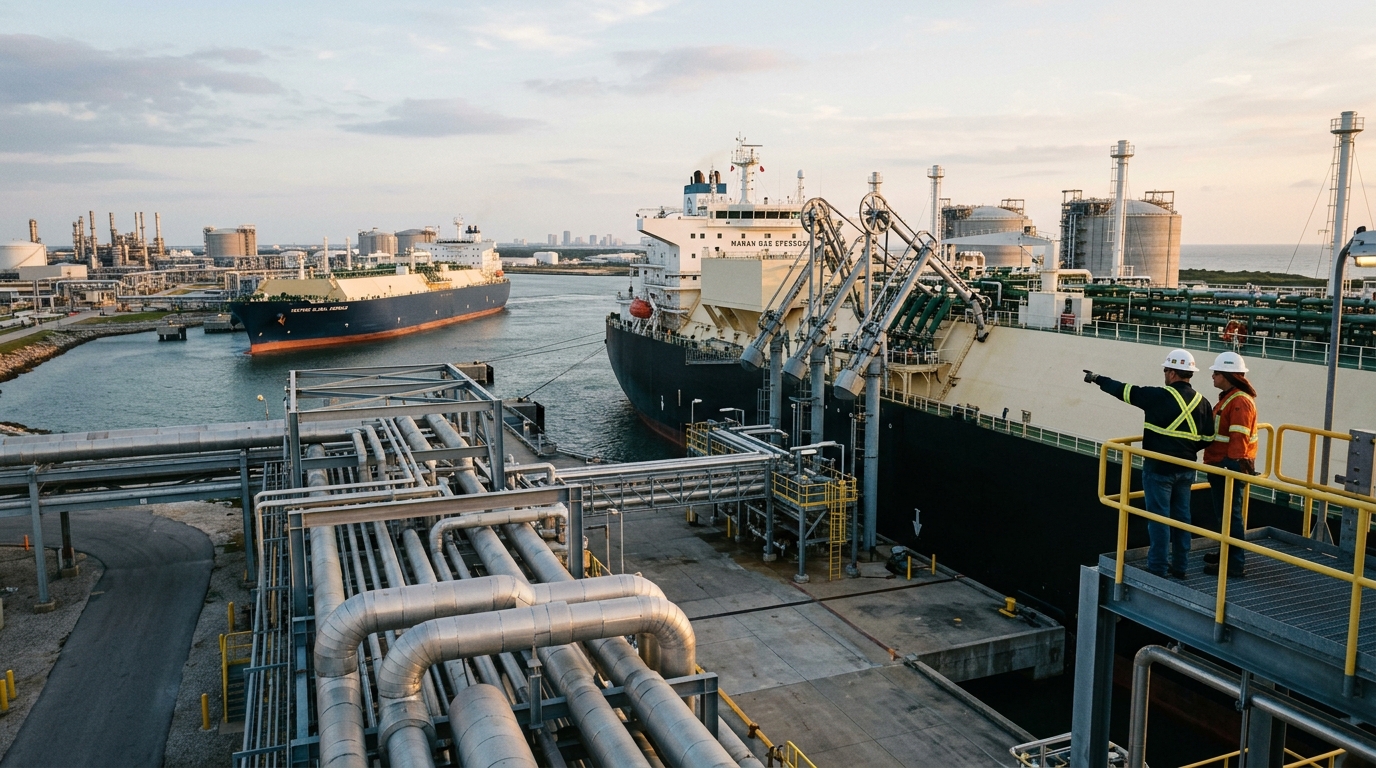
Here is the question energy investors are now arguing over: does a multi-year QatarEnergy contract change the floor price of uncontracted U.S. LNG volumes, or is this a one-time emergency buy that tells you nothing about where the market settles?
The facts that set up the debate are significant. The contract talks are part of QatarEnergy’s effort to replace lost volumes from its Ras Laffan facility after two of its 14 LNG trains and a gas-to-liquids facility were damaged by Iranian strikes in March 2026. QatarEnergy CEO Saad al-Kaabi said in March 2026 that the repairs would sideline 12.8 million tons per year of LNG capacity for three to five years. That is roughly 17% of Qatar’s export capacity gone until at least 2029, and possibly 2031.
The discussions mark a shift from QatarEnergy’s purchases of dozens of U.S. spot LNG cargoes to help meet commitments to some of its Asian clients, suggesting it now wants longer-term solutions. Sources told Reuters this month that the company is seeking 2 to 3 mtpa in multi-year deals running to 2031, with talks involving Venture Global, Cheniere, and Woodside.
The Bull Case for U.S. LNG Valuations
The bull argument is structural. Saul Kavonic, head of energy research and advisory at MST Marquee, told Reuters that Qatar’s pursuit of long-term volumes signals it sees risk to its ability to export LNG for several years, and that it considers the disruption of the Strait of Hormuz may prove longer lasting, with damage more extensive than initially hoped.
If that reading is right, Qatar is not a distressed buyer filling a short-term gap. It is a sophisticated trading operation locking in supply because it has concluded the outage is structural, not cyclical. A counterparty of that caliber committing to five-year contracts does not do so unless it believes spot alternatives will get more expensive, not less. For Cheniere and Venture Global, a QatarEnergy contract is the most credible external validation their uncontracted volumes could receive.
U.S. projects under construction have a total of 25 million metric tons of LNG available for purchase, according to data compiled by research firm Rapidan Energy and cited by Reuters. Venture Global has the most uncontracted capacity at 10 mtpa, while both Cheniere and Woodside each have 6 mtpa available, with Sempra’s Port Arthur project adding another 3 mtpa. QatarEnergy is asking for 2 to 3 mtpa of that pool. Not enormous in absolute terms, but enough to tighten a market where every committed tonne raises the clearing price for what remains.
The Bear Case
Bears push back on the permanence. QatarEnergy is trading, not investing. Its goal is to honor customer commitments in China, South Korea, Italy, and Belgium, not to restructure the global LNG market in Cheniere’s favor. QatarEnergy declared force majeure on some of its long-term LNG supply contracts affecting customers in those four countries after the March 2026 attacks, and al-Kaabi said the damage implied annual revenue losses of about $20 billion. That revenue pressure creates urgency to contract quickly, which means Qatar’s negotiating position may be weaker than it looks. Sellers who believe the outage is shorter than three to five years could be giving up long-term upside by locking in at today’s distressed-demand prices.
The Hormuz risk is also real from the seller’s side. The International Energy Agency says there are no alternative routes to supply natural gas from Qatar or the UAE to the global LNG market other than the existing LNG liquefaction facilities. Talk of bypass infrastructure continues, but after months of conflict the practical constraints remain, with no physical solution imminent. American LNG loads from the Gulf Coast and has no Hormuz exposure, which strengthens the value argument but only if Asian buyers can actually receive the cargoes.
What Investors Are Missing
The overlooked implication is what a signed QatarEnergy contract does to the negotiating position of every other buyer still in discussions. Once the world’s dominant LNG producer publicly commits to multi-year U.S. supply, the remaining uncontracted volume carries an implicit floor. Venture Global’s 10 mtpa of available capacity, currently the largest single pool in the U.S. project pipeline, becomes a different asset if QatarEnergy has already signed for 2 to 3 mtpa of it.
Stocks to Watch
Venture Global (VG) has the most to gain in volume terms, with 10 mtpa uncontracted as of the Rapidan data cited by Reuters. A QatarEnergy deal would materially reduce that overhang and lift realized fee expectations above the $6.45 per MMBtu the company reported as its implied weighted average fixed liquefaction fee for Q2 2026.
Cheniere Energy (LNG) enters the conversation with 6 mtpa available and a longer operating track record, which matters to a creditworthy counterparty like QatarEnergy. The combination of volume and covenant quality makes Cheniere a natural anchor for the deal.
Woodside Energy (WDS) has 6 mtpa to offer and a different strategic angle: an Australian producer with Atlantic basin exposure gives QatarEnergy geographic diversification. If Hormuz stays contested, routing flexibility has value.