
Bullet Summary
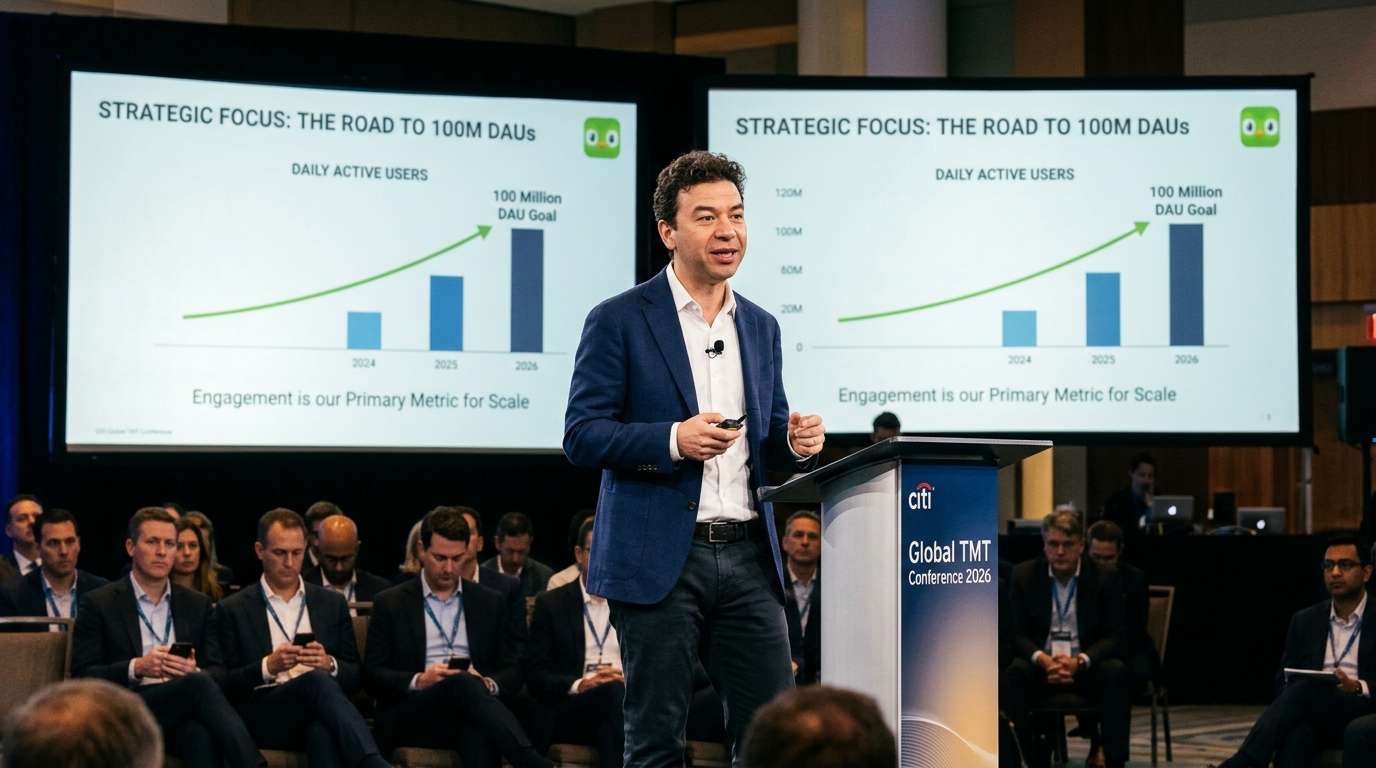
- Duolingo defended its engagement-first strategy at Citi’s Global TMT Conference on September 9, 2026, eight to nine months into the strategic reset.
- Q2 2026 daily active users grew 23% year over year to 58.7 million, accelerating from 21% in Q1.
- Full-year 2026 bookings guidance sits at roughly $1.285 billion, implying 10.9% growth versus 33% in FY 2025.
- Adjusted EBITDA margin guidance was raised to approximately 26.5% for the full year, up from the original 25% target.
- Management is deliberately sacrificing more than $50 million in bookings to lower friction for free users.
- AI content production delivered 20,500 skills across language courses in Q1 2026 alone, up from 7,100 per quarter in 2025.
- The 100 million DAU target by 2028 is the stated conversion thesis: audience first, monetization second.
The Conference Moment That Sharpens the Trade
Duolingo used Citi’s 2026 Global TMT Conference on September 9 to defend a major strategic shift: the language-learning app is putting user growth and engagement ahead of near-term revenue. The timing matters. This was not an earnings call with obligatory optimism; it was a room full of institutional investors who have watched DUOL bookings growth decelerate from 33% in FY 2025 to a full-year 2026 guide of 10.9%. Von Ahn walked into that room and said the deceleration is the point.
The CEO said Duolingo is aiming for 100 million daily active users by 2028 and believes AI will help it teach better, cheaper, and at larger scale. He also argued that the company sees little risk from AI competition, citing data, product design, and brand as durable edges, and confirmed the strategic pivot began eight to nine months ago.
What the Numbers Actually Say
Q2 2026 revenues increased 18% year over year to $298.5 million, while daily active users grew 23% to 58.7 million, accelerating from the first quarter. That DAU acceleration is the single data point management wants traders to anchor on. The company is knowingly giving up more than $50 million in bookings to improve the free-user experience.
The company raised its full-year adjusted EBITDA margin outlook to approximately 26.5% from the earlier 25% target, with the $320 million EBITDA projection reflecting stronger-than-expected gross margin performance and lower AI costs. That margin beat is a meaningful signal: AI inference costs are falling faster than the model assumed, which gives the engagement strategy more runway before it needs to monetize.
In Q1 2026 alone, Duolingo published 20,500 skills across language courses, up from 7,100 per quarter in 2025 and 1,800 per quarter in 2024. That content velocity is AI-driven and structurally difficult for a smaller competitor to replicate.
Scenario Modeling
Bull Case. DAU growth hits 25% in Q4 2026, triggering a potential $10 million bonus plan threshold and signaling that the engagement reset is compounding. If Duolingo reaches 100 million DAUs, the monetization will follow because that audience represents a base advertisers, content partners, and premium subscribers will pay to reach. DUOL re-rates toward 8x forward revenue.
Base Case. Q3 revenue of approximately $302 million and bookings of $307 million land in line with guidance, with an adjusted EBITDA margin of 25.2%. The stock grinds sideways as the market waits for 2027 monetization re-acceleration evidence.
Bear Case. If the DAU target is not reached, the company will have sacrificed years of revenue growth for a user base that AI competitors can serve for free. Bookings growth stalls below 10% into 2027, and the valuation multiple compresses sharply.
Active Trader Framework
Management’s bonus plan may trigger if Q4 DAU growth reaches 25%, with a potential $10 million payout, making that threshold a live catalyst to track into the November report. Watch Q3 bookings versus the $307 million guide as the near-term tell. Duolingo is experimenting with product packaging including longer free trials, Super Lite, and expanded video calls to monetize without harming DAU growth. Any signal that these experiments are lifting average revenue per user without stalling engagement would close the gap between the current price and the bull case rapidly. Volatility around the Q3 report on any DAU deceleration deserves attention as a potential risk point.
Conclusion
The Citi conference did not resolve the central tension in DUOL. It clarified it. Von Ahn is running a deliberate, time-bound experiment: accept lower bookings growth now, build the largest daily habit in language learning, then monetize at scale. The Q2 DAU acceleration and the EBITDA margin beat suggest the first half of that trade is working. Whether the second half delivers is a 2027 question. Disciplined traders track the Q4 DAU number and the AI cost trajectory. Those two variables will tell the story before the income statement does.